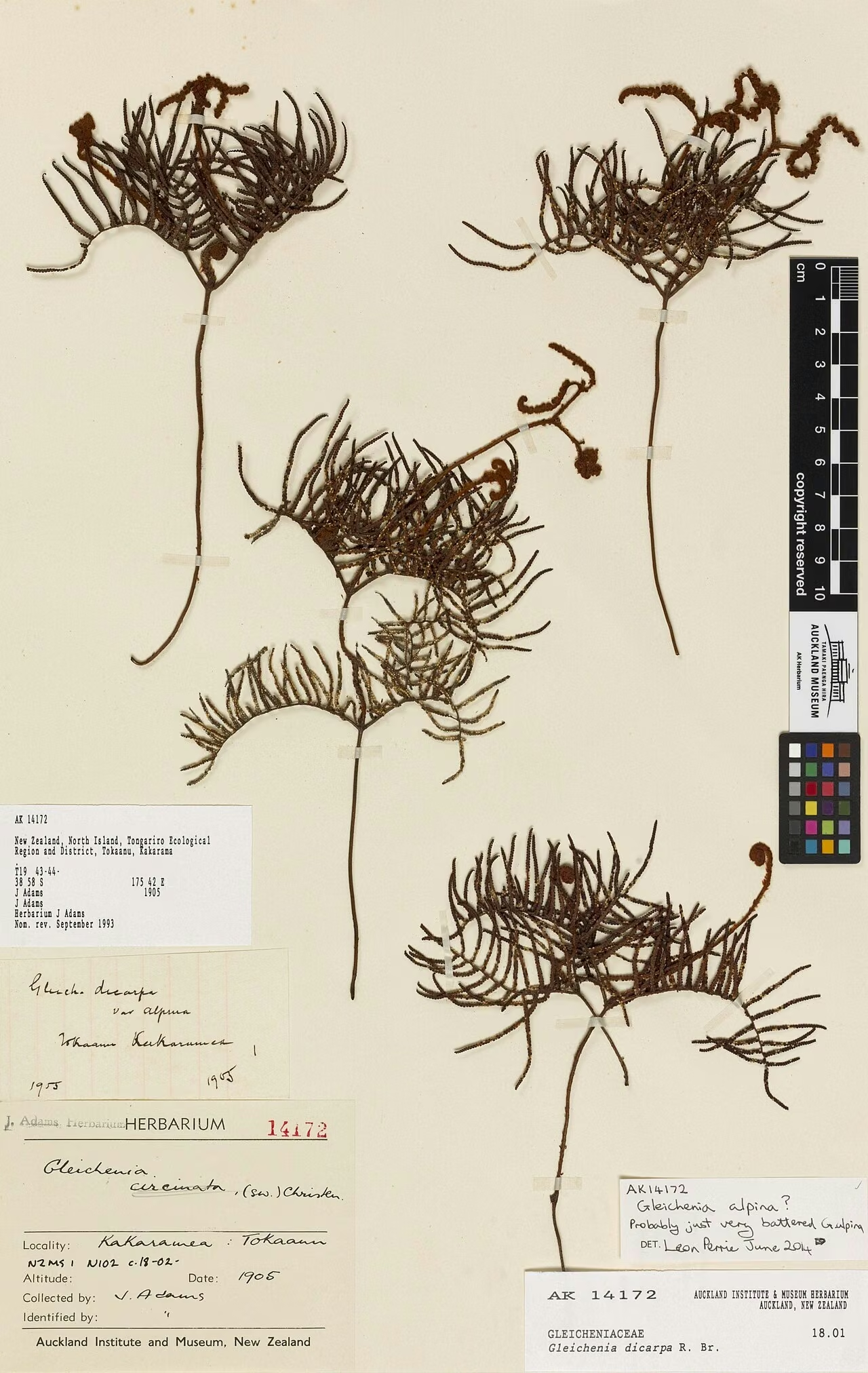
Alpine Tangle Fern
Gleichenia alpina
Last updated:
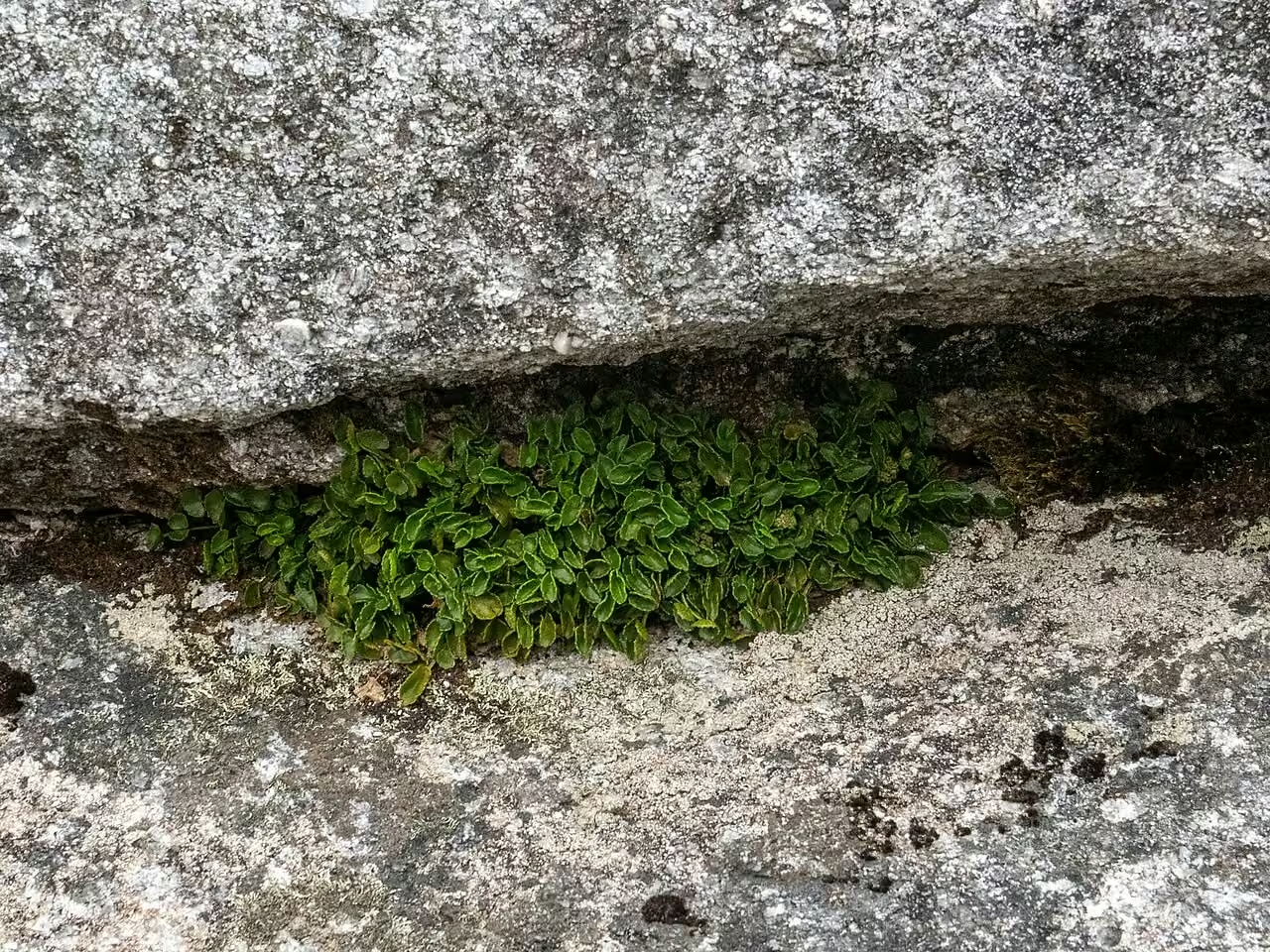
Alpine tangle fern (Gleichenia alpina) is a creeping, mat-forming fern of cold, wet, open places. Its tiered, repeatedly forking fronds carry tiny rounded segments under a millimetre long that are pouched and strongly convex above and white beneath, partly hidden by orange-brown scales. It grows from the central North Island to Stewart Island, from sea level in the south to about 1380 m, in peat bogs, around tarns and in poorly drained fellfield and subalpine scrub. It also occurs in Tasmania and mainland Australia. It is ranked Not Threatened but is often confused with the larger, more common tangle fern Gleichenia dicarpa. Explore more native ferns in our native plant guide.
Plant Description
Gleichenia alpina has long-creeping rhizomes from which fronds arise at intervals. Fronds bear one to eight tiers of branches that fork repeatedly, and are clothed when young in red-brown to orange-brown scales that become paler with age. NZPCN gives typical fronds as 100 to 220 mm, while the Flora of New Zealand records frond lengths up to 1250 mm where plants scramble through other vegetation.
The ultimate segments (pinnules) are tiny, about 0.7 to 1 mm long, rounded to squarish, strongly pouched and convex above and white beneath, where dense scales partly obscure the surface. Each sorus holds only two sporangia.
It is easily confused with Gleichenia dicarpa. Alpine tangle fern has shorter frond axes, rounded rather than lanceolate scales, no stellate scales with spreading branches on the costae, usually only 0 to 1 pseudodichotomous forks in the pinnae, and no accessory leaflets around the rachis bud.
Quick Facts
| Scientific Name | Gleichenia alpina |
|---|---|
| Height | Low; fronds typically 10-22 cm |
| Spread | Spreads indefinitely by long-creeping rhizomes |
| Water Needs | High; permanently moist to wet |
| Light | Full sun, open sites |
| Frost Tolerance | High; subalpine to alpine |
| Salt Tolerance | No information available |
| Growth Rate | Slow |
| Lifespan | Perennial |
Climate Best Suited to
Suits cold, wet, cloudy montane to alpine climates and cool lowland sites in the far south where boggy ground stays saturated year round.
Regional Suitability
| City | Climate Suitability |
|---|---|
| Auckland | Low |
| Wellington | Low |
| Christchurch | Low |
| Dunedin | Medium |
Plant Habitat
In New Zealand it ranges from the central North Island (Volcanic Plateau, Gisborne, Taranaki) through Nelson, Westland, Canterbury, Otago, Fiordland and Southland to Stewart Island. It reaches sea level in the south and climbs to about 1380 m in the North Island. NZPCN notes records from Takaka and the Denniston Plateau, and that the Mt Somers plants share Tasmanian haplotypes.
It grows from lowland to alpine zones in peat bogs, around the margins of tarns, in poorly drained fellfield and in subalpine scrub, often scrambling through other vegetation and frequently alongside the wire rush Empodisma.
Growing Requirements
Soil Requirements
It is a peatland fern and needs acidic, low-nutrient, permanently wet soil.
- Peat or a peat and pumice mix
- Acidic and low in nutrients
- Never allowed to dry out
Light Requirements
Its habitats are open bogs, tarn edges and fellfield with little canopy.
- Full sun in cool climates
- Some shade only where summers are warm
Water Requirements
Constant moisture is essential, and NZPCN recommends growing it in pots partly immersed in water.
- Stand pots in a saucer or tray of water
- Use rainwater rather than hard tap water where possible
Planting and Establishing
This fern is best attempted in a bog garden or in a container standing in water rather than in an ordinary garden bed. Fill with a peat and pumice mix and position it in an open, cool site.
Because it resents root disturbance, plant it out from its pot with the root ball intact and do not move it afterwards.
Ecological Role
As a fern it reproduces by wind-borne spores and spreads vegetatively through its long-creeping rhizomes. Its tangled mats help bind peat surfaces and provide cover for small invertebrates in bogs and fellfield.
It is a component of the specialised flora of cold peatlands, where it grows with Empodisma, cushion plants and sedges. NZPCN gives its wetland indicator status as FACW, meaning it usually occurs in wetlands.
Uses & Significance
Garden Uses
A specialist fern for bog gardens and alpine wetland displays.
- Bog gardens in cool climates
- Water-tray containers
- Botanic garden peatland collections
Ecological Value
It contributes to the structure of subalpine bogs and wet fellfield vegetation.
- Binds and shelters peat surfaces
- Habitat for bog invertebrates
- Part of cold wetland plant communities shared with Tasmania
Landscaping Uses
In a naturalistic bog planting, let it weave between wire rush, sundews and small sedges, as it does in the wild.
Its fine, tiered foliage gives texture beside a garden pond edge in southern districts, provided the roots stay in permanently wet peat.
Seasonal Care Calendar
Spring
New fronds unfurl from the rhizome, covered in orange-brown scales.
- Top up water trays
- Avoid disturbing the rhizomes
Summer
Fronds mature and sori develop on the undersides of the segments.
- Keep the peat saturated in hot weather
- Provide light shade in warm districts
Autumn
Spores are released from the paired sporangia.
- Collect fertile fronds for spore sowing
- Remove weeds from the mat
Winter
The fern withstands frost and snow cover in alpine bogs.
- Leave old fronds as insulation
- Ensure pots do not freeze solid in shallow trays
When to Prune and How Much
No regular pruning is needed. Dead fronds can be trimmed away in spring if the mat looks untidy, but leaving them helps protect the rhizomes.
Do not cut or tear the rhizomes, as the plant responds poorly to root disturbance.
How to Grow Alpine Tangle Fern
NZPCN describes the propagation of Gleichenia alpina as fickle, with very variable success. As a fern it can be raised from spores or increased by dividing its creeping rhizomes, but neither method is reliable. Grow young plants in a peat and pumice mix in pots partly standing in water, and avoid disturbing the roots once they are established. Do not dig plants from bogs and fellfield, since wild collection damages fragile peatland habitats and transplanted pieces rarely survive.
From Spores
Each sorus contains only two sporangia, so a large number of fertile segments is needed to collect enough spores. Sterile technique reduces moss and algae competition during the long establishment phase of the gametophytes.
- Place fertile fronds in a paper envelope for a few days so spores drop out.
- Sow spores thinly on the surface of sterilised, finely sieved peat in a covered container.
- Keep in bright, indirect light at cool temperatures and maintain high humidity.
- Mist with boiled cooled water once prothalli form to allow fertilisation.
- Prick out young sporophytes into small clumps and grow on in peat and pumice with the pot base in water.
By Division
Division of cultivated plants is possible, but because the fern resents root disturbance it should be done sparingly, taking a well-rooted section of rhizome with several fronds attached.
- In spring, cut a section of rhizome with fronds and roots from the edge of a cultivated mat.
- Pot immediately into a peat and pumice mix without trimming the roots.
- Stand the pot in water in a cool, bright spot and leave undisturbed until new fronds appear.
Pests & Diseases
No specific pests of alpine tangle fern are recorded. In cultivation, failure usually results from the roots drying out, from root disturbance, or from water that is too warm or alkaline.
In the wild, drainage of peatlands and trampling are more significant than pests.
Cultural Significance
No Māori name or traditional use specific to Gleichenia alpina is recorded in the sources consulted; the names recorded for tangle fern refer to the widespread Gleichenia dicarpa. The genus honours Baron Wilhelm Friedrich von Gleichen (1717 to 1783), a German botanist, and alpina refers to its mountain habitat.
Its status in New Zealand was uncertain for many years because it was hard to separate from G. dicarpa, until molecular evidence confirmed that New Zealand plants match Tasmanian material.
Bonus Tip
To check whether a tangle fern is G. alpina, turn a frond over and look at the small rounded segments under a hand lens: if the costae lack star-shaped scales with spreading branches and the pinnae fork only once or not at all, you are probably looking at alpine tangle fern rather than G. dicarpa.
Related Plants
Explore other native plants that share similar characteristics or habitats with Alpine Tangle Fern (Gleichenia alpina), offering further insights into New Zealand's diverse flora. These related species provide context and opportunities for complementary planting in your garden.
Gingidia decipiens
Gingidia decipiens
Stewart Island Aniseed
Gingidia flabellata
Gingidia grisea
Gingidia grisea
Gingidia trifoliolata
Gingidia trifoliolata
Glossostigma cleistanthum
Glossostigma cleistanthum
Gonocarpus aggregatus
Gonocarpus aggregatus
Gonocarpus incanus
Gonocarpus incanus
Creeping Raspwort
Gonocarpus micranthus
Plant Conservation
Gleichenia alpina is ranked Not Threatened (2023) with the qualifier SO (secure overseas), reflecting its occurrence in Australia as well as New Zealand.
Its habitats, peat bogs, tarn margins and wet fellfield, are sensitive to drainage, trampling and vehicle damage. Protecting the hydrology of subalpine wetlands is the main way to keep it secure, and better survey work is needed to clarify its full distribution.
Frequently Asked Questions
What is the difference between alpine tangle fern and tangle fern?
Gleichenia alpina has smaller fronds with fewer forks, rounded rather than lanceolate scales, and lacks the star-shaped scales with spreading branches found on the costae of Gleichenia dicarpa.
Where does Gleichenia alpina grow in New Zealand?
It is recorded from the Volcanic Plateau, Gisborne and Taranaki south through Nelson, Westland, Canterbury, Otago, Fiordland and Southland to Stewart Island, in bogs, tarn margins and wet fellfield.
Is alpine tangle fern native to New Zealand only?
No. It is indigenous to New Zealand but also grows in Tasmania and mainland Australia, and genetic work shows some New Zealand populations share Tasmanian haplotypes.
Is Gleichenia alpina easy to grow?
NZPCN calls it fickle in cultivation; it does best in a peat and pumice mix in a pot partly standing in water, and it resents root disturbance.
Sources and Further Reading
The botanical, growing, and conservation details for Alpine Tangle Fern (Gleichenia alpina) on this page draw on the New Zealand plant references below. Consult them for full technical records and the latest distribution data.