Aniseed
Gingidia trifoliolata
Last updated:
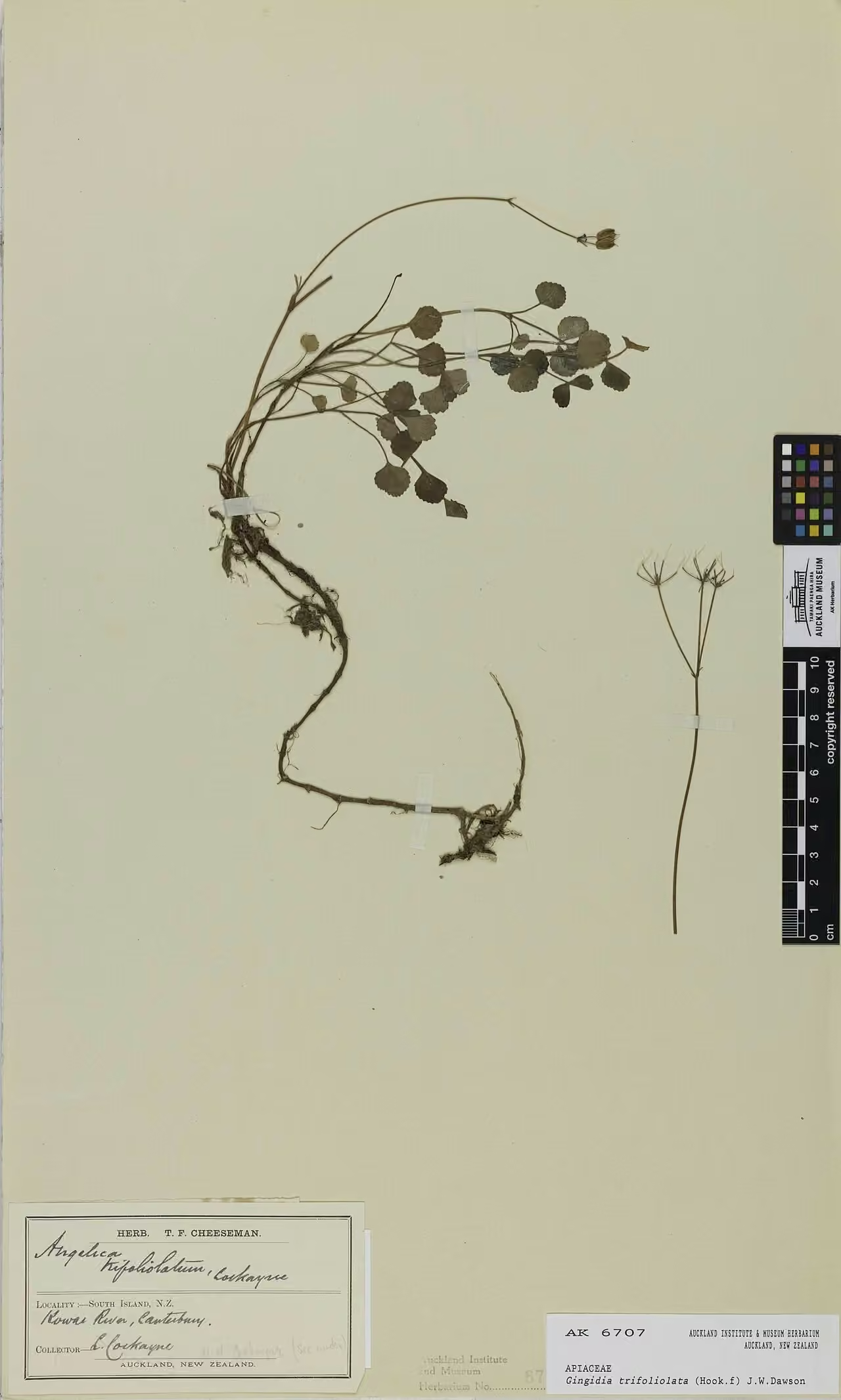
Gingidia trifoliolata is a glaucous, usually solitary perennial herb of the carrot family (Apiaceae) that grows to about 45 cm tall and smells faintly of aniseed when bruised. It is endemic to the eastern South Island, from the southern and eastern Marlborough ranges and Lake Tennyson south into Canterbury. It grows in montane to subalpine country, usually above 900 m, in or beneath grey scrub on river terraces, talus, cliffs and boulder falls. Its leaves have relatively few, stalked leaflets, often in threes, which gives it the name trifoliolata. Scattered and easily overlooked, it is ranked At Risk - Naturally Uncommon. Explore more native flowering plants in our native plant guide.
Plant Description
Gingidia trifoliolata is a glaucous herb, usually growing as a single plant, that reaches up to 450 mm tall and gives off a faint aniseed smell when bruised. It has a stout taproot about 20 to 80 mm long and 10 to 15 mm thick, and is often rhizomatous, with rhizomes ending in clusters of leaves.
The basal leaves are 7 to 18 cm long, once to twice pinnate or ternate-pinnate, with fan-shaped to diamond-shaped leaflets that are glaucous beneath and bluntly toothed to scalloped on the margins. Inflorescences 10 to 30 cm long carry compound umbels of 2 to 5 small umbels, each with 3 to 11 delicate white flowers, from November to January. Fruits about 6.5 mm long, made of flattened mericarps with broad lateral wings, ripen from December to February.
It most resembles Gingidia montana but is much smaller and has only 3 to 7 leaflets on short stalks (petiolulate), compared with the 11 to 30 stalkless leaflets of G. montana.
Quick Facts
| Scientific Name | Gingidia trifoliolata |
|---|---|
| Height | Up to 0.45 m in flower |
| Spread | Usually a single plant; can form small leaf clusters from rhizomes |
| Water Needs | Low to moderate; free-draining sites |
| Light | Full sun to light shade under scrub |
| Frost Tolerance | High; montane to subalpine |
| Salt Tolerance | Low; an inland mountain species |
| Growth Rate | Slow |
| Lifespan | Perennial |
Climate Best Suited to
Suits a continental eastern South Island mountain climate with cold winters, hot dry summers and regular frost, typical of inland Marlborough and Canterbury.
Regional Suitability
| City | Climate Suitability |
|---|---|
| Auckland | Low |
| Wellington | Low |
| Christchurch | Medium |
| Dunedin | Medium |
Plant Habitat
Gingidia trifoliolata is endemic to the South Island, ranging from the southern and eastern Marlborough ranges and the Lake Tennyson area south into Canterbury. It is a montane to subalpine plant, generally found above 900 m.
It usually grows in or under scrub, especially grey scrub of small-leaved divaricating shrubs, on river terraces, colluvium, steep slopes, alluvial fans, talus, cliff faces and boulder falls. Occasionally it is found in wetlands. Populations are scattered, which has meant it was historically overlooked.
Growing Requirements
Soil Requirements
Its habitats are stony, well-drained alluvium, colluvium and talus, so it needs gritty, free-draining soil.
- Stony or gravelly free-draining soil
- Deep enough to accommodate the taproot
- Low to moderate fertility
Light Requirements
In the wild it often sits within or beneath shrubs, receiving partial shelter from sun and browsing animals.
- Full sun to dappled light
- Shelter from neighbouring shrubs is beneficial
Water Requirements
It tolerates dry eastern summers on free-draining ground but appreciates moisture during the growing season.
- Water during extended drought
- Avoid wet, stagnant soil around the crown
Planting and Establishing
Only plant nursery-raised stock. A gravelly rock garden or scree bed in a cold eastern district, with a small native shrub such as Coprosma or Corokia nearby for partial shelter, comes closest to its grey scrub habitat.
Plant into deep, gritty soil without disturbing the taproot, and mulch with stones. Protect from rabbits and hares, which may browse it.
Ecological Role
The open white umbels are visited by small insects, and its fruits have broad lateral wings and are dispersed by wind, according to NZPCN. This allows seed to move across talus slopes and river terraces.
Its association with grey scrub reflects a pattern in which shrubs protect palatable herbs from browsing animals. It forms part of the diverse eastern South Island scrub and rock flora that also supports native invertebrates and lizards.
Uses & Significance
Garden Uses
A plant for specialist alpine and rock garden collections in cold districts rather than general gardens.
- Scree and alpine gardens
- Conservation collections of eastern South Island flora
- Underplanting for small-leaved native shrubs
Ecological Value
It contributes to the herb layer of grey scrub, an ecosystem often under-appreciated and frequently cleared.
- Endemic to Marlborough and Canterbury
- Food source for small pollinating insects
- Indicator of intact montane grey scrub and talus
Landscaping Uses
Its blue-grey foliage and airy white umbels work best in naturalistic dryland plantings among rocks and low shrubs.
Combine with Muehlenbeckia axillaris, small tussocks and Coprosma species to recreate a fragment of eastern montane scrub.
Seasonal Care Calendar
Spring
Leaves expand from the crown and rhizome tips after winter dormancy.
- Check protection from browsing animals
- Weed competing grasses
Summer
Flowering runs from November to January and winged fruits ripen to February.
- Water in long dry spells
- Collect seed from cultivated plants
Autumn
Foliage begins to fade as cooler weather arrives.
- Sow seed in autumn for winter chilling
- Remove old flower stems
Winter
The plant withstands hard frosts and snow in its native mountains.
- Ensure drainage is clear
- Leave undisturbed
When to Prune and How Much
Pruning is unnecessary. Cut away spent inflorescences after seed has dispersed and remove dead leaves from the base.
If grown beneath a shrub, trim the shrub occasionally so the herb still receives enough light.
How to Grow Aniseed
NZPCN describes Gingidia trifoliolata as difficult to propagate and advises that it should not be removed from the wild. It is rarely available in nurseries, and anyone wanting to grow it should work with a specialist grower or a conservation programme. Seed is the main option, and because the plant is often rhizomatous, careful division of rhizome offsets from established cultivated plants is a possible secondary method, though no published propagation records for this species were found.
From Seed
Winged fruits ripen from December to February and are spread by wind, so collect them as soon as they turn dry and brown. Many montane Apiaceae benefit from a period of cold before germinating, so autumn sowing outdoors is a reasonable approach.
- Collect ripe winged fruits from cultivated plants in late summer.
- Sow on a gritty seed mix and cover lightly with fine gravel.
- Leave the tray outdoors through winter in a cold, sheltered place.
- Keep moist but never waterlogged and watch for germination in spring.
- Pot seedlings individually into deep pots to protect the taproot.
By Rhizome Division
Where a cultivated plant has produced rhizomes ending in separate leaf clusters, one of these may be detached with some root. Success is uncertain, so take only one division at a time and leave the parent intact.
- In early spring, gently uncover a rhizome leading to a separate leaf cluster.
- Cut it from the parent with a clean knife, keeping roots attached.
- Pot into gritty mix and keep in a cool, bright spot until new growth appears.
Pests & Diseases
NZPCN lists browsing by accessible animals as its main threat; deer, goats, hares and rabbits can all eat palatable herbs in its range. Garden plants may also suffer slug damage.
In cultivation the plant is vulnerable to rot if soils stay wet in warm weather.
Cultural Significance
No Māori name or traditional use specific to Gingidia trifoliolata is recorded in the sources consulted. It was first described by Joseph Hooker and has been placed in Angelica, Gingidium and Ligusticum before John Dawson transferred it to Gingidia.
The epithet trifoliolata means with three leaflets, describing the reduced leaves of many plants.
Bonus Tip
When searching for this plant in the field, look inside and beneath patches of grey scrub on stony terraces and talus rather than in open grassland. Crushing a leaf (on a plant you are permitted to touch) and checking for the faint aniseed smell helps separate it from other blue-grey herbs.
Related Plants
Explore other native plants that share similar characteristics or habitats with Aniseed (Gingidia trifoliolata), offering further insights into New Zealand's diverse flora. These related species provide context and opportunities for complementary planting in your garden.
Alpine Avens
Geum uniflorum
Gingidia decipiens
Gingidia decipiens
Stewart Island Aniseed
Gingidia flabellata
Gingidia grisea
Gingidia grisea
Alpine Tangle Fern
Gleichenia alpina
Glossostigma cleistanthum
Glossostigma cleistanthum
Gonocarpus aggregatus
Gonocarpus aggregatus
Gonocarpus incanus
Gonocarpus incanus
Plant Conservation
Gingidia trifoliolata is ranked At Risk - Naturally Uncommon (2023) with qualifiers Sp (sparse), CD (conservation dependent), DPS, DPT and RR. The CD qualifier indicates that ongoing management, such as protection from browsing, is needed to keep it secure.
Protecting grey scrub from clearance and fire and controlling goats, deer and other browsers are the most useful actions. Recording new populations helps clarify its true distribution.
Frequently Asked Questions
What does Gingidia trifoliolata look like?
It is a blue-grey glaucous herb up to 450 mm tall with a stout taproot, clustered basal leaves of 3 to 7 stalked leaflets, and compound umbels of delicate white flowers.
Where does Gingidia trifoliolata grow?
It is endemic to the eastern South Island from the Marlborough ranges and Lake Tennyson to Canterbury, mostly above 900 m in grey scrub, talus, cliffs and on river terraces.
How is it different from Gingidia montana?
NZPCN says it is much smaller than G. montana and has 3 to 7 stalked leaflets, whereas G. montana has 11 to 30 stalkless leaflets per leaf.
Can you grow Gingidia trifoliolata in a garden?
NZPCN describes it as difficult to grow and says it should not be removed from the wild, so it is best left to specialist and conservation growers.
Sources and Further Reading
The botanical, growing, and conservation details for Aniseed (Gingidia trifoliolata) on this page draw on the New Zealand plant references below. Consult them for full technical records and the latest distribution data.