Bamboo Orchid
Earina aestivalis
Last updated:
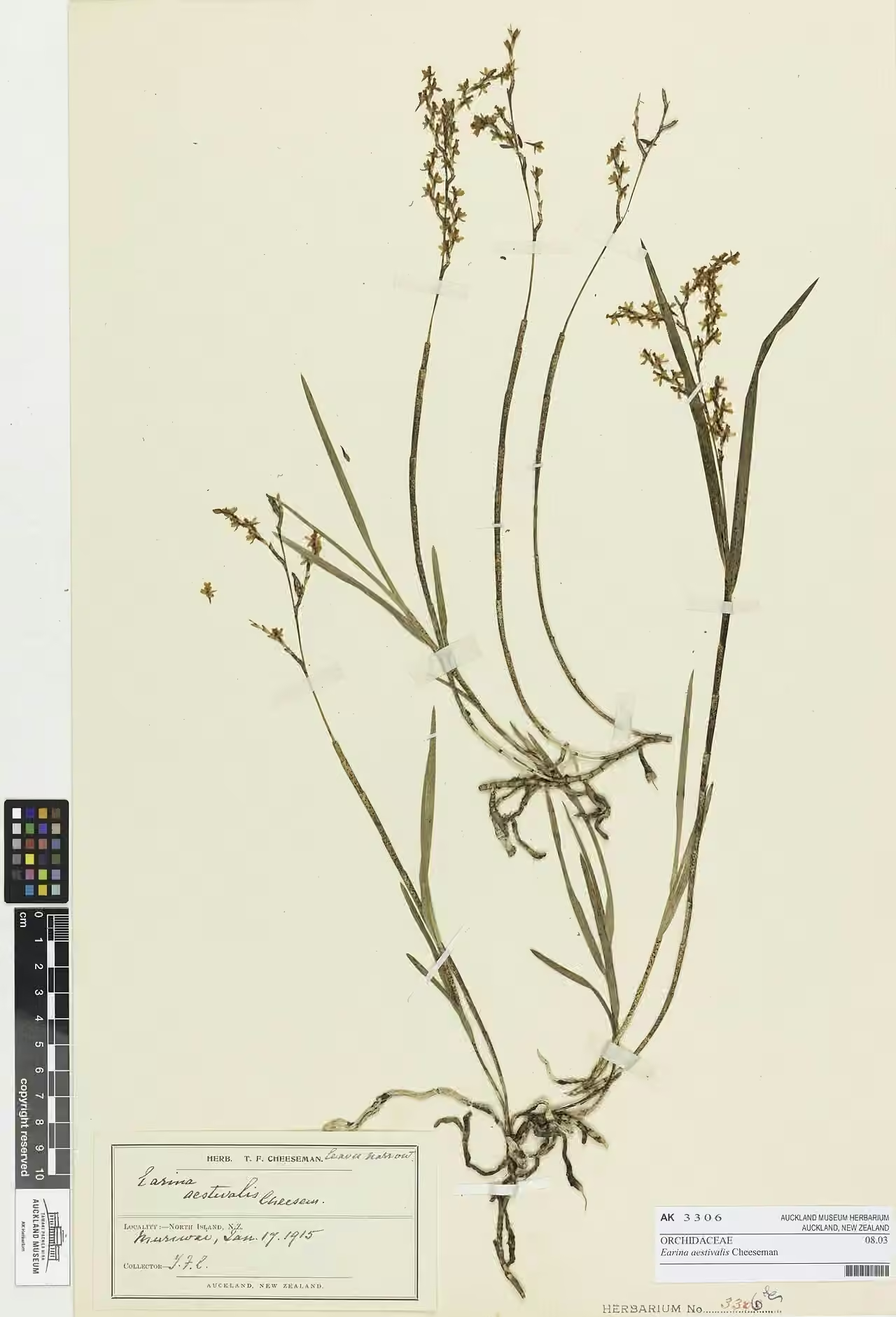
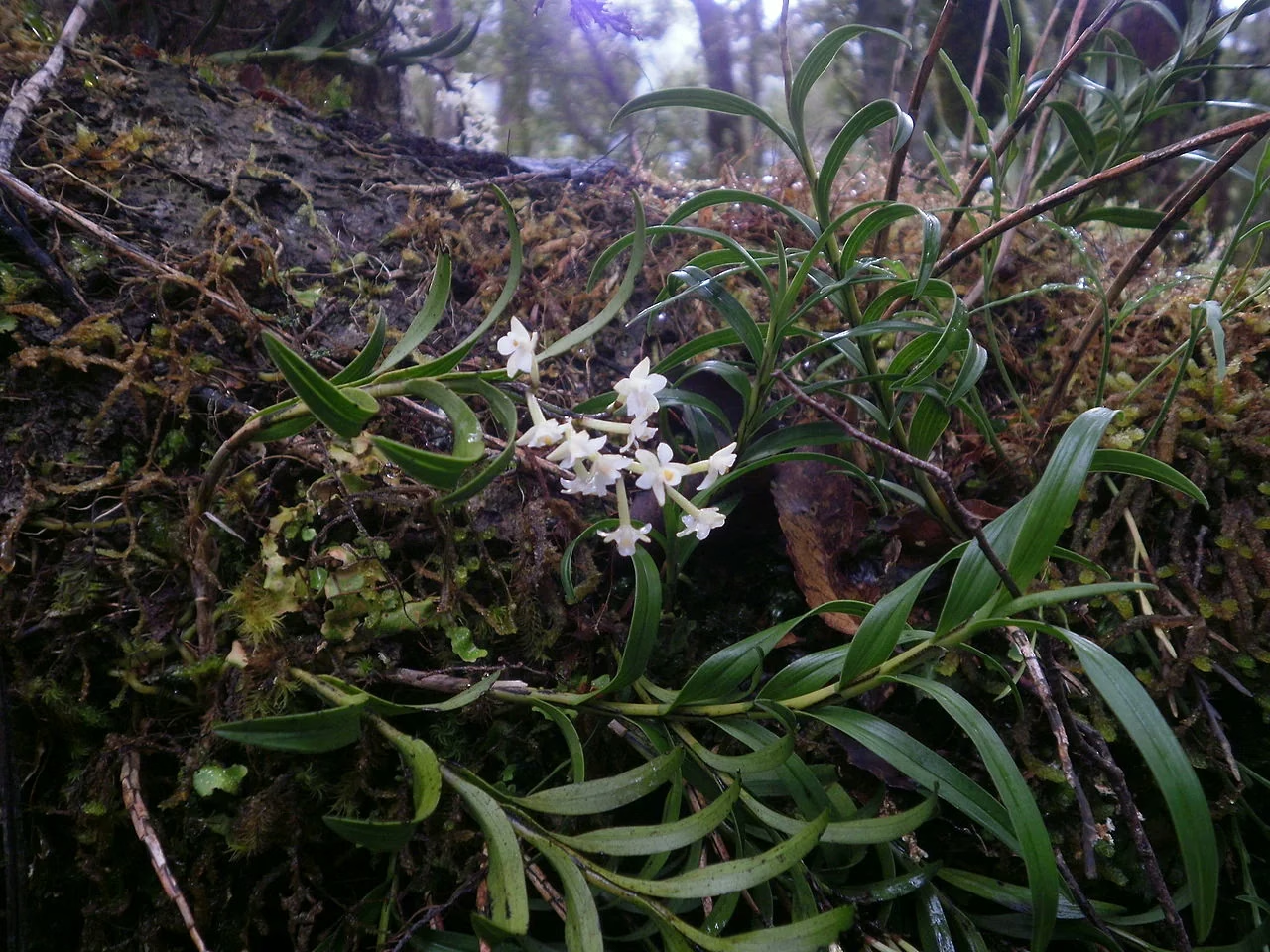
Bamboo orchid, also called summer earina (Earina aestivalis), is an endemic New Zealand orchid that grows as a low epiphyte on tree trunks and branches in coastal forest. Its many leafy, cane-like stems reach about 60 cm long, hanging from a tangle of tough rhizomes, and the leaf sheaths are marked with dark purple-black spots. From December to March it produces sprays of small greenish-cream flowers with a yellow-orange to deep apricot lip. It occurs on the North, South, Stewart and Chatham Islands and is ranked Not Threatened. Its later, summer flowering separates it from the more widespread Earina mucronata. Explore more native flowering plants in our native plant guide.
Plant Description
Earina aestivalis is an epiphytic orchid that forms clumps of many leafy stems up to 60 cm long, arising from extensive, intertwined rhizomes that grip the bark of host trees. The persistent leaf sheaths, 5 to 12 mm long, are arranged in two rows along the stem and are ivory to yellowish with distinctive dark purple-black spots.
The leaves are lance-shaped, 60 to 100 mm long and 6 to 8 mm wide, with a deeply channelled midrib, and are relatively short-lived. Between December and March the stem tips bear a branched inflorescence of two to eight racemes. Each flower is 10 to 14 mm across, with pale greenish-cream to yellowish petals and sepals and a broader lip ranging from yellow-orange to deep apricot, narrowed into a waist-like neck. Elliptic-ovoid capsules mature grey between January and August.
The very similar Earina mucronata is more widespread and flowers earlier, in spring to early summer. E. aestivalis has shorter stems, leaf sheaths that flare away from the stem, broader leaves with a deeper channelled midrib, and larger dark spots on the sheaths.
Quick Facts
| Scientific Name | Earina aestivalis |
|---|---|
| Height | Stems up to 0.6 m long, usually hanging |
| Spread | Clumps spread by intertwined rhizomes |
| Water Needs | Humid air with frequent moisture; free drainage |
| Light | Dappled light to partial shade |
| Frost Tolerance | Low to moderate; a coastal lowland plant |
| Salt Tolerance | Moderate; grows in coastal forest, but no specific data |
| Growth Rate | Slow |
| Lifespan | Long-lived perennial |
Climate Best Suited to
Suits mild, humid coastal and lowland climates with regular rain and few hard frosts. It struggles in hot, dry or very cold sites.
Regional Suitability
| City | Climate Suitability |
|---|---|
| Auckland | High |
| Wellington | Medium |
| Christchurch | Low |
| Dunedin | Low |
Plant Habitat
Bamboo orchid is endemic to New Zealand and occurs on the North Island, South Island, Stewart Island/Rakiura and the Chatham Islands. NZPCN notes that the Chatham Island populations warrant further taxonomic study.
It grows in coastal and lowland forest, usually as a low epiphyte on tree trunks and branches, where its rhizomes wrap tightly around the bark. Occasionally it grows on cliff faces and rock outcrops.
Growing Requirements
Soil Requirements
As an epiphyte it does not grow in soil. Its roots and rhizomes cling to bark, moss and accumulated debris on trees or rock.
- Mount on a log, tree fern trunk or wood slab
- A pad of sphagnum moss helps hold moisture around new roots
- Avoid potting in ordinary garden soil
Light Requirements
In forest it grows low on trunks where light is filtered by the canopy.
- Bright, dappled light
- Shelter from hot afternoon sun and drying wind
Water Requirements
It relies on rain, mist and humid forest air, drying briefly between wettings because its roots are exposed on bark.
- Water frequently until a mounted plant is established
- Mist in dry weather but allow roots to dry between wettings
Planting and Establishing
Plants are occasionally available from specialist native plant nurseries; wild collection is discouraged. Rather than planting in the ground, attach a rooted division firmly to a log, tree fern trunk or wood slab with soft ties, packing a little moss around the roots.
Hang or position the mount in a sheltered, warm, humid place with filtered light, such as under a tree canopy or in a shadehouse. Over time the rhizomes will grip the surface and the ties can be removed.
Ecological Role
Like other orchids it produces enormous numbers of minute, dust-like seeds that are dispersed by wind, allowing it to colonise new trees. Specific pollinator records for this species were not found in the sources consulted.
As a low epiphyte it forms part of the layered community of mosses, ferns and orchids on coastal forest trees, and its dense rhizome mats provide shelter for small invertebrates.
Uses & Significance
Garden Uses
In mild gardens it is a rewarding plant for a shaded tree trunk, fern log or shadehouse collection.
- Mounted on tree fern trunks or slabs
- Native orchid collections
- Adding late-summer flowers to a shady native garden
Ecological Value
It contributes to the epiphyte flora of coastal and lowland forest throughout New Zealand.
- Part of the forest epiphyte community
- Shelter for invertebrates in rhizome mats
- Late-summer flowers when few other native orchids bloom
Landscaping Uses
Mounted on the trunk of an established tree or a tree fern in a sheltered courtyard, bamboo orchid creates a natural, hanging display of fine, cane-like foliage. Position it at eye level where its small flowers can be appreciated.
It pairs well with other native epiphytes such as ferns and Earina mucronata, whose earlier flowering extends the season of interest.
Seasonal Care Calendar
Spring
New stems begin to grow from the rhizomes.
- Good time to mount new divisions
- Increase watering as the weather warms
Summer
Flowering runs from December to March, with creamy flowers and apricot lips at the stem tips.
- Keep mounted plants humid in dry spells
- Enjoy the flowers at close range
Autumn
Seed capsules develop and begin to mature grey.
- Leave capsules to release seed naturally
- Reduce watering as temperatures drop
Winter
Capsules continue maturing into August while growth slows.
- Protect from hard frost in colder areas
- Avoid keeping roots constantly wet
When to Prune and How Much
Pruning is not required. Older stems naturally shed their leaves and eventually die back, and can be cut off at the base once completely dry and brown.
Do not cut green stems, as they continue to support the plant even after their leaves have fallen.
How to Grow Bamboo Orchid
NZPCN states that Earina aestivalis can be grown from division of established plants, and division is the practical method for home growers. Orchid seed is microscopic and needs a specific fungal partner or laboratory culture to germinate, so seed raising is a specialist technique. Always source divisions from cultivated plants or nursery stock; NZPCN discourages taking plants from the wild. Divisions establish best when taken from vigorous clumps and given warmth, shelter and frequent watering while they attach to their new mount.
By Division
Large clumps can be separated into pieces, each with several stems and a portion of rhizome with healthy roots. NZPCN advises strapping rooted pieces to a log, fern trunk or wood slab and suspending them in a sheltered, warm position, then watering frequently until established.
- Choose a healthy, well-established cultivated clump in spring
- Cut the rhizome into sections, each with several stems and active roots
- Place a thin pad of moss on a log, tree fern slab or wooden board
- Tie the division firmly onto the mount with soft ties or fishing line
- Hang in a warm, sheltered, humid spot with dappled light
- Water or mist frequently until new roots grip the surface
From Seed
Seed capsules mature from January to August and release minute, wind-dispersed seed. In nature germination depends on symbiotic fungi, and in cultivation it generally requires sterile laboratory culture, so this method is not practical for most gardeners.
- Allow capsules on cultivated plants to mature and turn grey
- Pass seed to an orchid propagation laboratory if raising seedlings is desired
Pests & Diseases
No specific pests of Earina aestivalis are documented in the sources consulted. In cultivation, orchids of this kind can be affected by scale insects and mealybugs, and by rot if the roots stay constantly wet.
Slugs and snails may graze new shoots and flowers, especially on low mounts in shadehouses.
Cultural Significance
No Māori name or traditional use specific to Earina aestivalis is recorded in the sources consulted.
The genus name Earina comes from a Greek word associated with springtime, while aestivalis means summer. The pairing neatly marks this species as the later-flowering cousin of the spring-flowering Earina mucronata. Thomas Cheeseman described it as a distinct species.
Bonus Tip
If you have a large old tree fern trunk in a sheltered spot, it makes an ideal host: the fibrous surface holds moisture yet drains freely, and a bamboo orchid division tied on in spring will often be gripping the trunk with new roots by the following summer.
Related Plants
Explore other native plants that share similar characteristics or habitats with Bamboo Orchid (Earina aestivalis), offering further insights into New Zealand's diverse flora. These related species provide context and opportunities for complementary planting in your garden.
Dracophyllum politum
Dracophyllum politum
Dracophyllum prostratum
Dracophyllum prostratum
Dracophyllum pubescens
Dracophyllum pubescens
D'Urville's Grass Tree
Dracophyllum urvilleanum
Chenopodium allanii
Chenopodium allanii
Sharp Spike Sedge
Eleocharis acuta
Sand Spike Sedge
Eleocharis neozelandica
Autumn Orchid
Autumn Orchid
Plant Conservation
Earina aestivalis is ranked Not Threatened nationally (2023). Regional assessments rank it Regionally Not Threatened in Northland, Auckland and Wellington, while in Otago it is Regionally Data Deficient.
Protecting coastal and lowland forest, including old trees that carry epiphytes, is the best way to conserve it. Buy plants from specialist nurseries rather than removing them from the wild.
Frequently Asked Questions
What is the difference between Earina aestivalis and Earina mucronata?
Earina aestivalis has shorter stems, flaring leaf sheaths, broader leaves with a more deeply channelled midrib and larger dark spots, and it flowers in late summer rather than spring to early summer like E. mucronata.
Why is Earina aestivalis called the bamboo orchid?
Its numerous long, jointed, leafy stems look like small bamboo canes hanging from tree trunks and branches.
Can you grow bamboo orchid at home?
Yes, with care. NZPCN says it can be grown by dividing established plants and strapping rooted pieces to a log, fern trunk or wood slab hung in a sheltered, warm spot and watered often until established.
When does the summer earina flower?
It flowers from December to March, which is why it is named aestivalis, from the Latin for summer. Seed capsules mature from January to August.
Sources and Further Reading
The botanical, growing, and conservation details for Bamboo Orchid (Earina aestivalis) on this page draw on the New Zealand plant references below. Consult them for full technical records and the latest distribution data.