Hair Grass
Deschampsia pusilla
Last updated:
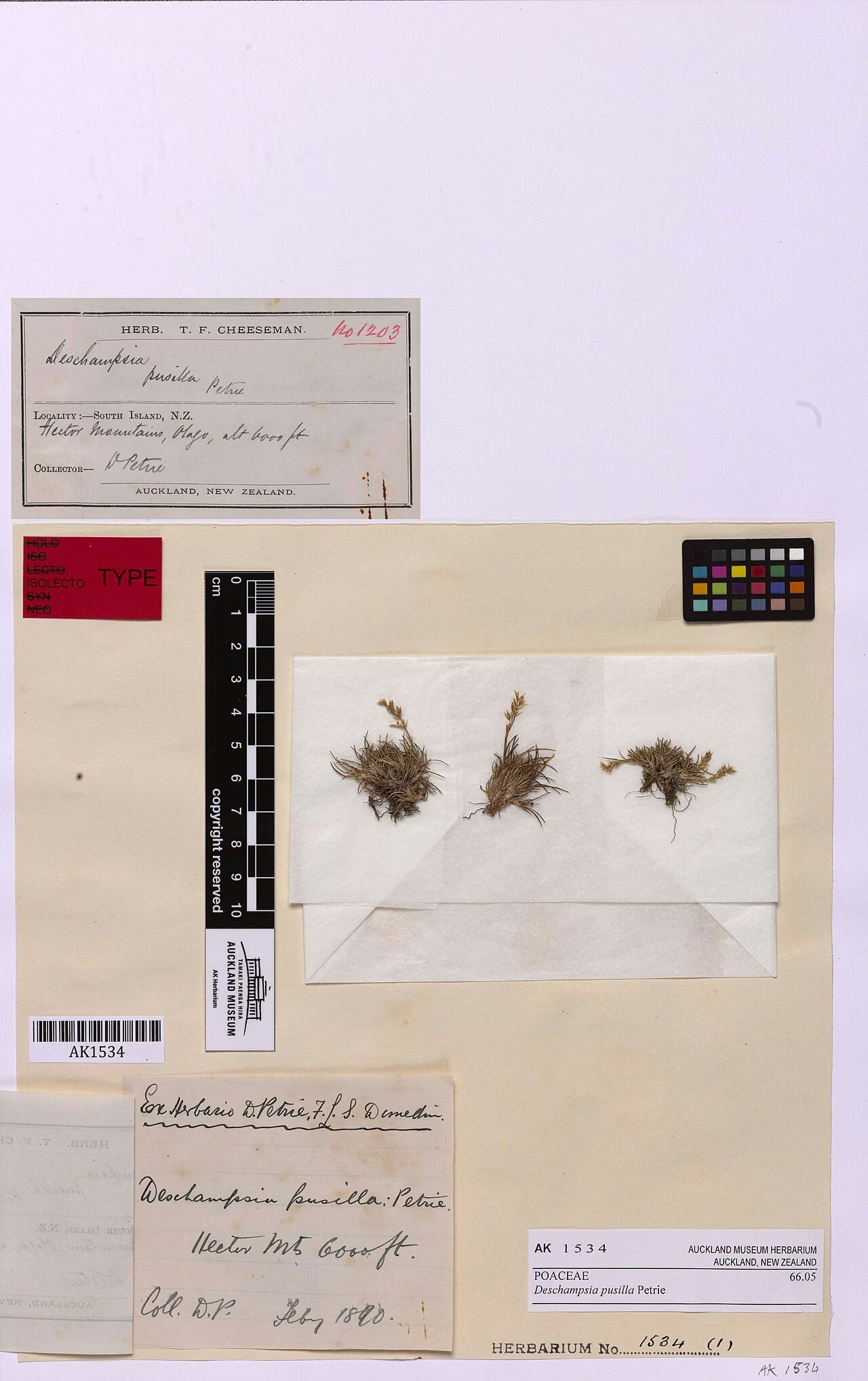
Deschampsia pusilla is one of New Zealand's smallest grasses: a compact, leafy tuft only 2 to 4.5 cm tall whose flowering stems are often hidden among the leaves. It is endemic and has been recorded only from the high alpine zone of the Central Otago mountains, including the Hector and Humboldt Mountains, Pisa Range, Remarkables, and Garvie and Umbrella Mountains. It grows in fellfield, around tarns and in seepages, often among small cushion plants. Because it is so small and its habitat so remote, it has been collected only a handful of times, and it is ranked At Risk - Naturally Uncommon. Explore more native grasses and flaxes in our native plant guide.
Plant Description
Deschampsia pusilla forms compact, leafy tufts just 2 to 4.5 cm tall, with leaves often reaching up to the base of the flower head. The leaf sheaths are wider than the blades, firmly membranous and light brownish grey with a few faint ribs. The ligule is 2 to 3.5 mm long and tapers to a sharp point. The leaf blades are 5.5 to 17 mm long and only 0.3 to 0.5 mm across, rolled inwards, smooth, with finely toothed margins and a bluntish tip.
The flowering stems are 1.2 to 2.5 cm long (rarely to 4 cm, and occasionally longer on mature plants), branched at the base and often almost completely hidden among the leaves. The compact panicle is under 2 cm long with a few minutely rough branches carrying greenish, shining spikelets 2.2 to 3 mm long. The glumes are about equal and as long as the spikelet, and the lemma is 4 to 5 toothed with a short point in the notch. The flowers are cleistogamous, meaning they self-pollinate without opening, and the grain is about 1 mm long.
NZPCN notes that it has no close relatives and is unlikely to be confused with the other grasses that share its habitat. Its tiny size, buried flower heads and shining green spikelets are the best field clues.
Quick Facts
| Scientific Name | Deschampsia pusilla |
|---|---|
| Height | 2-4.5 cm |
| Spread | Small compact tufts a few centimetres across |
| Water Needs | Constantly moist; grows in seepages and beside tarns |
| Light | Full sun, open alpine sites |
| Frost Tolerance | Very high; a high alpine species |
| Salt Tolerance | No information available; an inland alpine plant |
| Growth Rate | Slow |
| Lifespan | Perennial |
Climate Best Suited to
Suits the harsh high alpine climate of the Central Otago ranges, with long snowy winters, intense summer sun and frequent freezing. It is not suited to lowland gardens anywhere in New Zealand.
Regional Suitability
| City | Climate Suitability |
|---|---|
| Auckland | Low |
| Wellington | Low |
| Christchurch | Low |
| Dunedin | Low |
Plant Habitat
Deschampsia pusilla is endemic to New Zealand and has been recorded only from the mountains of Central Otago in the South Island. The Flora of New Zealand lists the Hector and Humboldt Mountains, the Pisa Range, the Remarkables, and the Garvie and Umbrella Mountains. The type specimen was collected by Donald Petrie in the Hector Mountains at about 6000 ft (roughly 1800 m) in 1890.
It is a plant of the high alpine zone, growing in fellfield, around tarns and in seepages, and it is often found among small cushion plants. A herbarium specimen from the Gem Lake area of the Umbrella Mountains was collected at about 4700 ft (around 1430 m).
Growing Requirements
Soil Requirements
It grows on thin, wet alpine soils in fellfield and on the damp ground around tarns and seepages.
- Gravelly or peaty alpine substrates
- Persistently moist ground fed by seepage or snowmelt
- Low-fertility soils shared with small cushion plants
Light Requirements
Its habitat is open, treeless high alpine ground with no shading vegetation.
- Full exposure to sun and wind
- Would be smothered by taller plants in a lowland setting
Water Requirements
Seepages and tarn margins keep its roots moist through the short alpine growing season.
- Needs a constant supply of cold moisture
- Snow cover protects it through winter
Planting and Establishing
Deschampsia pusilla is not in cultivation and no propagation information is available, so it is not suitable for gardens. It should be appreciated in the wild and never dug up.
Anyone surveying Central Otago's alpine tarns and seepages can help by recording sightings with photographs on iNaturalist NZ, since more records are needed to clarify its true abundance.
Ecological Role
Its florets are wind dispersed (Thorsen et al. 2009), and its flowers are cleistogamous, so seed is set by self-pollination inside closed flowers. This allows it to reproduce reliably in a cold, windy environment where insect visits are few.
It shares its habitat with small cushion plants in fellfield and damp alpine turfs. No insects or other animals are recorded as depending on it in the sources consulted.
Uses & Significance
Garden Uses
It has no practical garden use because it is not cultivated and its high alpine needs are almost impossible to meet at lower altitudes.
- Not available from nurseries
- Of interest to botanists and alpine plant enthusiasts in the field
- Should not be collected from the wild
Ecological Value
It is part of the specialised alpine flora of the Central Otago block mountains, a region rich in endemic plants.
- An endemic grass with a very small known range
- Contributes to the plant cover of alpine seepages and tarn margins
- A poorly known species that would benefit from more survey work
Landscaping Uses
This grass is not used in landscaping. Its tiny size means it would be lost among other plants, and it would not survive lowland conditions.
Gardeners wanting the look of a fine native hair grass are better served by larger, cultivated grasses suited to their own region.
Seasonal Care Calendar
Spring
In late spring the snow melts from its tarns and seepages and new leaves begin to grow.
- Habitat may still be snow-covered into early summer
- Meltwater keeps the ground saturated
Summer
Summer is the short growing season when flowering heads form, although its exact flowering months are not recorded.
- Look for tiny shining green spikelets among the leaves
- Tread carefully in seepages where it grows
Autumn
Seed is presumably shed in late summer or autumn before the snow returns; fruiting times are not documented.
- Florets are dispersed by wind
- Mature stems can lengthen up to about 10 cm
Winter
The tufts lie dormant beneath snow through the long alpine winter.
- No growth during winter
- Snow cover insulates the plants from extreme cold
When to Prune and How Much
No pruning is needed or appropriate. In the wild the tufts look after themselves, and old leaves help shelter the buried flower heads.
Field visitors should avoid trampling seepages and tarn margins, which is the only management this plant requires.
How to Grow Hair Grass
NZPCN records no information on propagating Deschampsia pusilla, and it is not known to be in cultivation. The notes below describe how other small alpine Deschampsia grasses would generally be raised, not a tested method for this species. Because its flowers are cleistogamous, each panicle should set seed without needing pollinators, which in principle makes seed the most practical route. Any propagation should be done only by conservation workers with permission from the Department of Conservation, using minimal seed collected from wild plants, and seedlings would need cold, moist, bright conditions to have any chance of survival at low altitude.
From Seed
The grain is about 1 mm long and is shed with its floret, which is dispersed by wind. Ripe seed would need to be gathered from the tiny panicles as soon as they turn straw coloured, before the wind takes it.
- Collect a small amount of ripe seed only under permit
- Sow on the surface of a gritty, moist, low-fertility mix
- Keep the tray cold, bright and constantly damp
- Grow seedlings on in a cool alpine house with good air movement
By Division
Established tufts of tufted grasses can often be split, but Deschampsia pusilla is so small that division would leave very little material. It is only worth considering for a plant already held in cultivation.
- Lift a cultivated tuft in spring as growth starts
- Gently tease apart a few rooted shoots
- Replant into wet, gritty mix in a shallow pan
- Keep cool and moist until new roots form
Pests & Diseases
No pests or diseases are recorded for Deschampsia pusilla. Its remote high alpine habitat keeps it largely free of the weeds and browsing animals that affect lowland grasses.
Trampling of seepages and tarn margins by people or stock, and changes to the water supply feeding its wet sites, are the most plausible local pressures.
Cultural Significance
No Māori name or traditional Māori use is recorded for Deschampsia pusilla in the sources consulted.
The species was described in 1891 by Donald Petrie, the Otago botanist and school inspector who explored the Central Otago ranges, from plants he collected in the Hector Mountains in February 1890. The genus honours the French naturalist Deschamps, and pusilla means small.
Bonus Tip
If you are searching for this grass on the Central Otago ranges, look low rather than for a grass head. The flowering stems are often buried in the leaves, so check small, tight tufts with shiny green spikelets nestled among cushion plants beside tarns and seepages, and photograph them for iNaturalist NZ rather than collecting them.
Related Plants
Explore other native plants that share similar characteristics or habitats with Hair Grass (Deschampsia pusilla), offering further insights into New Zealand's diverse flora. These related species provide context and opportunities for complementary planting in your garden.
Cyrtostylis rotundifolia
Cyrtostylis rotundifolia
Cystopteris tasmanica
Cystopteris tasmanica
Damnamenia vernicosa
Damnamenia vernicosa
Deparia petersenii subsp. congrua
Deparia petersenii subsp. congrua
Deschampsia tenella
Deschampsia tenella
Short-Hair Plume Grass
Pentapogon inaequiglumis
Purple Plume Grass
Pentapogon micranthus
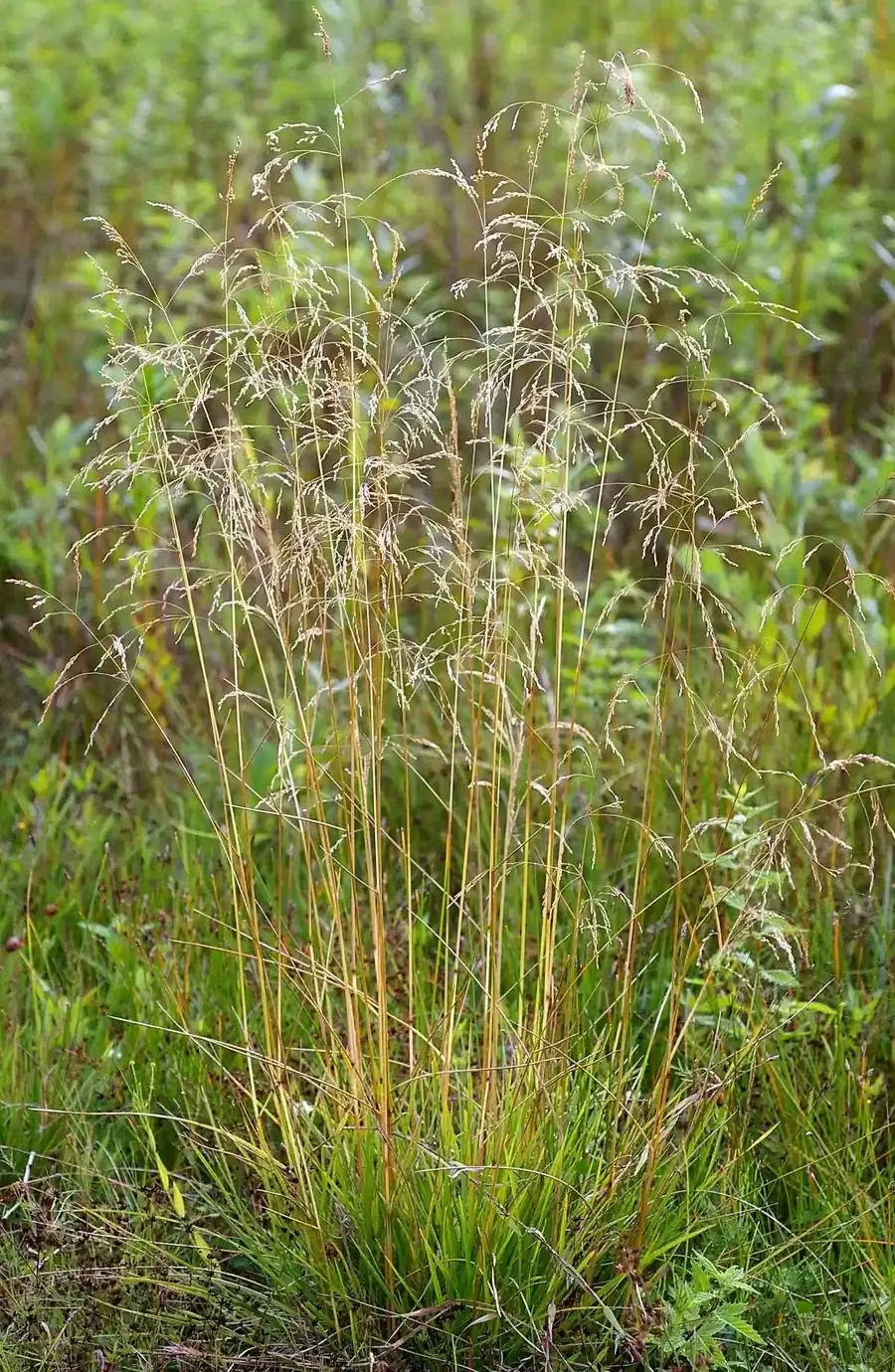
Cespitosa Grass
Deschampsia Cespitosa Grass
Plant Conservation
Deschampsia pusilla is ranked At Risk - Naturally Uncommon (2023) with the qualifier Sparse, the same ranking it held in 2009, 2012 and 2017. NZPCN explains that because of its small size and restriction to remote high alpine places it is known from only a few collections; it may be common in its habitat, but its exact status remains uncertain until thorough surveys are done.
Protecting the alpine tarns and seepages of the Central Otago ranges from disturbance, and adding well-documented observations to herbarium and iNaturalist records, are the most useful actions for this species.
Frequently Asked Questions
Where does Deschampsia pusilla grow?
It has been recorded only from the high alpine zone of Central Otago, on ranges such as the Hector Mountains, Pisa Range, Remarkables and Umbrella Mountains, in fellfield, seepages and around tarns.
How big is Deschampsia pusilla?
It is a compact tuft only 2 to 4.5 cm tall, with flowering stems usually 1.2 to 2.5 cm long that are often almost completely hidden among the leaves.
Is Deschampsia pusilla rare?
It is ranked At Risk - Naturally Uncommon. NZPCN notes it is known from few collections and may be more common than records suggest, but thorough surveys are still needed.
Does Deschampsia pusilla have a common name?
No common name is in use. It belongs to Deschampsia, the hair grass genus, and its epithet pusilla simply means small.
Sources and Further Reading
The botanical, growing, and conservation details for Hair Grass (Deschampsia pusilla) on this page draw on the New Zealand plant references below. Consult them for full technical records and the latest distribution data.