Woollyhead
Craspedia robusta var. pedicellata
Last updated:
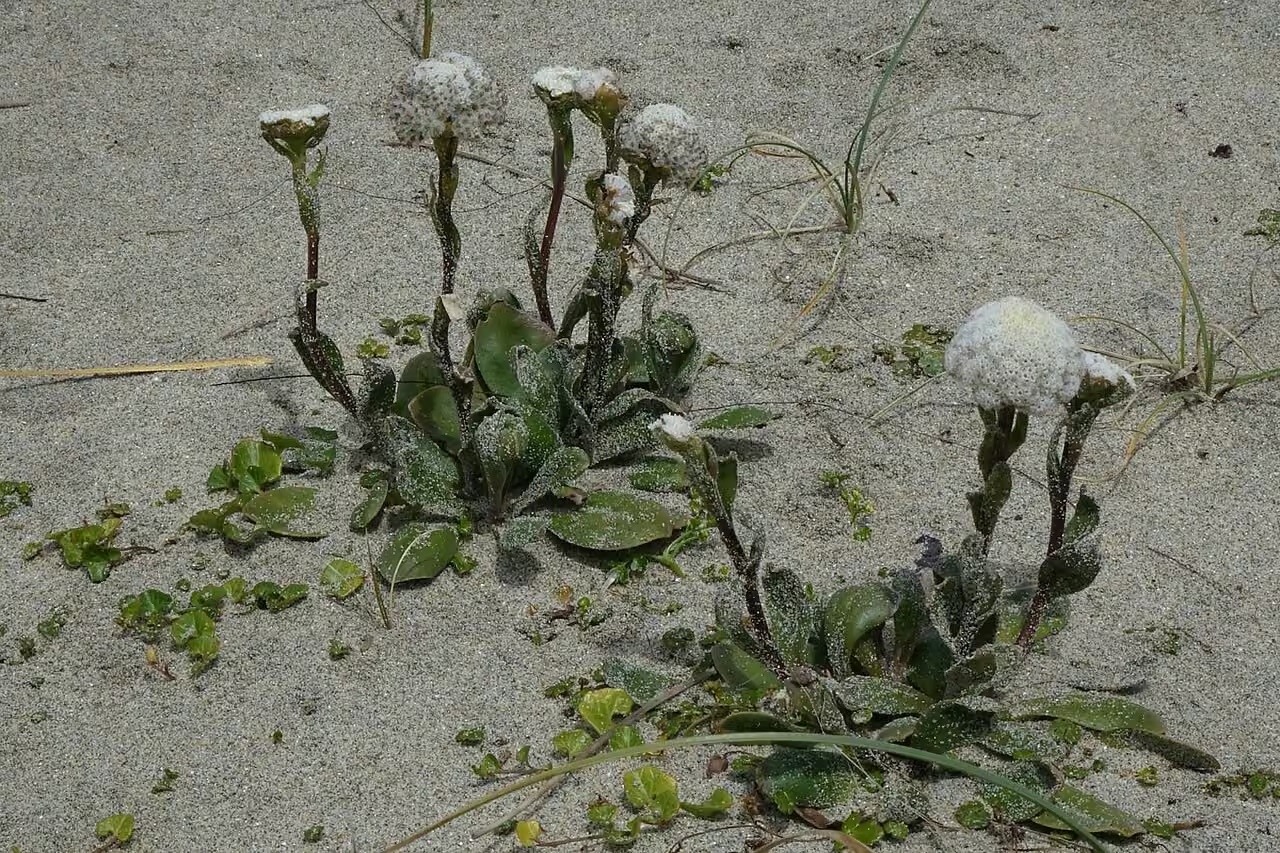
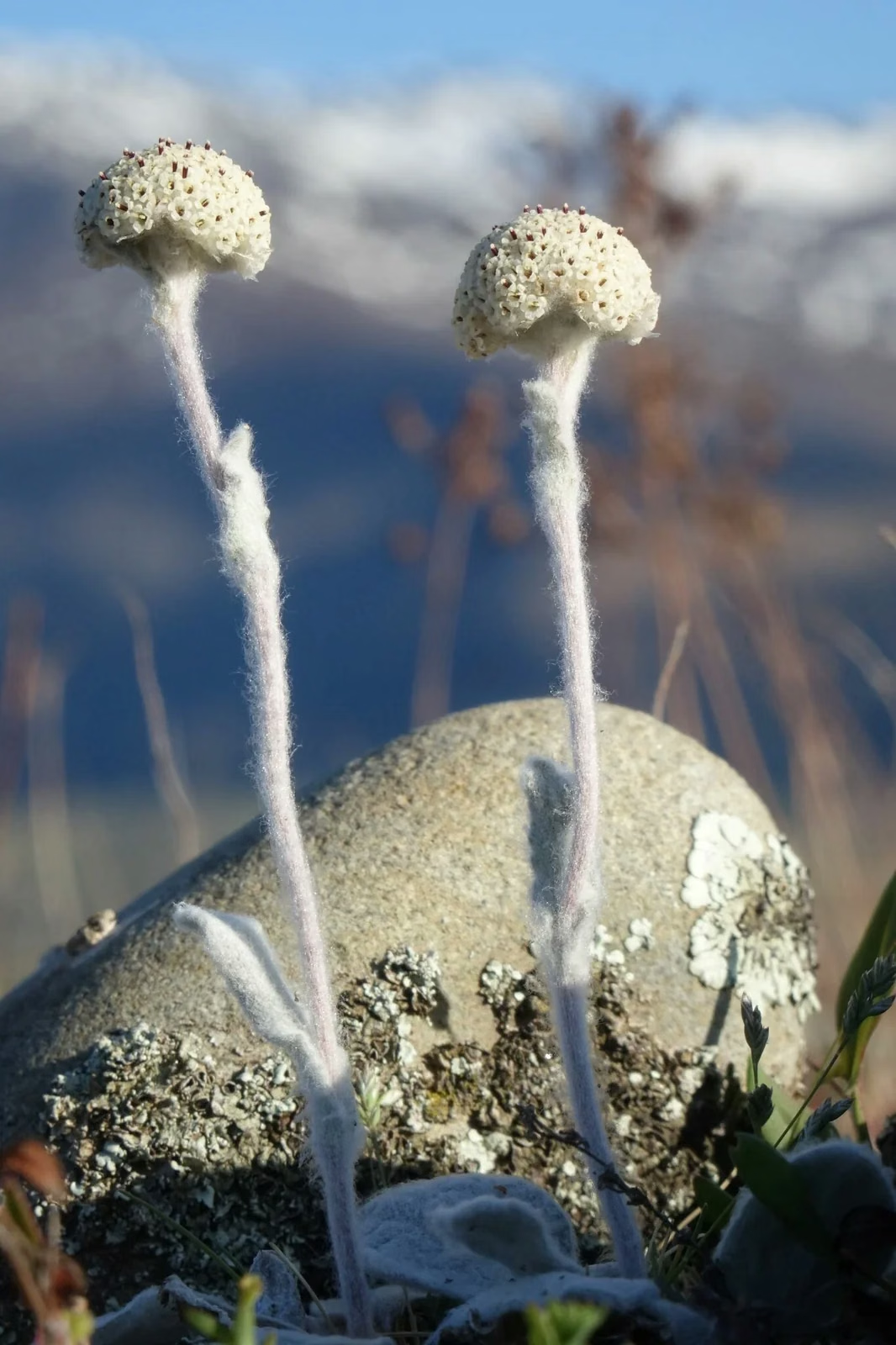
Craspedia robusta var. pedicellata is a woollyhead found only on Stewart Island/Rakiura and its outlying islands. It forms rosettes of broad leaves up to 15 cm long and sends up stout stems carrying large white flower heads up to 5 cm across, among the biggest in the genus. Its distinguishing feature, reflected in the name pedicellata, is that the small flower clusters within each head sit on short stalks 4-8 mm long. It grows from coastal sand dunes to subalpine moorland on Mount Anglem/Hananui and is ranked At Risk - Naturally Uncommon because of its very restricted range. Explore more native flowering plants in our native plant guide.
Plant Description
This is a robust rosette-forming herb in the daisy family. The Flora of New Zealand describes the rosette leaves of var. pedicellata as up to 15 cm long and 5 cm wide, broader than in many other woollyheads. As in the species as a whole, the leaves range from narrowly elliptic-obovate to broadly obovate-spathulate, can be hairless to hairy on the faces, and have a fringe of hairs along the margins, the feature that gave Craspedia its name.
The flowering stems of Craspedia robusta are stout and deeply grooved. In var. pedicellata each stem carries a rounded head (glomerule) up to 5 cm across, packed with white florets up to 6 mm long. The individual capitula within the head sit on short stalks 4-8 mm long, and the pappus hairs on the seeds are up to 5 mm long. The chromosome number is 2n = 22.
The stalked capitula and very large heads separate it from the typical variety, var. robusta, of the western South Island coast. Allan noted, however, that the robusta varieties look very distinct in their extreme forms but are linked by intermediates, partly because of habitat-induced variation and hybridism, so not every Rakiura plant is easy to place.
Quick Facts
| Scientific Name | Craspedia robusta var. pedicellata |
|---|---|
| Height | Flowering stems to about 0.6 m (species maximum) |
| Spread | Rosettes about 0.2-0.3 m across |
| Water Needs | Moderate; tolerates both damp moorland and sandy dunes |
| Light | Full sun to light shade in open sites |
| Frost Tolerance | Moderate to high; grows to about 980 m on Rakiura |
| Salt Tolerance | Moderate to high; grows on coastal dunes at Mason Bay |
| Growth Rate | Moderate |
| Lifespan | Perennial |
Climate Best Suited to
Suits the cool, wet, windy and cloudy oceanic climate of Stewart Island, with mild coastal winters and cold, misty uplands.
Regional Suitability
| City | Climate Suitability |
|---|---|
| Auckland | Low |
| Wellington | Medium |
| Christchurch | Medium |
| Dunedin | High |
Plant Habitat
Craspedia robusta var. pedicellata is endemic to Stewart Island/Rakiura. Allan's Flora recorded it as a coastal plant of Stewart Island, with the type from The Old Neck near Paterson Inlet. Herbarium collections also come from sand dunes at Mason Bay, the side of a sandy channel at about 40 m near West Ruggedy, open grassy dunes among Poa laevis on Codfish Island/Whenua Hou, and moorland at about 980 m on Mount Anglem/Hananui.
It therefore spans an unusually wide altitudinal range within a small geographic area, from coastal sand and turf to subalpine moorland. Like other woollyheads, it needs open ground and is generally absent from closed forest.
Growing Requirements
Soil Requirements
In the wild it grows both in sand and in peaty moorland soils, so drainage matters more than soil type.
- Sandy or gritty loam with good drainage
- Low to moderate fertility
- Tolerates acid, peaty conditions like those on Rakiura
- Avoid compacted clay that stays waterlogged
Light Requirements
An open-ground plant that needs plenty of light; full sun is best in most of New Zealand.
- Full sun in cool southern gardens
- Light afternoon shade in warmer, drier districts
Water Requirements
It comes from a district with frequent rain and high humidity, so keep the soil evenly moist during the growing season while ensuring excess water drains away.
- Water during summer dry spells
- Do not let pots dry out completely
- Sharp drainage prevents crown rot in winter
Planting and Establishing
Because the variety is range restricted, garden and restoration plants should be propagated from legally collected, cultivated stock rather than taken from the wild. Plant in spring into a sunny, open position in sandy or gritty soil, setting the crown level with the surface.
Within Rakiura and the islands, it can be included in dune and coastal turf restoration plantings using local-source seed. Elsewhere it is best grown as a specimen in a rock garden, raised bed or large pot.
Ecological Role
Its large white heads offer abundant small florets to visiting insects, but no study of the pollinators of this variety was found. The seeds are pappate cypselae dispersed by wind, as NZPCN records.
On Rakiura it is part of the open herb communities of dunes, sandy channels and moorland, habitats kept open by wind, salt spray, shifting sand and poor peaty soils. On Codfish Island/Whenua Hou it has been collected among Poa laevis and introduced grasses on open dune.
Uses & Significance
Garden Uses
A bold woollyhead with some of the largest flower heads in the genus, best for collectors and southern gardens.
- Specimen plant in a rock garden or raised bed
- Coastal gardens in Southland and Otago
- Large containers with free-draining mix
- Long-stemmed white drumstick flowers for picking
Ecological Value
Growing it in cultivation helps maintain a range-restricted Rakiura endemic and provides nectar for small native insects.
- Ex situ insurance for a Naturally Uncommon taxon
- Floral resource in dune and moorland communities
- Wind-dispersed seed recolonises open sandy ground
Landscaping Uses
Use it as a focal point among low coastal plants such as Pimelea, Leptinella and small Carex, where the broad rosettes and tall white globes stand out. In a large trough it makes a good companion for other southern herbs from Stewart Island.
Its stout stems hold up well in wind, so it suits exposed southern gardens where many tall-flowered perennials would flop.
Seasonal Care Calendar
Spring
Rosettes resume growth and new leaves expand.
- Plant or divide
- Apply a light gravel mulch
Summer
Stout stems rise and the large white heads open.
- Water in dry spells
- Watch for slugs on flower stems
Autumn
Heads turn fluffy as the seeds ripen and disperse on the wind.
- Collect and sow fresh seed
- Cut spent stems
Winter
Rosettes persist through winter in a slow, semi-dormant state.
- Keep crowns free of debris
- Check pots drain freely
When to Prune and How Much
Cut finished flower stems at the base once seed has been collected or dispersed. No other pruning is required.
Remove old, decaying leaves from under the rosette in late winter to reduce rot and slug hiding places.
How to Grow Woollyhead
No published propagation notes specific to this variety were found, so the methods below follow those used for related woollyheads such as Craspedia lanata and C. uniflora, which nurseries raise from fresh seed and division. Seed should only be collected with appropriate permission because the plant grows mainly on conservation land on Rakiura and Whenua Hou, the latter a strictly protected nature reserve. Woollyheads hybridise readily, so seed from mixed garden collections may not come true to variety.
From Seed
Seed ripens in late summer to autumn as the large heads break up into fluffy seeds. Sow it fresh, as is usual for daisy-family seed with a pappus.
- Pick heads as they start to fluff, before the seeds blow away
- Rub the seeds free and sow on the surface of a free-draining seed mix
- Cover with a thin layer of grit and water gently
- Keep trays cool, bright and evenly moist
- Pot seedlings individually once they have a few true leaves
By Division
Mature plants that have formed several crowns can be split in spring. This keeps the stalked-head character of a known plant. Only divide vigorous clumps with at least three or four rosettes, and leave the parent with enough crowns to carry on flowering the following summer.
- Lift the clump in early spring
- Separate rosettes, keeping roots attached to each
- Replant or pot into sandy, gritty mix
- Water in and shelter from wind and strong sun until new roots form
Pests & Diseases
No specific pests are recorded for this variety. In gardens, slugs and snails are the most likely problem, grazing the broad leaves and young flower stems, and crown rot can develop in heavy, waterlogged soils.
In the wild, browsing animals such as deer and possums are present on Stewart Island, though I found no documented evidence of their impact on this plant.
Cultural Significance
No Māori name or traditional use specific to this woollyhead was found. Its home, Rakiura, and Whenua Hou are places of great significance to Ngāi Tahu, and Whenua Hou is a nature reserve managed jointly with the iwi.
Botanically, Thomas Kirk first described this plant as a variety of Craspedia uniflora. Cheeseman later sank it into C. fimbriata var. robusta, and H.H. Allan restored it as Craspedia robusta var. pedicellata in the 1961 Flora of New Zealand.
Bonus Tip
If you grow several woollyheads, keep this one well apart from the others or isolate a flowering plant when you want to save seed. Craspedia taxa cross readily, and keeping a pure, documented line of a Naturally Uncommon variety is far more valuable than an anonymous hybrid.
Related Plants
Explore other native plants that share similar characteristics or habitats with Woollyhead (Craspedia robusta var. pedicellata), offering further insights into New Zealand's diverse flora. These related species provide context and opportunities for complementary planting in your garden.
Red Leek Orchid
Corunastylis nuda
Craspedia incana
Craspedia incana
Craspedia lanata var. lanata
Craspedia lanata var. lanata
Craspedia robusta var. robusta
Craspedia robusta var. robusta
Kirk's Crassula
Crassula kirkii
Crassula mataikona
Crassula mataikona
Crassula peduncularis
Crassula peduncularis
Argentea Plant
Argentea Plant
Plant Conservation
Craspedia robusta var. pedicellata is ranked At Risk - Naturally Uncommon (2023) with the qualifiers RR (Range Restricted) and Sp (Sparse). It has held a Naturally Uncommon or Range Restricted ranking since the first national assessments in 2004.
Most of its habitat lies within Rakiura National Park and Whenua Hou Nature Reserve, so its small natural range rather than active decline is the reason for its ranking. Keeping dunes free of invasive marram and weeds, protecting moorland, and maintaining cultivated insurance populations all help.
Frequently Asked Questions
Where is Craspedia robusta var. pedicellata found?
It is endemic to Stewart Island/Rakiura. The type locality is The Old Neck, and herbarium collections come from Mason Bay dunes, West Ruggedy, Codfish Island/Whenua Hou and moorland at about 980 m on Mount Anglem/Hananui.
What does pedicellata mean?
Pedicellata means stalked. NZPCN explains that it refers to the stalked clusters of florets: the capitula within each large head sit on pedicels 4-8 mm long.
Is the Stewart Island woollyhead threatened?
It is ranked At Risk - Naturally Uncommon (2023) with the qualifiers Range Restricted and Sparse, because it occurs naturally only on Rakiura and nearby islands.
What colour are the flowers of Craspedia robusta var. pedicellata?
NZPCN records the flower colour as white. The florets are up to 6 mm long and form globe-shaped heads up to 5 cm in diameter.
Sources and Further Reading
The botanical, growing, and conservation details for Woollyhead (Craspedia robusta var. pedicellata) on this page draw on the New Zealand plant references below. Consult them for full technical records and the latest distribution data.