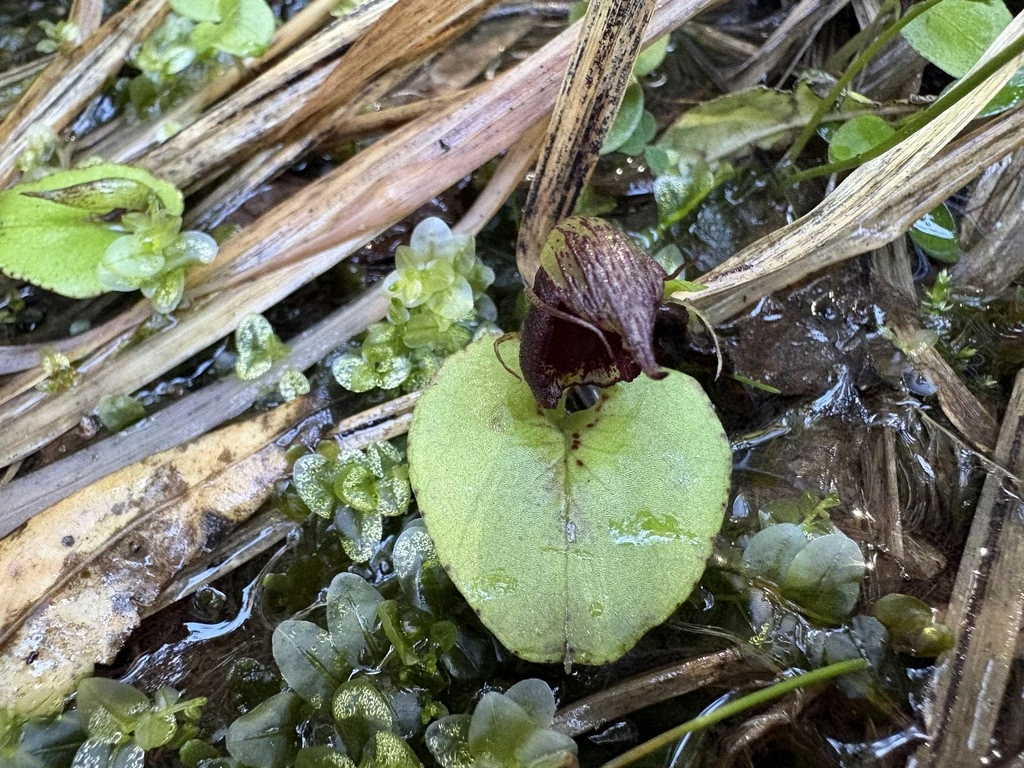
Spider Orchid
Corybas orbiculatus
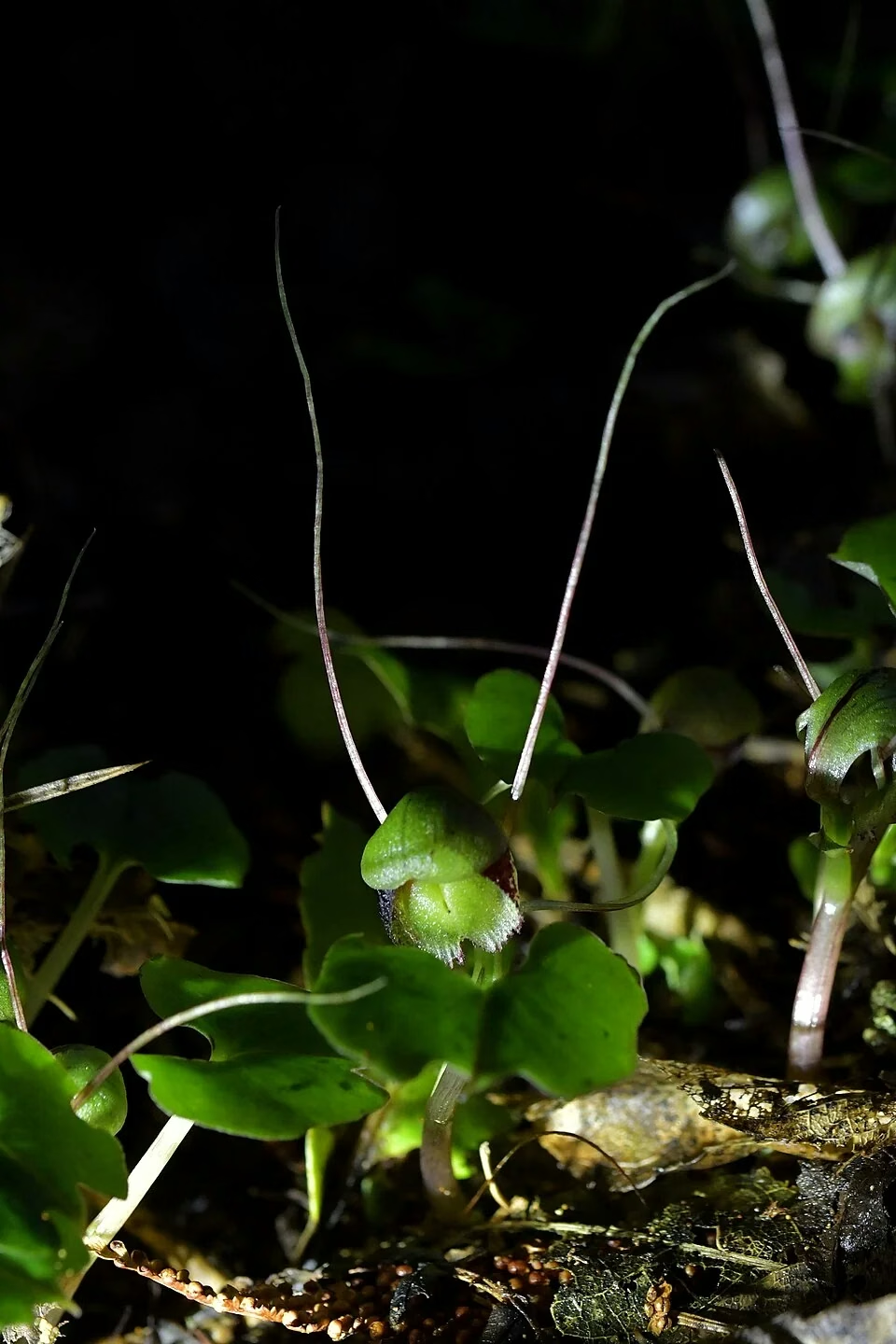
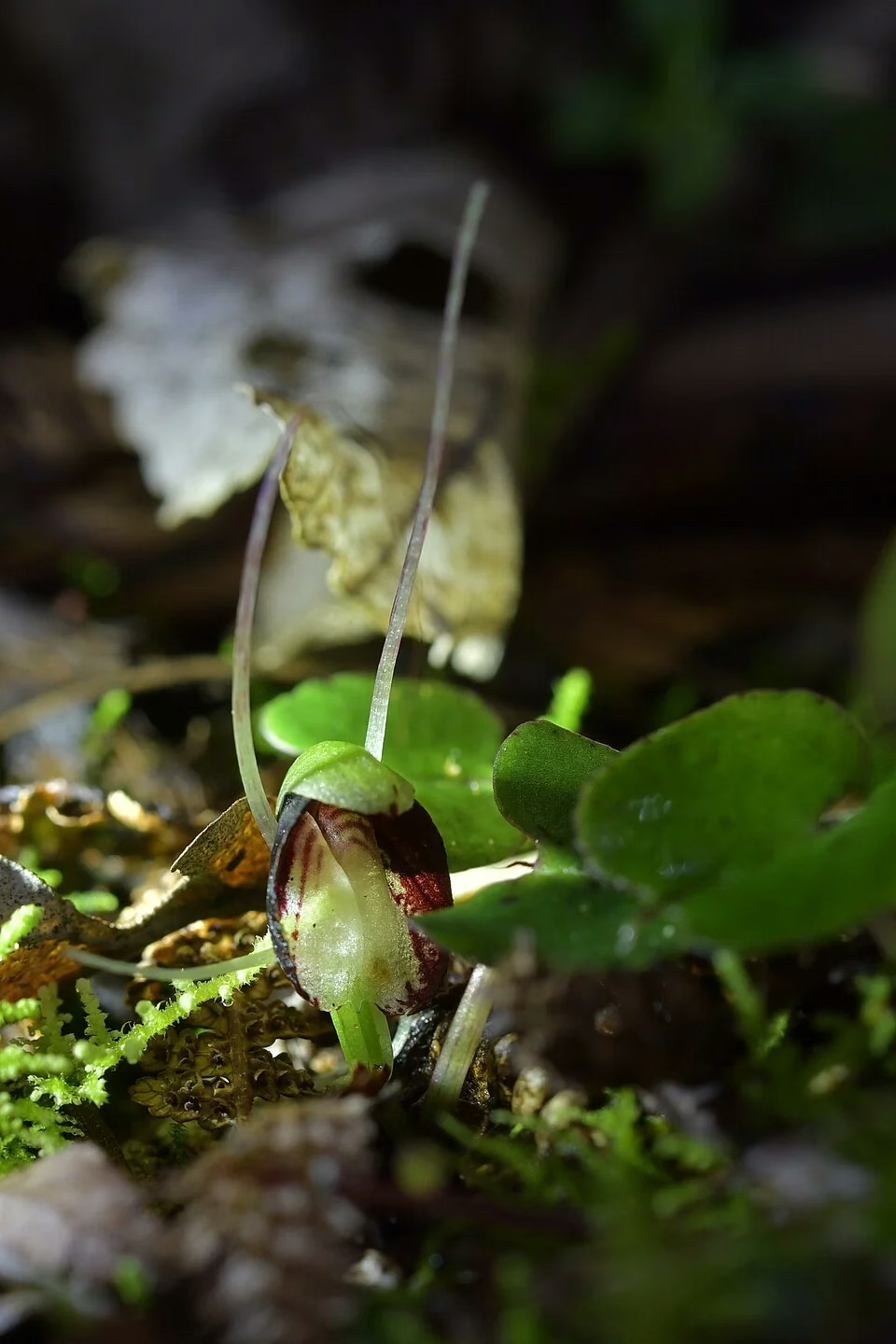
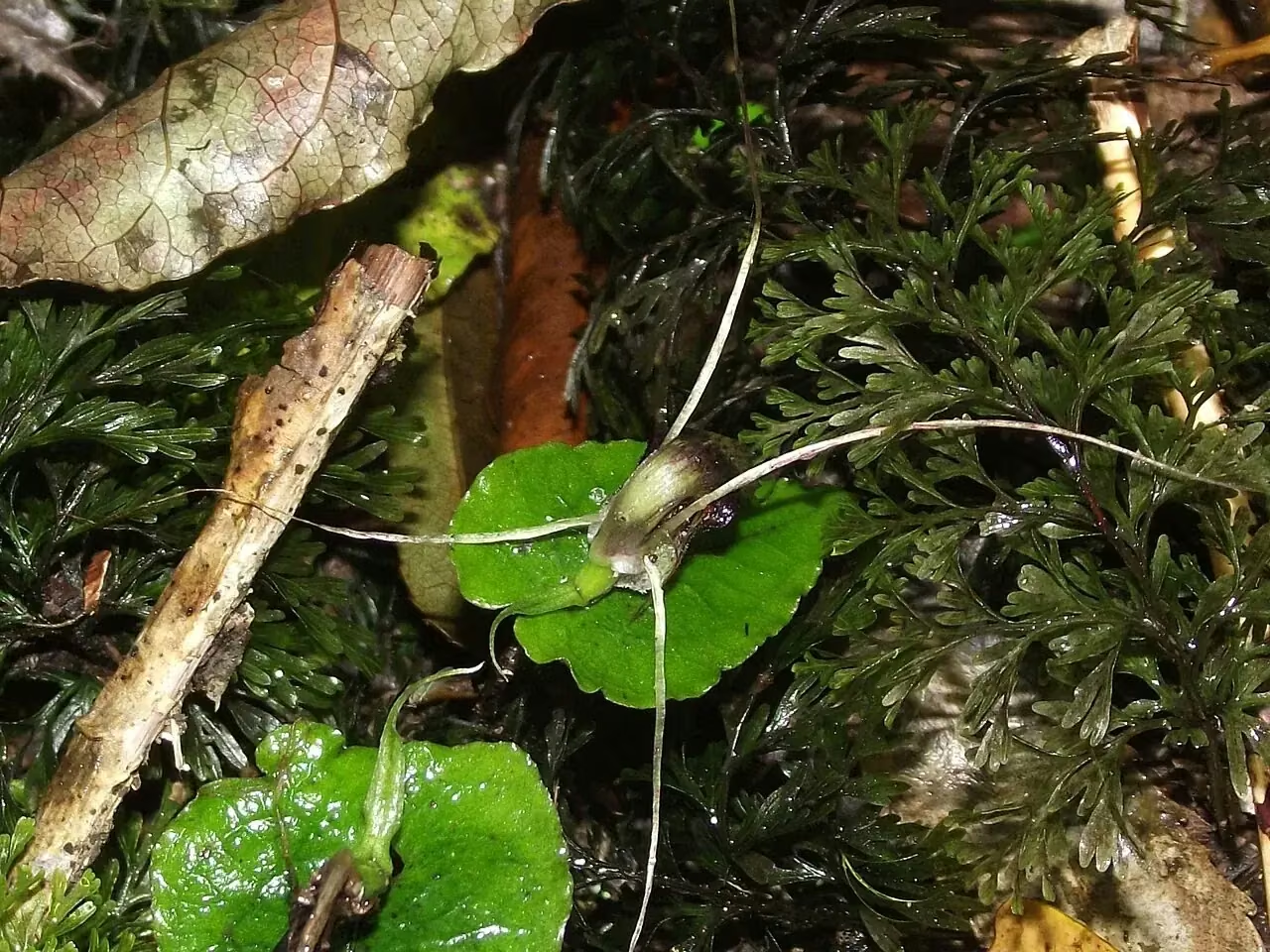
Corybas orbiculatus is a small endemic spider orchid with a single fleshy leaf and a dark flower whose lip has strongly inward-folded edges. Flowering plants are about 30-35 mm tall.
Identification
Flowering plants are about 30-35 mm tall. Their solitary, fleshy leaf usually lies flat on the ground, is 15-25 mm long, and is often purple-flecked above with a silvery underside.
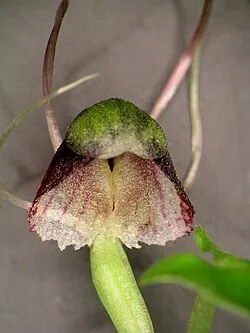
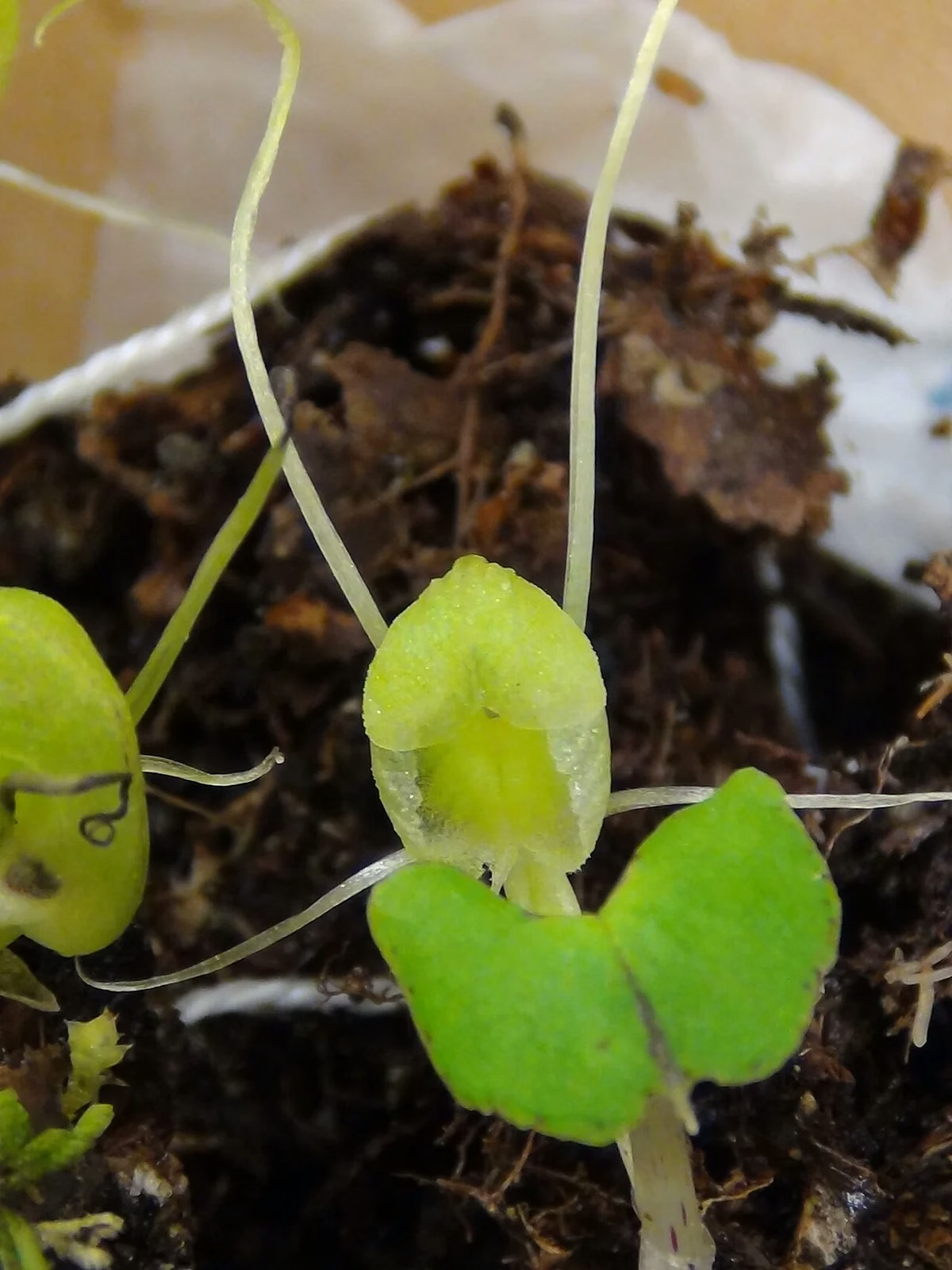
The flower is dark red-green to reddish purple. Its dark lip bends downward and has sharply inrolled edges; the slender lateral sepals and petals are relatively short.
Quick facts
| Scientific Name | Corybas orbiculatus |
|---|---|
| Former name | Nematoceras orbiculatum |
| Family | Orchidaceae |
| Height in flower | 30-35 mm |
| Flowering | August to November |
| Fruiting | October to January |
| National status | Not Threatened (2023) |
| Height | 3-3.5 cm at flowering |
| Water Needs | Natural sites remain damp; cultivation is described as difficult |
| Light | Naturally associated with well-lit damp sites |
| Spread | Usually solitary; lateral spread is not quantified |
| Frost Tolerance | Minimum tolerated temperature is not documented |
| Salt Tolerance | Salt tolerance is not documented |
| Growth Rate | Annual extension is not quantified in the cited accounts |
| Lifespan | Winter-to-spring-green tuberous herb |
Natural range
NZPCN records this endemic orchid on the North and South Islands, Stewart Island/Rakiura and the Chatham Islands. It occurs from coastal to montane elevations, up to approximately 1,000 metres.
| City | Climate Suitability |
|---|---|
| Auckland | Not assessed |
| Wellington | Not assessed |
| Christchurch | Not assessed |
Habitat and distribution
The species favours well-lit, permanently damp coastal turf, banks and cliff faces, often on base-rich materials including calcareous mudstone, limestone, marble and basalt.
New Zealand Native Orchids also records it on wet mossy road banks, in damp forest, wet tussock herbfields and dunes.
Natural growing conditions
NZPCN describes permanently damp, well-lit ground over base-rich rock as a favoured habitat. It also describes propagation as difficult and advises that this orchid should not be removed from the wild.
Planting considerations
The cited profile documents natural habitat but does not provide a tested planting method. NZPCN says this small orchid is difficult to propagate and that plants should not be taken from the wild.
Ecology
This terrestrial, tuberous orchid is generally solitary and green from winter into spring. The New Zealand Wetland Plant List classifies it as facultative, occurring in wetlands and in non-wetland settings.
Observing the flower
The lip is dark purple-red to maroon, with folded-in upper margins and a downward-curved tip that usually touches the leaf. Its edges develop fine to more obvious teeth on either side.
Garden context
Its documented natural habitats include wet mossy banks, coastal turf and damp forest. NZPCN describes propagation as difficult and advises leaving wild plants in place; it does not provide a garden planting protocol.
Flowering and fruiting
NZPCN records flowering from August to November and fruiting from October to January. New Zealand Native Orchids lists November for flowering; the published accounts therefore differ in the breadth of the period.
Seasonal growth
The orchid usually has one leaf and one flower, with the leaf flat against the ground. It is green in winter and spring; the cited sources do not prescribe pruning for this small terrestrial plant.
How to Grow Spider Orchid (Corybas orbiculatus)
Seed and propagation evidence
NZ Plant Conservation Network describes propagation of Corybas orbiculatus as difficult and advises against removing wild plants. Its account does not supply a sowing method or an artificial growing medium. The presence of rounded to ellipsoid tuberoids on extended roots is part of its botanical description; it should not be presented as proof that separating those structures produces successful cultivated plants.
Damp, Well-Lit Natural Sites
This orchid favours permanently damp coastal turf, banks and cliff faces, extending into montane areas up to about 1,000 m. Its substrates include calcareous mudstone, siltstone, limestone, marble, basalt and basaltic andesite, together with soils derived from those rocks. The association with well-lit sites is useful evidence about its habitat, but the profile does not translate it into a specific shade-house rating or numerical pH requirement.
Winter and spring growth
Plants are mainly solitary and green from winter into spring. Flowering is recorded from August to November, with fruit from October to January. A flowering plant stands only about 3-3.5 cm tall. Its single fleshy leaf generally lies flat on the ground, on a short stalk approximately 2.5-6 mm long.
Recognising Its Leaf
The leaf blade is usually 1.5-2.5 cm long, elliptic-heart-shaped to broadly heart-shaped, with a rounded tip ending in a short point. Purple flecks may occur on the margins or across the green upper surface. The underside is silvery and translucent. The midrib is grooved above and raised beneath, features worth checking alongside the solitary flower when identifying an existing collection.
Plant health
The NZPCN species profile does not list pest or disease treatments. Purple flecks on the leaf and toothed margins on the flower lip are normal features described for this orchid.
Naming and classification
William Colenso published the original name Corysanthes orbiculata in 1891. The orchid was later placed in Corybas and has also been called Nematoceras orbiculatum.
Distinguishing related orchids
NZPCN distinguishes this species from members of the Corybas rivularis complex by its relatively short sepals and petals and its narrow, pointed lip with distinctly inrolled, toothed margins.
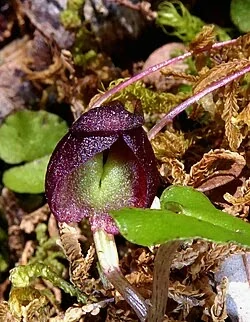
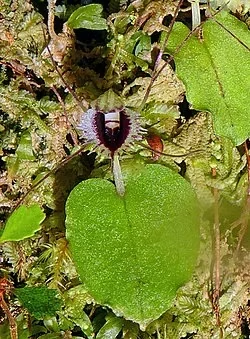
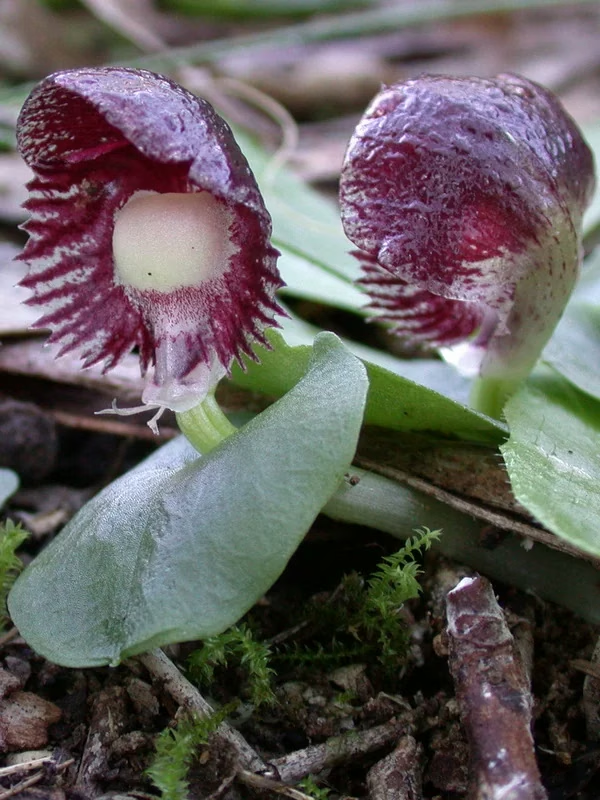
Related New Zealand spider orchids
Explore other Corybas species and their distinctive flowers and leaves.
Conservation
Corybas orbiculatus was assessed as Not Threatened nationally in 2023. NZPCN notes genetic evidence that Chatham Island plants assigned to it may be distinct, and says this needs further research.
Frequently asked questions
Is Nematoceras orbiculatum the same plant?
Yes. Flora of New Zealand lists it as a synonym of Corybas orbiculatus .
Where does it grow?
It favours permanently damp places, including coastal turf, banks and cliffs, and is also recorded on mossy road banks and in wet forest or tussock herbfields.
Does it normally form a dense carpet?
The species account describes Corybas orbiculatus as mainly solitary. A dense colony should therefore be identified carefully rather than assigned to this species from leaf shape alone.
Sources
Identification, habitat and conservation: NZPCN. Names and botanical description: Flora of New Zealand. Habitat and flowering observations: New Zealand Native Orchids.
Last updated: