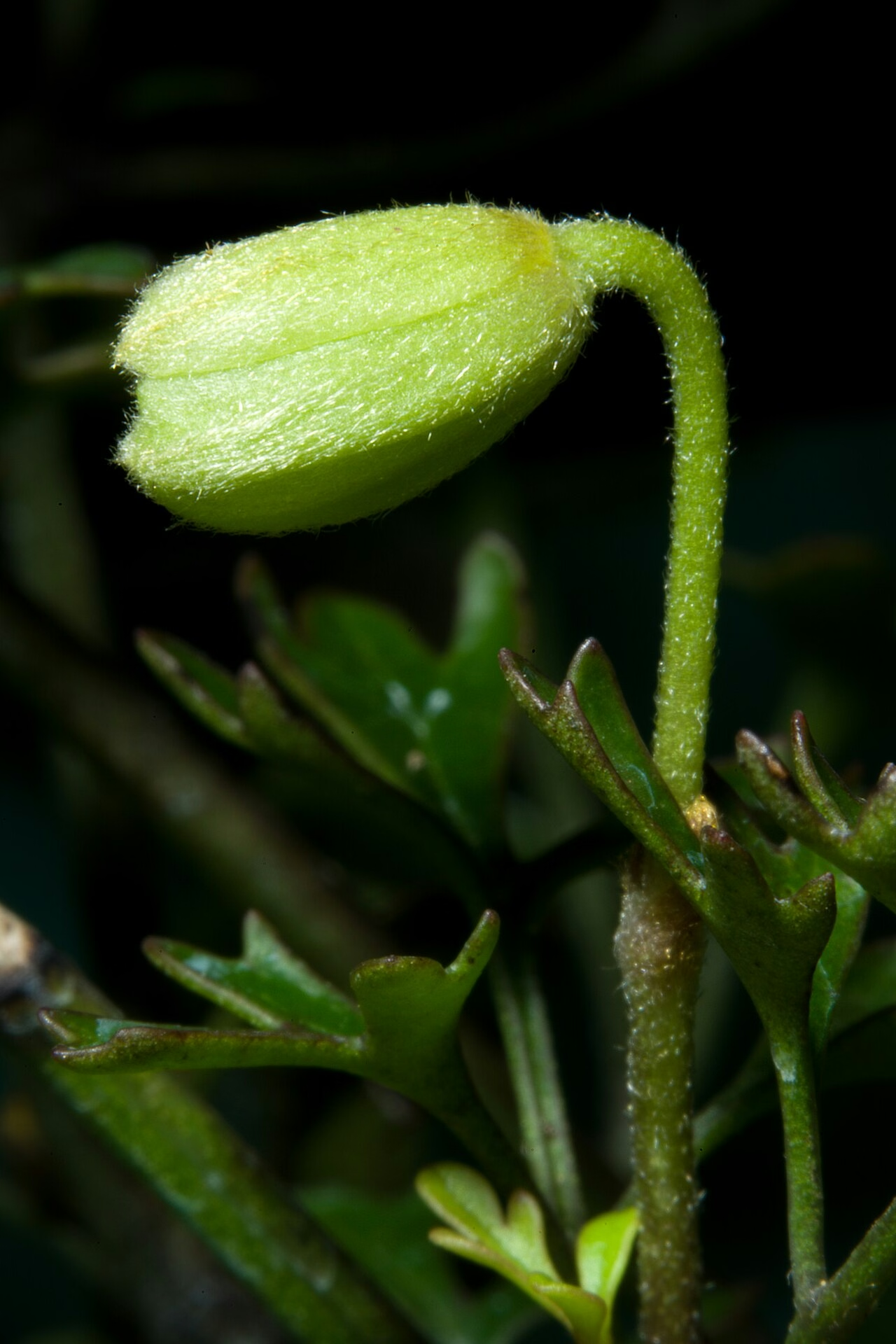
Clematis
Clematis petriei
Last updated:
Clematis petriei is an evergreen woody vine endemic to the eastern South Island, found from the Awatere River in Marlborough south to the Waimakariri and upper Rakaia rivers in Canterbury. It twines up to about 2 m through grey scrub and small trees on river terraces and alluvial fans in lowland to montane inland basins. From late spring into early summer it bears fruity-scented, uniformly yellow-green flowers up to 35 mm across, with male and female flowers on separate plants. It is closely related to Clematis forsteri but has hairless, chestnut-brown seeds. NZPCN describes it as easy to grow in free-draining soil. Explore more native climbers in our native plant guide.
Plant Description
Clematis petriei is an evergreen woody liane that climbs over shrubs and small trees. Its stems reach about 2 m long and 5 to 6 mm thick; they are ribbed and sparsely hairy when young and become hairless with age. The leaves are made of three leathery green leaflets 10 to 30 mm long, which vary from simple and broadly ovate to deeply lobed or pinnately divided.
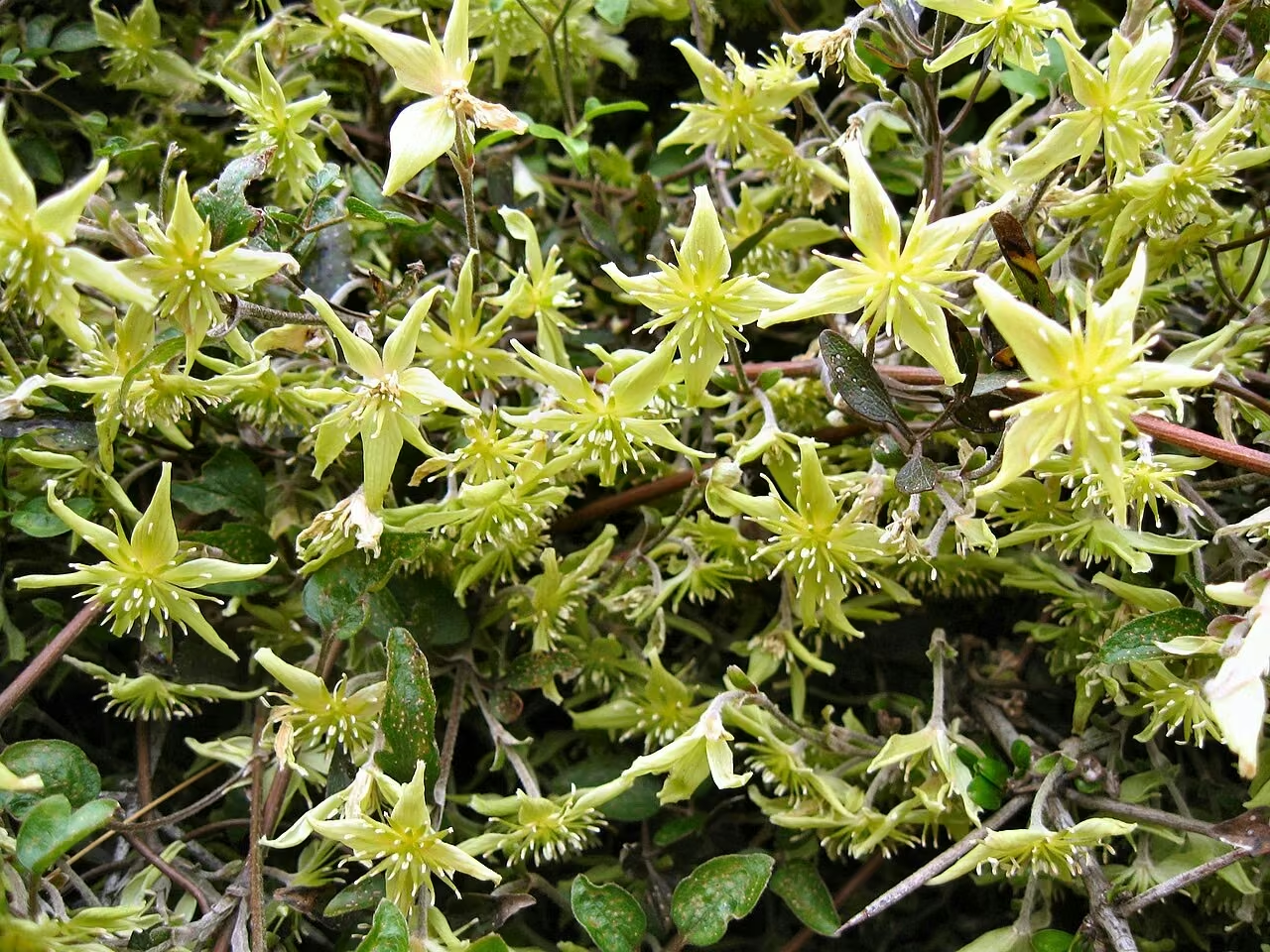
The plant is dioecious. Flowers are 12 to 35 mm across and have a distinctive fruity scent. Male flowers have six to eight yellow-green sepals and 14 to 24 stamens; female flowers have similar sepals, an outer ring of sterile staminodes, and 30 to 39 carpels. Like all clematis, the flowers have no petals.
The fruit is a cluster of hairless, chestnut-brown achenes 3.5 to 4.4 mm long, each topped by a persistent feathery style up to about 17 mm long. It is most likely to be confused with Clematis forsteri, from which it differs in its scent, its uniformly yellow-green sepals and its glabrous achenes.
Quick Facts
| Scientific Name | Clematis petriei |
|---|---|
| Height | Stems up to 2 m long |
| Spread | About 1-2 m through host shrubs |
| Water Needs | Low to moderate; dislikes waterlogging |
| Light | Full sun with a cool root run |
| Frost Tolerance | High; grows in frosty inland basins |
| Salt Tolerance | No reliable information available |
| Growth Rate | Moderate |
| Lifespan | Long-lived perennial |
Climate Best Suited to
Suits the dry, continental climate of eastern South Island inland basins, with warm summers, cold frosty winters and low humidity. It resents humid conditions.
Regional Suitability
| City | Climate Suitability |
|---|---|
| Auckland | Low |
| Wellington | Medium |
| Christchurch | High |
| Dunedin | Medium |
Plant Habitat
Clematis petriei is endemic to the eastern South Island, ranging from the Awatere River in Marlborough south to central Canterbury, where it reaches the Waimakariri and upper Rakaia rivers. It occurs from the lowlands to montane altitudes within inland, intermontane basins.
It usually grows in grey scrub and the associated sparse treeland that develops on river terraces, on colluvium, or at the bases of semi-stable alluvial fans, twining through shrubs or small trees along alluvial flats. It is widespread but often sparsely scattered, though at times locally common.
Growing Requirements
Soil Requirements
NZPCN advises a free-draining, fertile soil. In the wild it grows on alluvial terraces and fan debris that drain quickly.
- Free-draining, reasonably fertile soil
- Stony or gravelly alluvial soils suit it
- Avoid waterlogged ground
Light Requirements
It climbs toward the light through scrub, with its roots shaded below.
- Plenty of sun on the stems and flowers
- A cool, shaded root run, as for most clematis
Water Requirements
It is adapted to dry inland basins and should never sit in wet soil.
- Water young plants regularly in their first summer
- Established plants tolerate dry spells
- Good air movement helps, as it resents humidity
Planting and Establishing
Plant in spring in a sunny, airy spot with free-draining, fertile soil, next to a shrub, small tree or support it can twine through. Shade the base with rocks, mulch or low plants to keep the roots cool.
Since plants are either male or female, plant both sexes if you want seed heads. Avoid sheltered, humid corners where air is still, as it does poorly in humid conditions.
Ecological Role
Clematis petriei is part of the grey scrub community of eastern South Island river terraces, a vegetation type dominated by small-leaved shrubs. Twining through these shrubs, it adds a climbing layer to otherwise low vegetation.
Its fruity-scented flowers suggest insect pollination, although specific pollinators have not been documented in the sources consulted. The feathery-tailed achenes are carried by wind.
Uses & Significance
Garden Uses
An easy, scented native clematis for drier eastern gardens.
- Twining through native shrubs or small trees
- On an open trellis or fence in a sunny, airy site
- Dryland and grey scrub restoration plantings in Canterbury and Marlborough
Ecological Value
It is a characteristic climber of the eastern South Island grey scrub, much of which has been cleared or invaded by weeds.
- Adds structural diversity to dryland shrubland
- Scented flowers for native insects
- Useful in restoring river terrace vegetation
Landscaping Uses
Pair Clematis petriei with small-leaved native shrubs such as Corokia, Coprosma or Olearia so that its yellow-green flowers appear among their twiggy branches, much as it grows in the wild.
It can also soften a fence or pergola in a dry, sunny Canterbury garden, where its fruity scent can be enjoyed near paths and seating.
Seasonal Care Calendar
Spring
Flowering begins from about October or November, with fruity-scented yellow-green flowers.
- Plant new vines in early spring
- Enjoy the scent on warm afternoons
Summer
Flowering continues into December and January, and achenes develop from December onward.
- Water young plants in dry spells
- Collect seed from female plants as it ripens
Autumn
Seed heads finish dispersing by about March and growth slows.
- Take semi-hardwood cuttings
- Mulch to keep roots cool
Winter
Evergreen and hardy to cold, frosty winters.
- Check drainage after heavy rain
- Tidy dead stems
When to Prune and How Much
Prune lightly after flowering to remove dead stems and keep it within bounds. Light pruning at this time avoids cutting off developing flower buds for the following season.
Older, tangled plants can be thinned by removing a few of the oldest stems at the base.
How to Grow Clematis
NZPCN describes Clematis petriei as easily grown, provided it has free-draining, fertile soil, a cool root run and plenty of sun, and it does not tolerate humidity or waterlogging. No detailed propagation protocol for this species was found in the sources consulted, so the methods below follow the standard approach used for native clematis. Seed ripens on female plants from December into March. Semi-hardwood cuttings let you choose the sex of the plant you raise, which matters for this dioecious species. Use a very open propagating mix and good ventilation to avoid rot.
From Seed
The hairless chestnut-brown achenes are carried on feathery styles. Collect them as the heads fluff up and sow fresh.
- Gather ripe seed heads from female plants in mid to late summer
- Sow fresh on a free-draining seed mix and cover lightly with grit
- Keep in a bright, airy place, moist but never soggy
- Expect slow, uneven germination over several months
- Pot on seedlings into a gritty mix once large enough to handle
From Cuttings
Semi-hardwood stem cuttings taken after flowering can be rooted with bottom heat and good ventilation.
- Take 10-15 cm cuttings of firm current-season growth in late summer
- Cut just below a node and reduce leaf area
- Insert into a pumice and bark mix
- Keep lightly misted but well ventilated to prevent rot
- Harden off rooted cuttings before planting out
Pests & Diseases
No specific pests are recorded for Clematis petriei in the sources consulted. The main problems in cultivation are root and stem rots caused by humid, still air or waterlogged soils.
In the wild, clearance of grey scrub and invasion by weeds on river terraces reduce available habitat.
Cultural Significance
No Māori name or traditional use is recorded for Clematis petriei in the sources consulted.
The species honours Donald Petrie (1846-1925), a Scottish-born botanist who came to New Zealand and became a leading authority on the Otago flora. It was named by H.H. Allan.
Bonus Tip
If you are unsure whether a wild yellow-green clematis on a Canterbury river terrace is C. petriei or C. forsteri, sniff the flowers: a fruity scent points to C. petriei. Confirm later by checking for hairless chestnut-brown seeds.
Related Plants
Explore other native plants that share similar characteristics or habitats with Clematis (Clematis petriei), offering further insights into New Zealand's diverse flora. These related species provide context and opportunities for complementary planting in your garden.
Veronica chionohebe
Veronica chionohebe
Veronica thomsonii
Veronica thomsonii
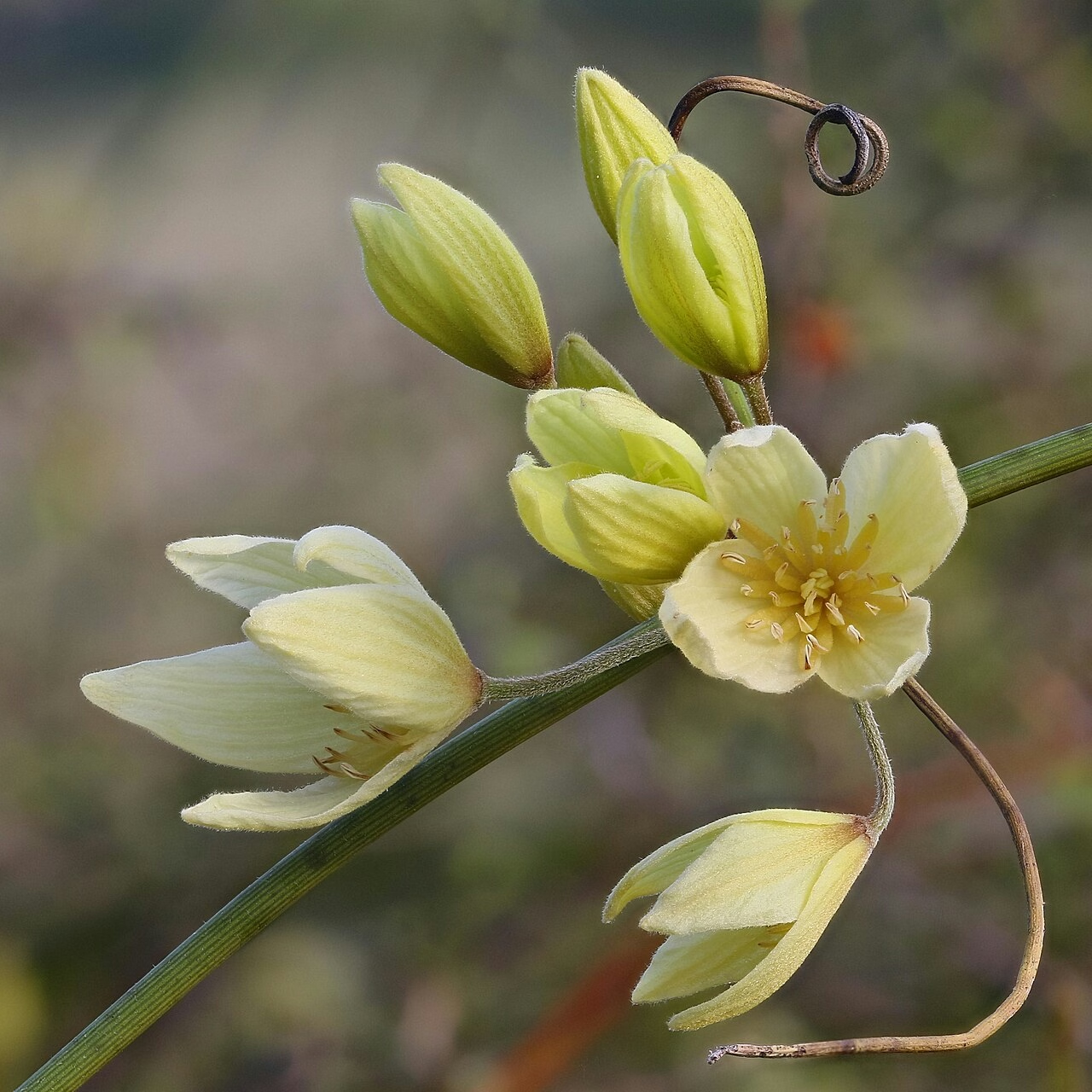
Leafless Clematis
Clematis afoliata
Clematis marata
Clematis marata
Koru
Lobelia physaloides
Colobanthus apetalus
Colobanthus apetalus
Colobanthus brevisepalus
Colobanthus brevisepalus
Cunninghamii Plant
Cunninghamii Plant
Plant Conservation
Clematis petriei is ranked Not Threatened (2023) with the qualifier Sparse, reflecting that it is widespread but usually scattered at low density, though locally common at times.
Its grey scrub habitat on river terraces and alluvial fans has been heavily reduced by farming and weeds, so protecting remnant shrubland and including it in eco-sourced dryland plantings help maintain populations.
Frequently Asked Questions
How is Clematis petriei different from Clematis forsteri?
Clematis petriei has a fruity scent, uniformly yellow-green sepals and hairless chestnut-brown achenes, whereas C. forsteri has hairy achenes. Older treatments lumped the two together under a broad C. forsteri.
Who was Clematis petriei named after?
It honours Donald Petrie (1846-1925), a Scottish-born botanist and school inspector who worked extensively on the flora of Otago and New Zealand.
Is Clematis petriei easy to grow?
NZPCN says it is easily grown but resents humidity and waterlogged soils. It does best in free-draining, fertile soil with a cool root run and plenty of sun.
Where does Clematis petriei grow naturally?
It grows in the eastern South Island from the Awatere River in Marlborough south to central Canterbury, in grey scrub and sparse treeland on river terraces, colluvium and alluvial fans in inland basins.
Sources and Further Reading
The botanical, growing, and conservation details for Clematis (Clematis petriei) on this page draw on the New Zealand plant references below. Consult them for full technical records and the latest distribution data.