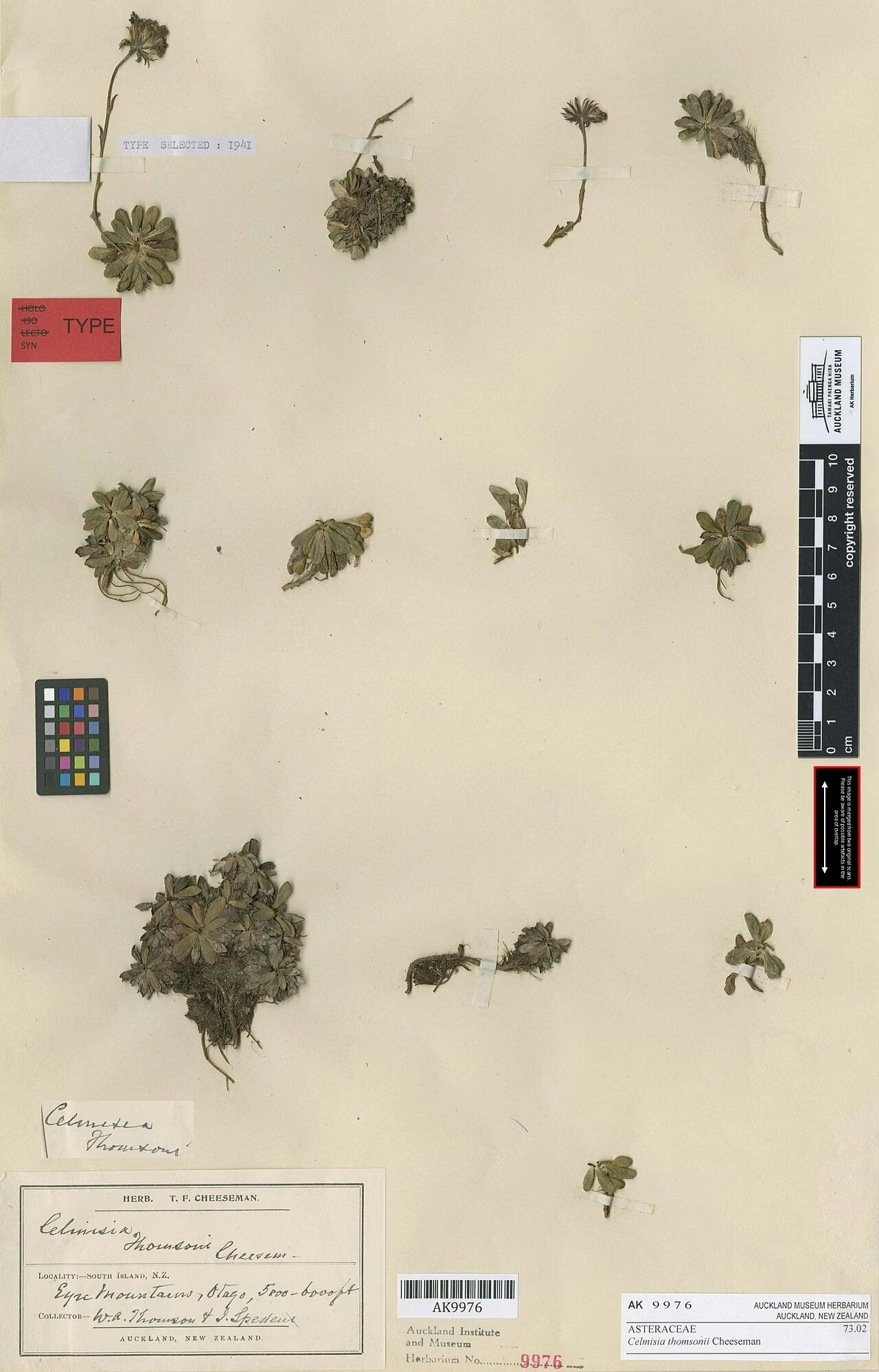
Thomson's Mountain Daisy
Celmisia thomsonii
Last updated:
Thomson's mountain daisy (Celmisia thomsonii) is a small alpine daisy found only in the Eyre Mountains, between Lake Wakatipu and northern Southland. Its hard, closely branched stems carry flat rosettes of small leathery leaves 10 to 15 mm long, and from November to January it produces daisies 15 to 20 mm across with white or pink rays. It grows in rock crevices on shaded cliff faces at the heads of valleys in the subalpine and alpine zones. It closely resembles the widespread Celmisia bellidioides but has dull rather than glossy leaves. It is ranked At Risk - Naturally Uncommon because of its tiny range. Explore more native ground covers in our native plant guide.
Plant Description
Celmisia thomsonii is a small alpine herb with rather stout, hard, closely branched stems. The living leaves form dense, flat rosettes at the tips of the branchlets. Each leaf is about 10 to 15 mm long and 3 to 5 mm wide, obovate to narrow-oblong and leathery, with a dull upper surface.
Flower heads 15 to 20 mm across carry numerous slender ray florets about 15 mm long, white or pink in colour, around the disc florets. The seeds are cylindric, 2.5 to 3 mm long and densely covered with silky hairs, and have a pappus for wind dispersal.
It is most similar to the widespread Celmisia bellidioides, a creeping daisy of wet alpine places. C. thomsonii is easily told apart by its dull rather than glossy upper leaf surface and its white to pink rather than uniformly white ray florets.
Quick Facts
| Scientific Name | Celmisia thomsonii |
|---|---|
| Height | Very low; flat rosettes on short stems |
| Spread | Small mats in rock crevices |
| Water Needs | Moist but free-draining |
| Light | Shade; grows on shaded cliffs |
| Frost Tolerance | High; subalpine to alpine |
| Salt Tolerance | No information available |
| Growth Rate | Slow |
| Lifespan | Perennial |
Climate Best Suited to
Suits the cold, snowy mountain climate of the Eyre Mountains, on cool shaded cliffs. NZPCN suggests it is probably difficult to grow in warm or humid climates.
Regional Suitability
| City | Climate Suitability |
|---|---|
| Auckland | Low |
| Wellington | Low |
| Christchurch | Low |
| Dunedin | Medium |
Plant Habitat
Thomson's mountain daisy is endemic to the Eyre Mountains of the southern South Island, a range west of Lake Wakatipu that spans northern Southland and western Otago. The type material was collected at 5,000 to 6,000 ft (about 1,500 to 1,800 m).
It is confined to the subalpine and alpine zones, where it grows in rock crevices on shaded cliff faces in the heads of valleys.
Growing Requirements
Soil Requirements
It roots into small crevices with little soil in shaded cliffs.
- Very gritty, free-draining mix
- Low fertility
- Cool, moist root run in a crevice
Light Requirements
Its natural cliffs are shaded, so it avoids strong direct sun.
- Shade or a south-facing crevice
- Bright but indirect light
Water Requirements
Shaded cliffs stay cool and moist, though water drains quickly from crevices.
- Keep evenly moist
- Avoid humid, still air
Planting and Establishing
This species is not in general cultivation, and its propagation is untested. Any attempt should use seed from a legitimate source and be grown by an experienced alpine grower.
A shaded crevice garden, tufa block or alpine pot facing away from the sun in a cool southern district is the most realistic setting. Do not collect plants from the Eyre Mountains.
Ecological Role
Its pappate cypselae are dispersed by wind, which suits a plant colonising scattered crevices on cliffs.
No information on pollinators or animal associations was found in the sources consulted.
Uses & Significance
Garden Uses
It is of interest mainly to botanists and specialist alpine growers.
- Shaded crevice gardens
- Alpine house collections
- Conservation collections of Eyre Mountains flora
Ecological Value
It is one of the narrow-range endemics of the Eyre Mountains, a range with a distinctive alpine flora.
- Endemic to a single mountain range
- Specialist of shaded cliff crevices
- Wind-dispersed seed
Landscaping Uses
In a specialist garden the flat rosettes would sit well tucked into a vertical crevice between slabs of rock, where the white or pink daisies can be seen at eye level.
Keep it away from vigorous neighbours, as it is small and slow and easily overgrown.
Seasonal Care Calendar
Spring
Rosettes resume growth as snow melts from the cliffs.
- Check drainage
- Remove dead leaves
Summer
Flowering runs from November to January, with white or pink daisies.
- Keep cool and shaded
- Water in dry spells
Autumn
Fruiting continues from December to March.
- Collect fresh seed from cultivated plants
- Sow outdoors to receive winter cold
Winter
Plants are dormant through the cold mountain winter.
- Protect pots from excess wet
- No feeding
When to Prune and How Much
No pruning is required. Remove spent flower stalks and dead leaves to keep rosettes clean.
Avoid disturbing the hard, woody stems.
How to Grow Thomson's Mountain Daisy
NZPCN states that the propagation of Celmisia thomsonii is not known, though it is likely to be easy from fresh seed that has been cold-treated and probably difficult to maintain in warm or humid climates. The methods below build on that suggestion and general practice for small mat-forming Celmisia, and should be treated as untested. Because it is an Eyre Mountains endemic known from only a few localities, no wild material should be taken without permission from the Department of Conservation, and any propagation is best carried out as part of a conservation collection.
From Seed
Seed ripens from December to March. NZPCN suggests that fresh seed given a cold treatment should germinate readily.
- Collect fresh seed from cultivated plants as the silky pappus opens
- Sow on a gritty, low-fertility mix and cover lightly with fine grit
- Give a period of cold, either by leaving the tray outdoors over winter or by chilling it in a refrigerator for several weeks
- Move to a cool, shaded spot to germinate
- Pot on seedlings carefully into individual pots
From Cuttings
Small rosettes on the tips of branchlets might be rooted as cuttings, as is done with some other mat-forming Celmisia, but this has not been reported for this species.
- Take a single rosette with a short piece of stem in late spring
- Insert in pumice or coarse sand
- Keep cool, shaded and lightly moist
- Pot into gritty mix once rooted
Pests & Diseases
No specific pests are recorded for Celmisia thomsonii. In cultivation, slugs and rot in warm, humid conditions are the likely problems.
On its shaded cliffs it is largely out of reach of browsing animals.
Cultural Significance
No traditional Māori name or use is recorded for Celmisia thomsonii in the sources consulted.
The species is named after W.A. Thomson, who collected the type specimen in the Eyre Mountains.
Bonus Tip
When searching for this daisy in the Eyre Mountains, look at the shaded faces of cliffs at valley heads in early summer. The pink-tinged flowers and dull, rather than shiny, leaves help separate it from Celmisia bellidioides, which also grows in the southern mountains.
Related Plants
Explore other native plants that share similar characteristics or habitats with Thomson's Mountain Daisy (Celmisia thomsonii), offering further insights into New Zealand's diverse flora. These related species provide context and opportunities for complementary planting in your garden.
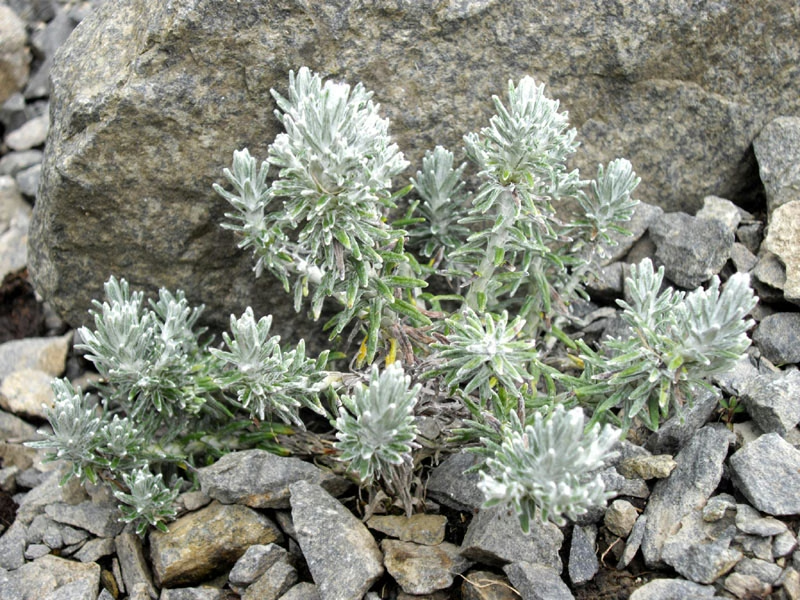
Celmisia ramulosa var. tuberculata
Celmisia ramulosa var. tuberculata
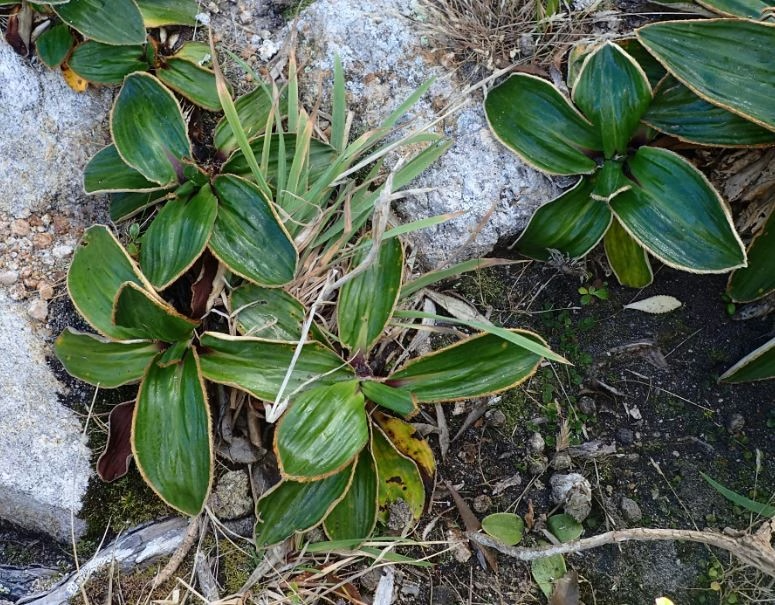
Celmisia rigida
Celmisia rigida
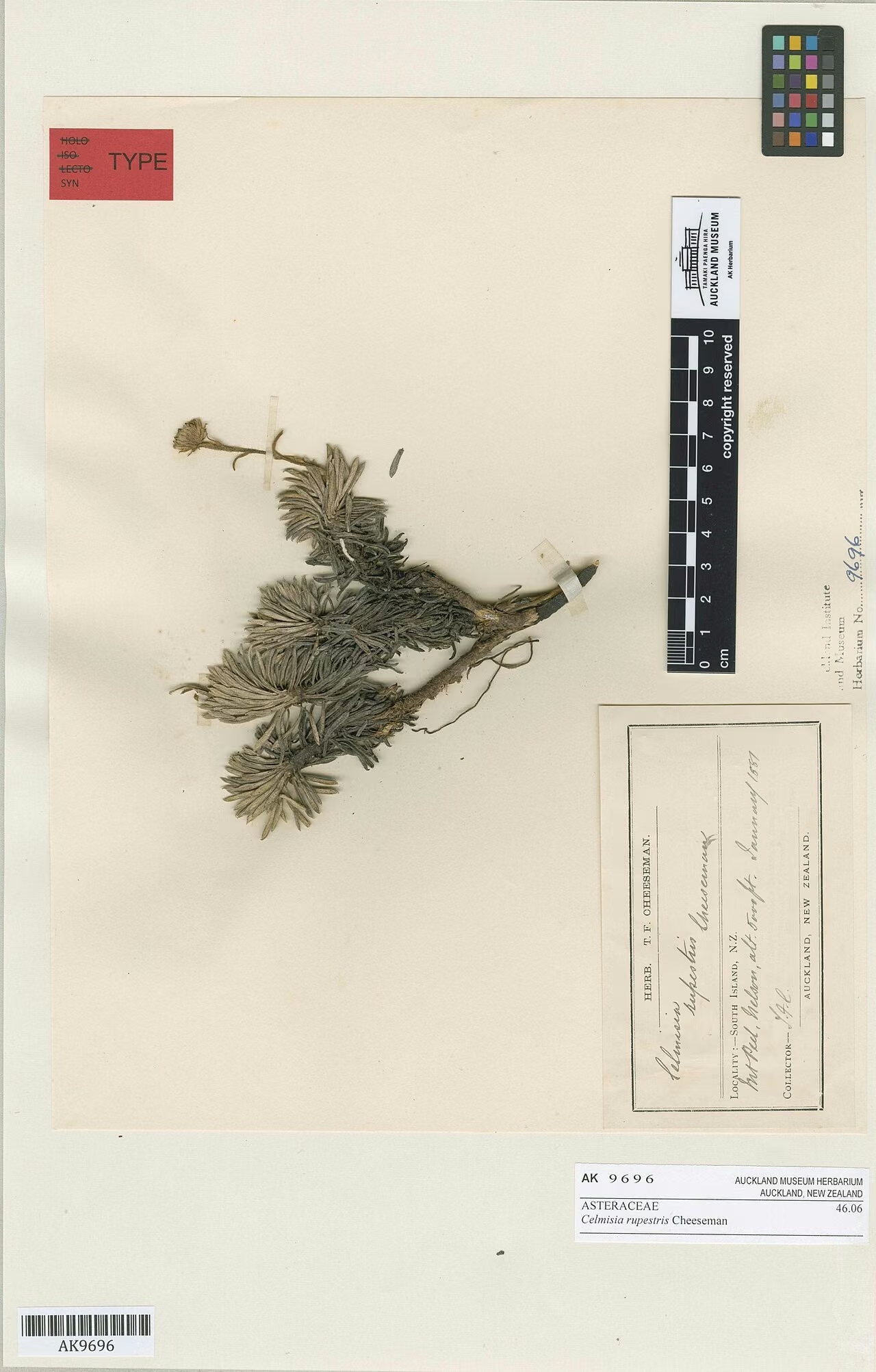
Celmisia rupestris
Celmisia rupestris
Celmisia rutlandii
Celmisia rutlandii
Celmisia traversii
Celmisia traversii
Large Burr Grass
Cenchrus caliculatus
New Zealand Sneezewort
Centipeda aotearoana
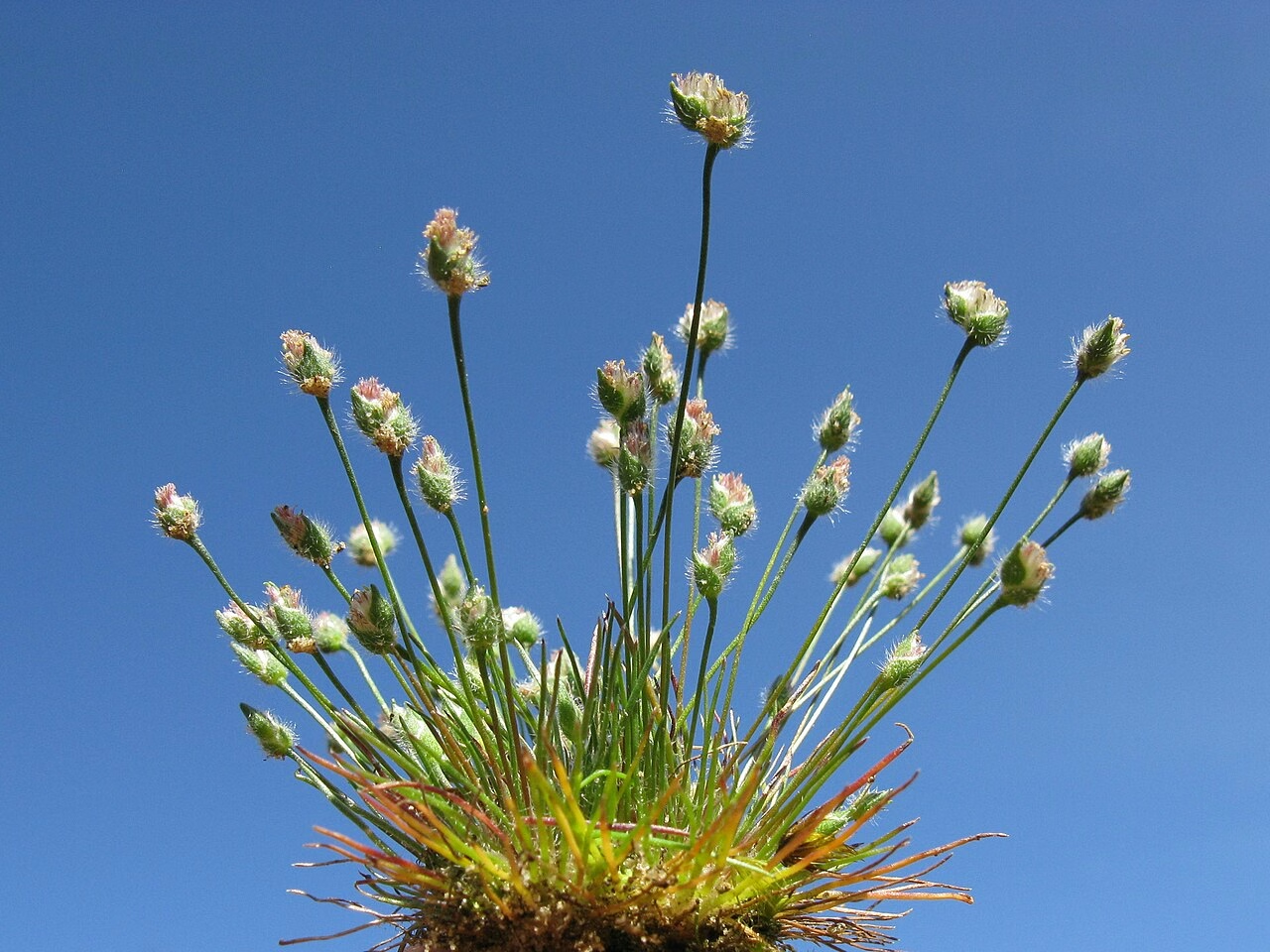
Centrolepis strigosa
Centrolepis strigosa
Plant Conservation
Celmisia thomsonii is ranked At Risk - Naturally Uncommon (2023) with the qualifiers Sparse and Range Restricted, and the 2025 Otago regional assessment lists it as Regionally Naturally Uncommon.
NZPCN describes it as an extremely localised, narrow-range endemic that is common within its few known localities and faces no obvious human-induced threats. Its shaded cliff habitat is naturally sheltered from most disturbance.
Frequently Asked Questions
Where does Thomson's mountain daisy grow?
It is endemic to the Eyre Mountains in the southern South Island, growing in rock crevices on shaded subalpine and alpine cliff faces at valley heads, at roughly 1,500 to 1,800 m.
How is Celmisia thomsonii different from Celmisia bellidioides?
NZPCN says it is easily distinguished by its dull rather than glossy upper leaf surfaces and its white to pink ray florets, whereas C. bellidioides has uniformly white rays.
Who is Celmisia thomsonii named after?
The Flora of New Zealand states it is named after W.A. Thomson, who collected the type specimen in the Eyre Mountains.
Sources and Further Reading
The botanical, growing, and conservation details for Thomson's Mountain Daisy (Celmisia thomsonii) on this page draw on the New Zealand plant references below. Consult them for full technical records and the latest distribution data.