Mountain Daisy
Celmisia rutlandii
Last updated:
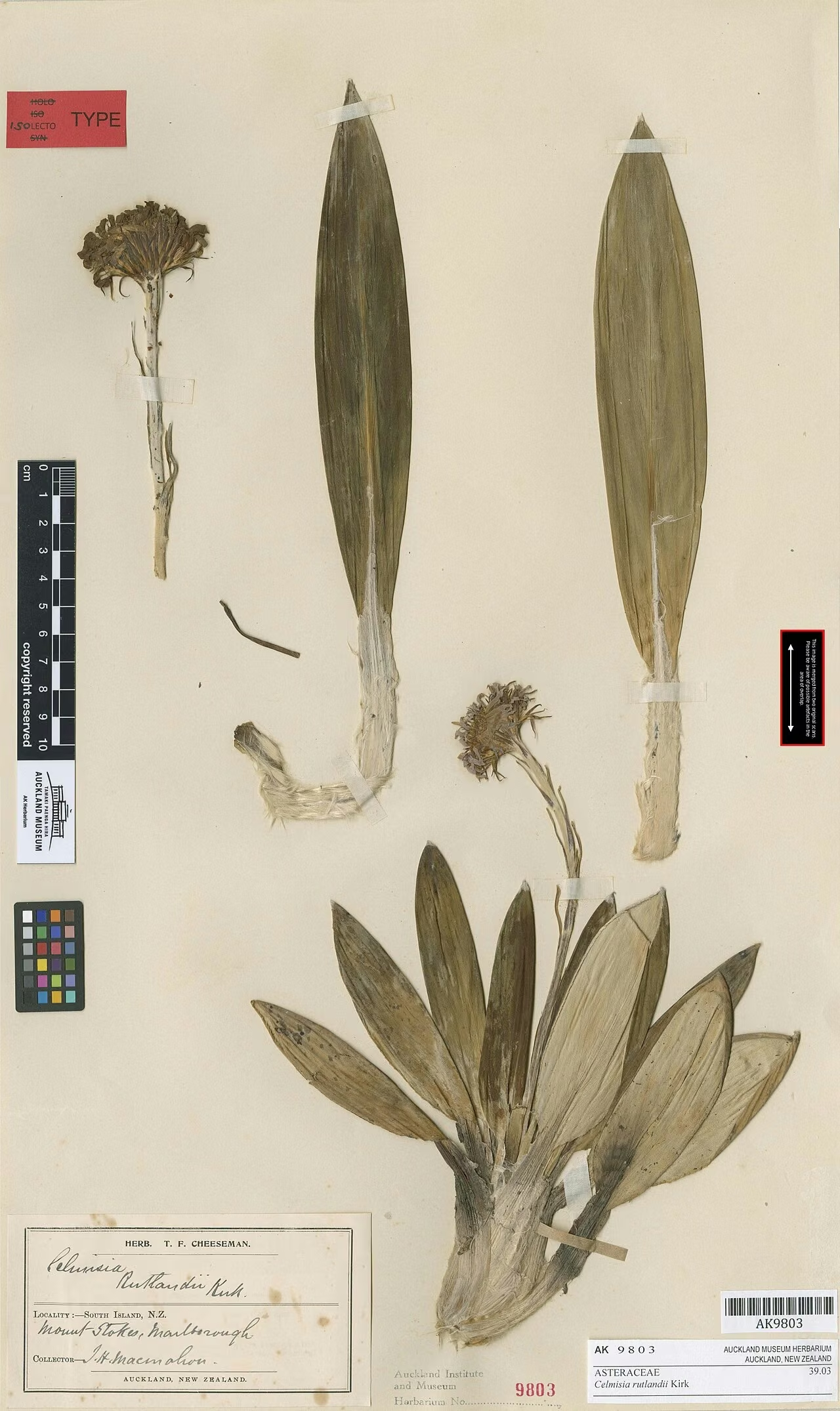
Celmisia rutlandii is a mountain daisy of the northern South Island, found on Mt Stokes above the Marlborough Sounds and in the Richmond Range and Wairau mountains. It forms clumps of one to eight rosettes of stiff, leathery, lance-shaped leaves 5 to 13 cm long, yellowish-green above and silvery-felted beneath, with purple sheaths around the base. White daisies with yellow centres are carried on stalks up to 25 cm from November to February. It grows in alpine fellfield and rock crevices within tussock grassland and is ranked At Risk - Naturally Uncommon. NZPCN notes it is one of the few Celmisia that does well in most climates. Explore more native flowering plants in our native plant guide.
Plant Description
Celmisia rutlandii is a woody-based herb with branchlets arising from a sparingly branched stock, forming clumps of one to eight rosettes. The rigid, leathery leaves are lanceolate-ovate, 50 to 130 mm long and 15 to 35 mm wide, yellowish-green above and covered with silvery tomentum beneath. Purple sheaths densely clothe the short pseudo-stem.
The flower heads have about 40 white ray florets and about 60 yellow disc florets and are carried on scapes up to 250 mm tall. The seeds are fusiform-cylindric and 3 to 5 mm long.
It resembles members of the Celmisia coriacea complex but is distinguished by its purple sheaths and stiff, cordate-based leaves that lack a pellicle, the thin silvery skin found on the upper leaf surface of some relatives. It differs from Celmisia morganii by its shorter leaves with rigid rather than flaccid blades.
Quick Facts
| Scientific Name | Celmisia rutlandii |
|---|---|
| Height | Low rosettes; flower stalks to 0.25 m |
| Spread | Clumps of 1 to 8 rosettes |
| Water Needs | Moist, free-draining |
| Light | Sun with afternoon shade |
| Frost Tolerance | High; an alpine species |
| Salt Tolerance | No information available |
| Growth Rate | Moderate for a Celmisia |
| Lifespan | Perennial |
Climate Best Suited to
Native to the cool alpine tops of Marlborough and Nelson, but NZPCN notes that it is one of the few Celmisia that does well in most climates, given moisture and afternoon shade.
Regional Suitability
| City | Climate Suitability |
|---|---|
| Auckland | Low |
| Wellington | Medium |
| Christchurch | Medium |
| Dunedin | High |
Plant Habitat
Celmisia rutlandii is endemic to the northern South Island. It is found on Mt Stokes, the highest point of the Marlborough Sounds, and in the Richmond Range and Wairau mountains, including Mt Patriarch, Mt Richmond, Mt Fishtail, Royal Knob, Mt Sunday and Mt Riley.
It grows in alpine fellfield and in crevices of rock outcrops within tussock grassland.
Growing Requirements
Soil Requirements
In the wild it roots into rock crevices and stony fellfield soils; in gardens it wants a moist, free-draining mix.
- Gritty, humus-rich soil
- Good drainage beneath the crown
- Low to moderate fertility
Light Requirements
NZPCN recommends afternoon shade, which protects the rosettes from overheating in summer.
- Morning sun with afternoon shade
- East-facing rockeries suit it well
Water Requirements
Keep it consistently moist; its alpine habitat is regularly wetted by rain and cloud.
- Water regularly in dry weather
- Avoid waterlogged soil
Planting and Establishing
This is one of the more garden-tolerant mountain daisies. Plant it in a rockery, raised bed or large pot with moist, free-draining soil, where it gets morning sun and afternoon shade.
Set the crown slightly proud of the surrounding soil and mulch with grit to keep moisture away from the base of the rosettes.
Ecological Role
It is part of the alpine fellfield and tussock grassland flora of the Marlborough and eastern Nelson mountains. Its pappate seeds are dispersed by wind.
Its pollinators are not documented in the sources consulted.
Uses & Significance
Garden Uses
It is a rewarding choice for gardeners wanting to try a mountain daisy outside the deep south.
- Rockeries and raised alpine beds
- Containers in a shaded courtyard
- Silver foliage contrast in native plantings
Ecological Value
It is a narrow-range endemic of the northern South Island mountains.
- Found only on Mt Stokes and the Richmond and Wairau ranges
- Contributes to alpine fellfield communities
- Wind-dispersed seed
Landscaping Uses
The stiff rosettes, with silvery undersides and purple bases, give year-round structure in a rock garden. White daisies held above the leaves add a summer highlight.
Group several plants among rocks or with small tussocks to echo its natural setting in alpine tussock grassland.
Seasonal Care Calendar
Spring
New leaves grow from the centre of each rosette.
- Remove dead outer leaves
- Watch for slugs
Summer
Flowering runs from November to February.
- Water in dry spells
- Ensure afternoon shade
Autumn
Seed ripens between December and April.
- Collect and sow fresh seed
- Cut spent stalks
Winter
Rosettes remain evergreen through winter.
- Check drainage after heavy rain
- Clear leaf litter from rosettes
When to Prune and How Much
No pruning is needed beyond removing old dead leaves and spent flower stalks.
Clearing dead leaves from the base improves air flow and reduces rot.
How to Grow Mountain Daisy
NZPCN states that Celmisia rutlandii is easily grown from fresh seed and is notably one of the few Celmisia that thrives in most climates, preferring moist, free-draining soil with afternoon shade. Seed is therefore the recommended method. Clumps with several rosettes may also be divided, although this is general Celmisia practice rather than a documented method for this species. Source seed from cultivated plants or authorised collections, since the species is naturally uncommon and confined to a few peaks.
From Seed
Seed ripens from December to April. Like other Celmisia, it should be sown fresh for good germination, ideally within days of collection. Raising a batch of seedlings is also the best way to build up a group of plants for a rockery.
- Collect seed heads when the pappus is dry
- Sow on the surface of a moist, free-draining seed mix
- Cover lightly with fine grit
- Keep the tray cool, shaded and evenly moist
- Pot on seedlings when they have a few leaves and grow in light shade
By Division
Established clumps with several rosettes can sometimes be split into rooted pieces. Each rosette sits on its own short branch of the woody stock, so cut cleanly between them rather than pulling the clump apart, and make sure every division keeps some roots.
- Lift the clump in early spring
- Separate rosettes with a portion of the woody stock and roots
- Replant or pot into gritty, humus-rich mix
- Keep shaded and moist until growth resumes
Pests & Diseases
No specific pests are recorded. Slugs and snails may damage young leaves and flower buds in gardens.
Crown rot can occur in poorly drained soil.
Cultural Significance
No traditional Māori name or use is recorded for Celmisia rutlandii in the sources consulted.
The species name commemorates someone named Rutland, but the sources consulted do not say who they were.
Bonus Tip
If you have struggled to keep other mountain daisies alive in a northern or lowland garden, try this one first. NZPCN singles it out as one of the few Celmisia that thrives in most climates, provided it has afternoon shade.
Related Plants
Explore other native plants that share similar characteristics or habitats with Mountain Daisy (Celmisia rutlandii), offering further insights into New Zealand's diverse flora. These related species provide context and opportunities for complementary planting in your garden.
Celmisia ramulosa var. ramulosa
Celmisia ramulosa var. ramulosa
Celmisia ramulosa var. tuberculata
Celmisia ramulosa var. tuberculata
Celmisia rigida
Celmisia rigida
Celmisia rupestris
Celmisia rupestris
Thomson's Mountain Daisy
Celmisia thomsonii
Celmisia traversii
Celmisia traversii
Large Burr Grass
Cenchrus caliculatus
New Zealand Sneezewort
Centipeda aotearoana
Plant Conservation
Celmisia rutlandii is ranked At Risk - Naturally Uncommon (2023) with qualifiers Sparse, Data Poor Size and Data Poor Trend. NZPCN describes it as a naturally uncommon species that does not appear to be actively threatened.
Part of its range lies in the Mount Stokes Scenic Reserve and Mt Richmond Forest Park. Monitoring would improve knowledge of its population size and trend.
Frequently Asked Questions
Where does Celmisia rutlandii grow naturally?
It is endemic to the northern South Island: Mt Stokes in the Marlborough Sounds, and the Richmond Range and Wairau mountains, including Mt Patriarch, Mt Richmond, Mt Fishtail, Royal Knob, Mt Sunday and Mt Riley.
Is Celmisia rutlandii easy to grow?
NZPCN says it is easily grown from fresh seed and is one of the few Celmisia that thrives in most climates, preferring moist, free-draining soil with afternoon shade.
How do you identify Celmisia rutlandii?
Look for purple sheaths densely clothing the short pseudo-stem and stiff, heart-based leaves without a pellicle, which separate it from the C. coriacea group. Its leaves are shorter and more rigid than those of C. morganii.
Is Celmisia rutlandii threatened?
It is ranked At Risk - Naturally Uncommon because it is sparse and confined to a few mountains, but NZPCN notes it does not appear to be actively threatened.
Sources and Further Reading
The botanical, growing, and conservation details for Mountain Daisy (Celmisia rutlandii) on this page draw on the New Zealand plant references below. Consult them for full technical records and the latest distribution data.