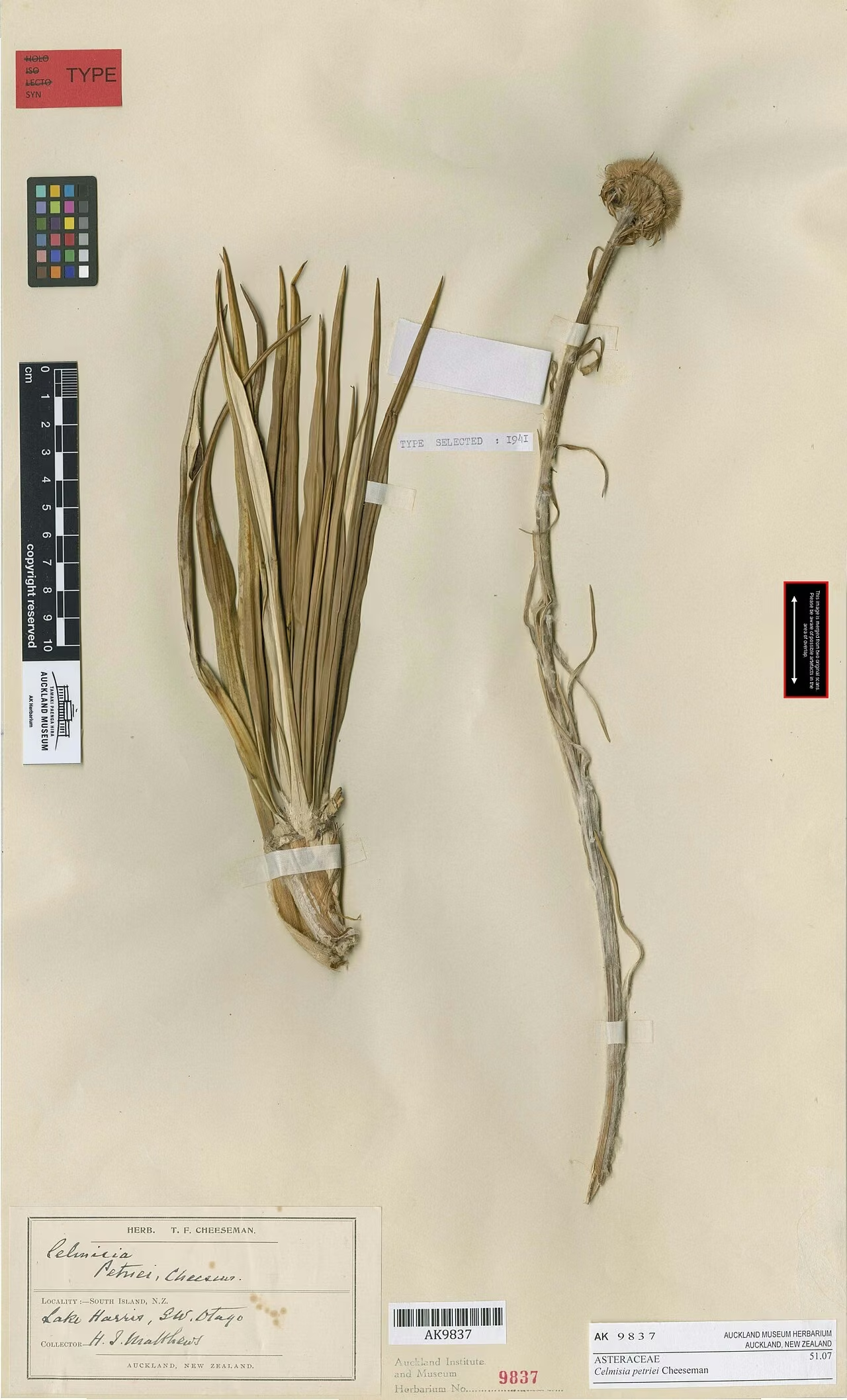
Petrie's Mountain Daisy
Celmisia petriei
Last updated:
Petrie's mountain daisy (Celmisia petriei) is a robust tufted herb endemic to the South Island, ranging from southern Marlborough and North Westland southward and becoming more plentiful in Otago and Southland. Its rigid, leathery leaves are 15 to 50 cm long and only 1 to 3 cm wide, hairless above with paired raised ribs, and covered in close white silky down beneath. From November to February woolly stems 20 to 50 cm tall carry white daisies 30 to 40 mm across. It grows in montane to subalpine grassland and herbfield, damp seepages in rock outcrops, boulder falls and talus. It is ranked Not Threatened. Explore more native flowering plants in our native plant guide.
Plant Description
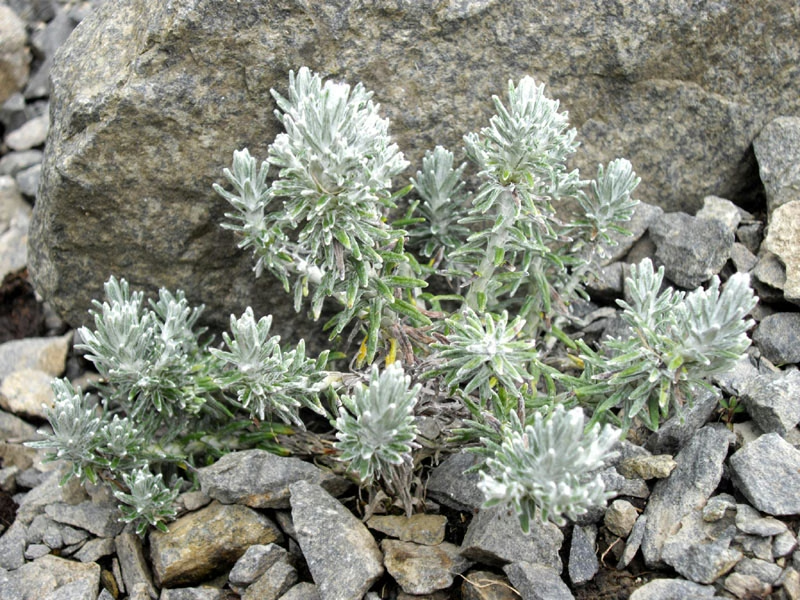
Celmisia petriei is a stout, tufted herb with strict, rigid and leathery leaves whose sheaths overlap densely around the stems. The leaf blade is linear-lanceolate, 150 to 500 mm long and 10 to 30 mm wide. The upper surface is hairless, with a pair of prominent ribs beside an obscure midrib, while the underside is completely covered in close-pressed white silky down with the midrib and lateral veins visible.
The flowering stem is about 200 to 500 mm tall and densely clothed in woolly hairs. Each flower head is 30 to 40 mm across with pale brown bracts, white ray florets about 17 to 20 mm long and tubular disc florets 6 to 7 mm long. Flowering is from November to February and fruiting from December to April.
It can be confused with Celmisia lyallii, which has a single prominent midrib rather than paired parallel veins beside an obscure midrib. It differs from Celmisia armstrongii in lacking the broad coloured band either side of the midrib on the upper leaf surface.
Quick Facts
| Scientific Name | Celmisia petriei |
|---|---|
| Height | Flowering stems 0.2-0.5 m; leaves 0.15-0.5 m long |
| Spread | Forms clumps of tufts; spread not documented |
| Water Needs | Permanently moist but free draining |
| Light | Shade in lowland gardens; open sites in the wild |
| Frost Tolerance | High; a montane to subalpine species |
| Salt Tolerance | Not documented; an inland mountain species |
| Growth Rate | Slow |
| Lifespan | Long-lived perennial |
Climate Best Suited to
Suits the cold, snowy winters and cool, moist summers of the southern South Island mountains. Hot, humid lowland summers are its main difficulty in gardens.
Regional Suitability
| City | Climate Suitability |
|---|---|
| Auckland | Low |
| Wellington | Low |
| Christchurch | Medium |
| Dunedin | Medium |
Plant Habitat
Celmisia petriei is endemic to the South Island. It ranges from southern Marlborough and North Westland southward and becomes increasingly abundant in the southern South Island.
It is a plant of the montane to subalpine zones, growing in grassland and herbfield, in damp seepages within rock outcrops, and among damp boulder falls and talus.
Growing Requirements
Soil Requirements
NZPCN recommends a permanently moist, free-draining, acidic soil, similar to the damp rocky ground it favours in the wild.
- Acidic, gritty, humus-rich soil
- Moisture available all year
- Sharp drainage around the crown
Light Requirements
It is easily grown in a shaded site in cultivation, which keeps the roots cool and reduces summer stress.
- Light shade or a south-facing aspect
- Protection from hot afternoon sun
Water Requirements
It dislikes humidity and will not tolerate drying out, reflecting its natural seepage and talus sites.
- Water regularly in dry weather
- Keep air moving around the foliage
Planting and Establishing
Plant in autumn or spring in a cool, lightly shaded rock garden, raised bed or large container with acidic, gritty soil. Position it where water seeps or can be supplied easily in summer, and mulch with stone.
It is not commercially available, so plants usually come from seed shared among alpine growers. Wild plants should not be dug up.
Ecological Role
Petrie's mountain daisy is a conspicuous member of southern herbfield and seepage communities. Its large white heads attract alpine insects, though its specific pollinators are not recorded in the sources consulted, and its achenes are spread by wind.
On damp boulder falls and talus it helps bind loose rock and builds organic matter around its tufts.
Uses & Significance
Garden Uses
A striking architectural plant for cool, southern alpine gardens.
- Specimen in a shaded rock garden
- Large trough or container
- Collections of large mountain daisies
Ecological Value
It is a characteristic large daisy of southern South Island montane and subalpine vegetation.
- Endemic to the South Island
- Common in the southern mountains
- Contributes to seepage and talus plant communities
Landscaping Uses
The stiff, upright, sword-like leaves give a bold, spiky outline that contrasts with rounded cushions and fine tussocks.
Plant it among large rocks with smaller alpine plants at its feet, where its silky white leaf undersides and woolly flower stems can be appreciated.
Seasonal Care Calendar
Spring
New leaves grow from the centre of each tuft.
- Top up grit mulch
- Check for slug damage
Summer
White daisies on woolly stems appear from November to February.
- Keep evenly moist
- Shade in hot weather
Autumn
Seed ripens through to April.
- Collect and sow seed fresh
- Remove spent scapes
Winter
Plants remain evergreen and are fully hardy to frost and snow.
- Keep drainage clear
- Remove dead leaves from the base
When to Prune and How Much
No pruning is needed. Cut spent flower stems at the base after seed has been released or collected.
Remove dead outer leaves carefully, as the rigid leaf bases can trap moisture against the stem.
How to Grow Petrie's Mountain Daisy
NZPCN advises propagating Celmisia petriei from fresh seed, sown immediately or stratified in a fridge for 1 to 3 months. Seed ripens between December and April. Large mountain daisies often produce many empty achenes, so sow generously and expect patchy germination. Established clumps with several tufts can also be divided, a standard approach for tufted Celmisia, although division is not specifically mentioned for this species in the sources consulted. Young plants need an acidic, gritty mix and a cool, shaded and well-ventilated position, and they should never be allowed to dry out. Growth is slow, and seedlings may take several years to reach flowering size. Use deep pots, because the stout stock and long roots resent disturbance. Plant out only when the young plant has a strong tuft of rigid leaves, ideally in autumn so it can establish over the cool months.
From Seed
Collect heads as the pappus fluffs open, separating the plump achenes from chaff if possible.
- Collect seed from December to April
- Sow fresh on the surface of a moist, acidic, gritty mix
- Or stratify in the fridge for 1 to 3 months before sowing
- Keep cool, shaded and moist
- Pot on seedlings individually into deep pots
By Division
Split multi-tufted clumps in cool weather in early autumn or spring.
- Lift the clump with plenty of soil
- Separate tufts that have their own roots
- Pot up and keep shaded and moist until established
Pests & Diseases
No pests specific to this species are recorded. Slugs and snails may damage seedlings and young leaves.
In warm, humid gardens, crown rot is the main cause of loss.
Cultural Significance
No traditional Māori name or use specific to Celmisia petriei is recorded in the sources consulted.
Thomas Cheeseman named the species after Donald Petrie (1846 to 1925), a Scottish-born botanist based in Otago who made important contributions to knowledge of the southern South Island flora.
Bonus Tip
To check whether a large narrow-leaved mountain daisy is Celmisia petriei, look at the upper leaf surface: two stout parallel ribs with a faint midrib between them point to C. petriei, a single strong midrib suggests C. lyallii, and a yellow band along the midrib suggests C. armstrongii.
Related Plants
Explore other native plants that share similar characteristics or habitats with Petrie's Mountain Daisy (Celmisia petriei), offering further insights into New Zealand's diverse flora. These related species provide context and opportunities for complementary planting in your garden.
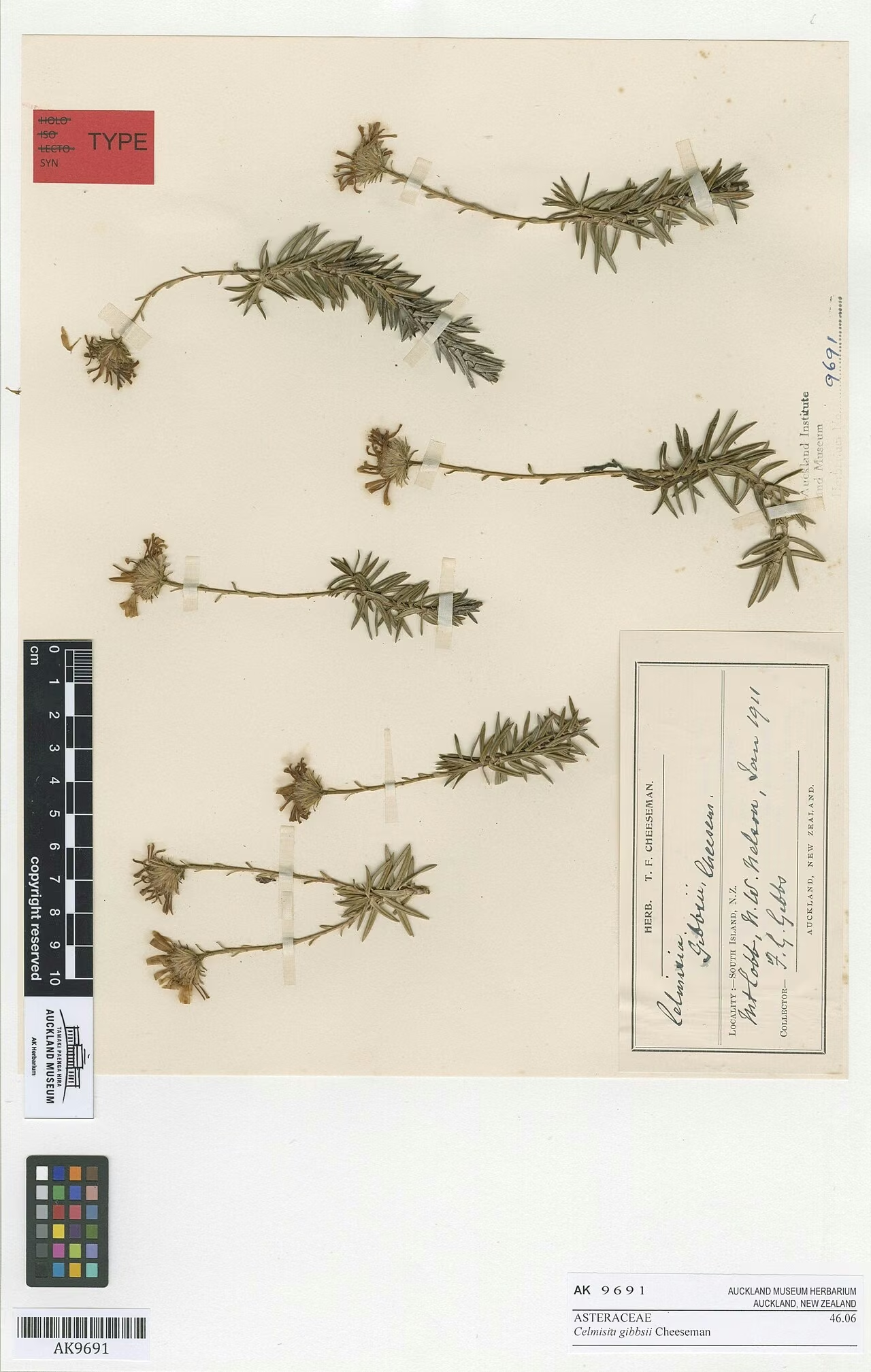
Gibbs's Mountain Daisy
Celmisia gibbsii
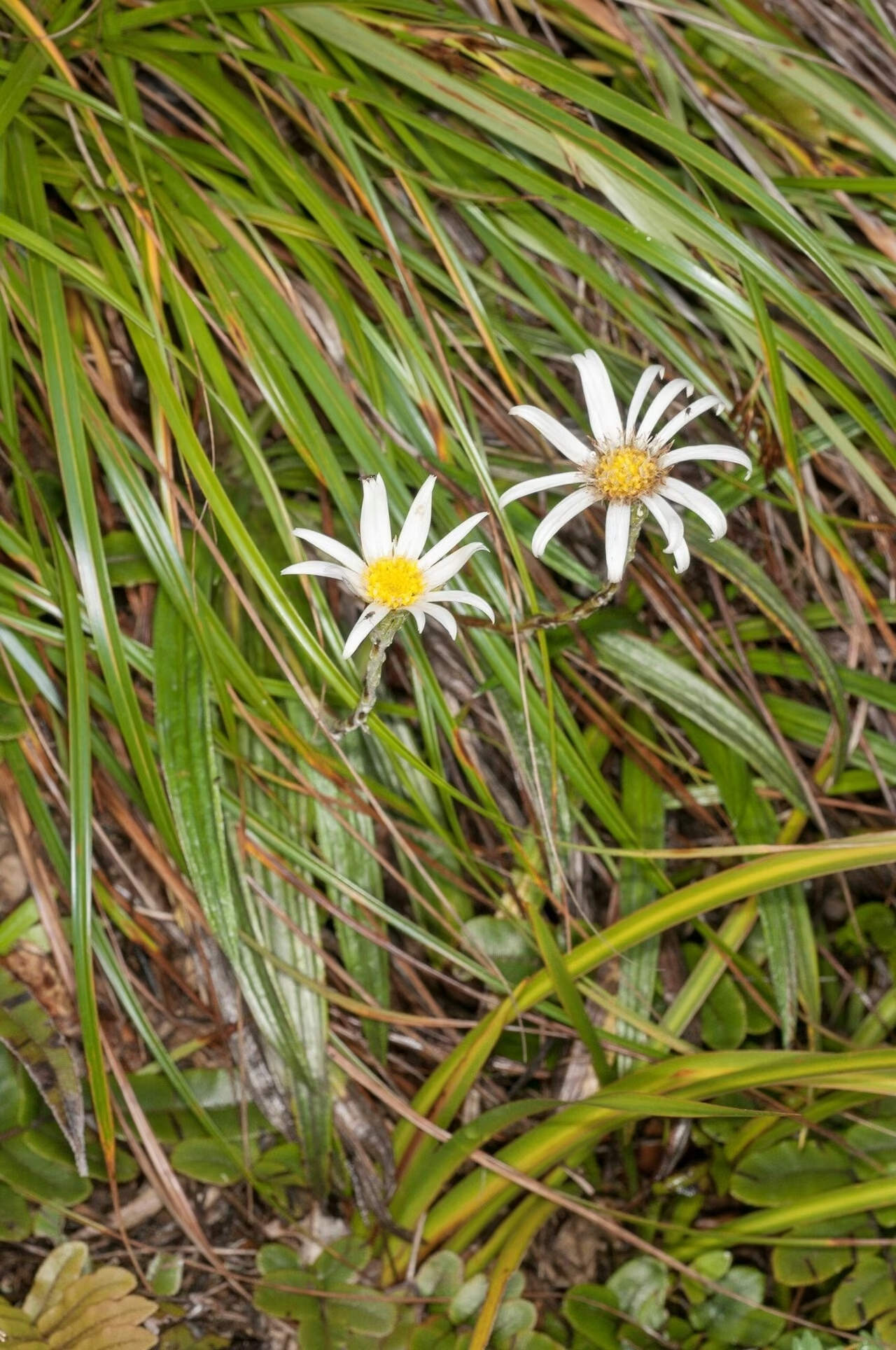
Celmisia graminifolia
Celmisia graminifolia
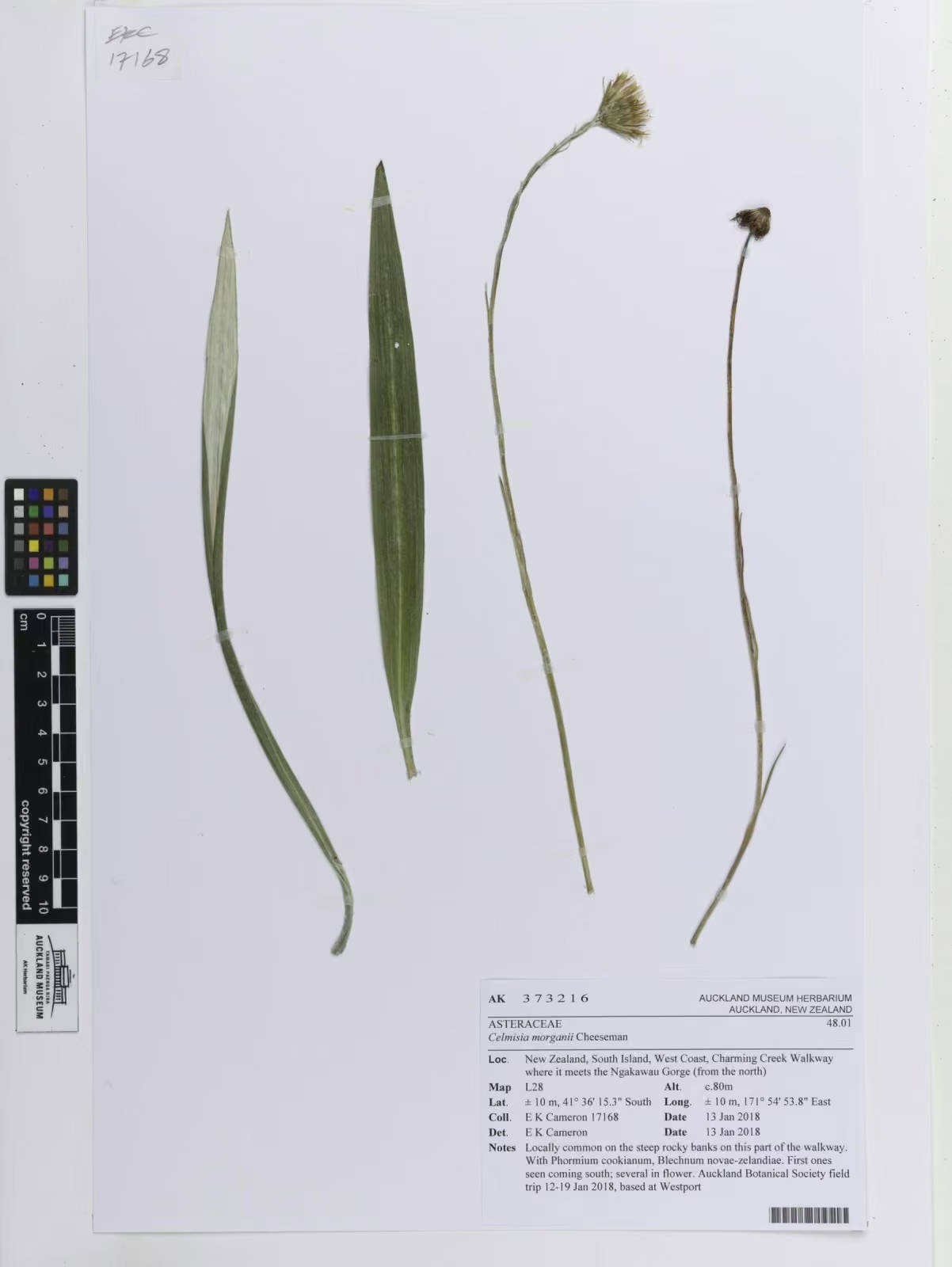
Ngakawau Gorge Daisy
Celmisia morganii
Celmisia parva
Celmisia parva
Tin Range Mountain Daisy
Celmisia polyvena
Celmisia prorepens
Celmisia prorepens
Celmisia ramulosa var. ramulosa
Celmisia ramulosa var. ramulosa
Celmisia ramulosa var. tuberculata
Celmisia ramulosa var. tuberculata
Plant Conservation
Celmisia petriei is ranked Not Threatened (2023), and the Otago regional assessment (2025) also lists it as Regionally Not Threatened.
It is widespread and common in the southern mountains. Protecting montane seepages, herbfields and tussock grasslands from weeds and damage keeps its habitat secure.
Frequently Asked Questions
How do you identify Petrie's mountain daisy?
Look for rigid, narrow leaves up to 50 cm long with two stout parallel ribs either side of an obscure midrib on the upper surface, and a silky white underside.
What is the difference between Celmisia petriei and Celmisia lyallii?
Celmisia lyallii leaves have a single prominent midrib, whereas C. petriei leaves have stout parallel veins beside an obscure midrib.
How is Celmisia petriei different from Celmisia armstrongii?
Celmisia armstrongii has a broad yellow band either side of the midrib on the upper leaf surface, which C. petriei lacks.
Who was Celmisia petriei named after?
It honours Donald Petrie (1846 to 1925), a Scottish-born botanist based in Otago who collected widely in the southern mountains.
Sources and Further Reading
The botanical, growing, and conservation details for Petrie's Mountain Daisy (Celmisia petriei) on this page draw on the New Zealand plant references below. Consult them for full technical records and the latest distribution data.