Aston's Hook Sedge
Carex hamlinii
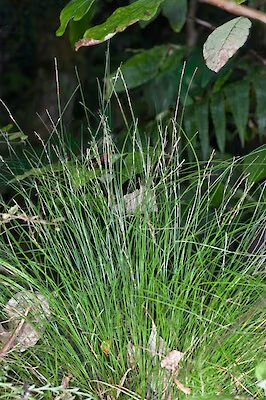
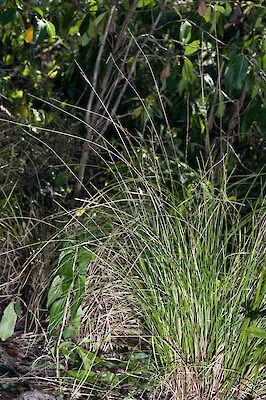
Carex hamlinii is a fine-leaved hook sedge endemic to New Zealand. Its dense tufts grow mainly in the understorey of beech forest, with slender spikes rising among wiry yellow-green leaves.
Identification
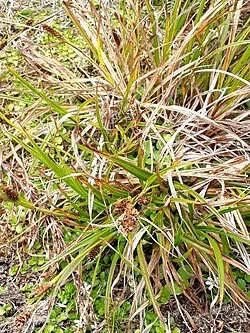
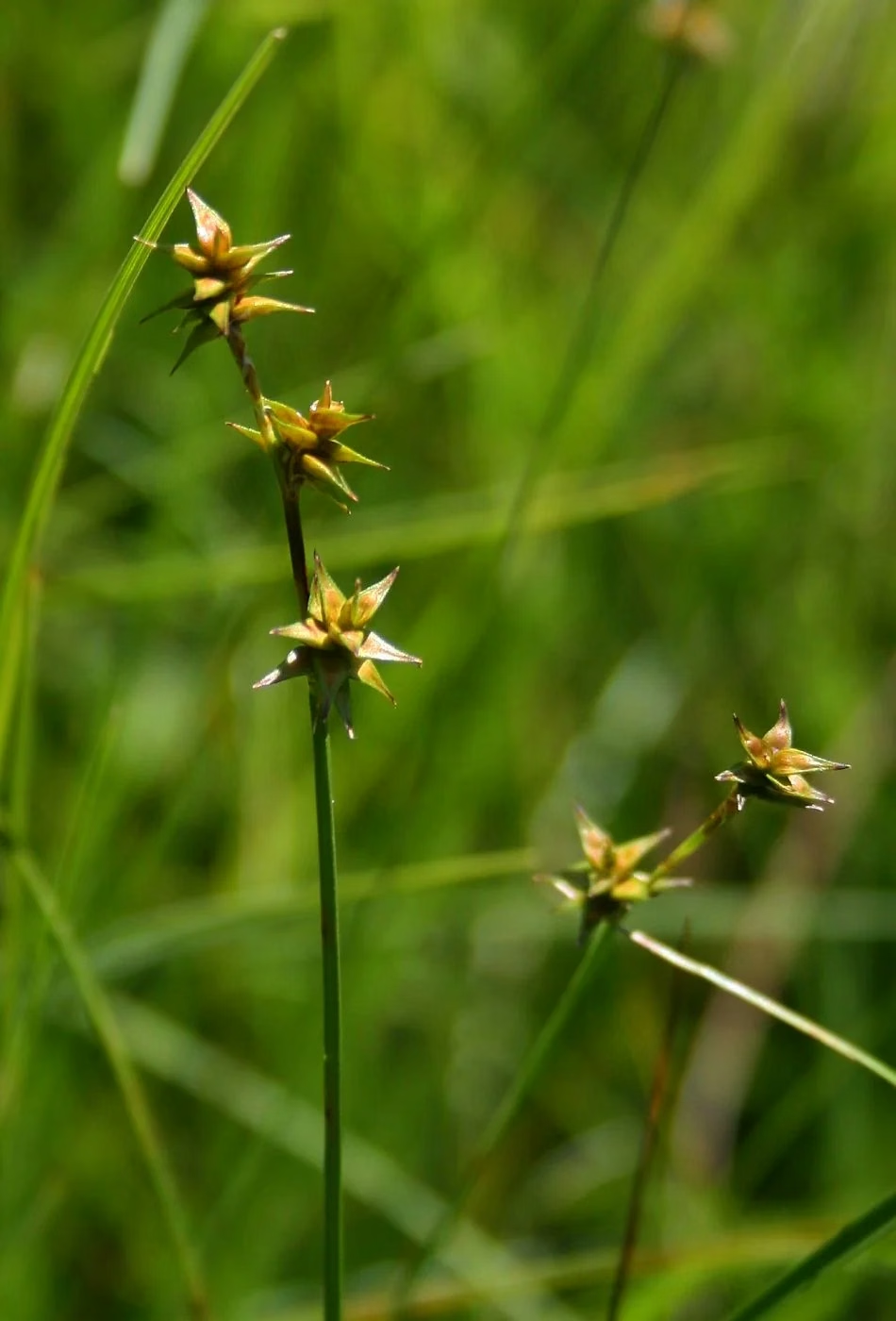
This densely tufted sedge has smooth stems 20-60 cm long and leaves 1-2 mm wide. The leaves are wiry, usually light yellow-green, with finely rough margins. Its spikes are 4-10 cm long; the grey-green fruiting utricles are 5.5-7 mm long and have a gradually tapering beak.
Quick facts
| Scientific Name | Carex hamlinii K.A.Ford |
|---|---|
| Earlier name | Uncinia astonii |
| Common name | Hamlin’s hook grass |
| Family | Cyperaceae |
| Origin | Endemic to New Zealand |
| Habitat | Beech forest understorey |
| Flowering | November to December |
| Fruiting | December to March |
| National status | Not Threatened (2023) |
| Height | Flowering stems 20-60 cm long |
| Water Needs | Permanently moist, deep, rich soil with free drainage |
| Light | Shade |
| Spread | Dense tufts; mature clump width is not specified |
| Frost Tolerance | Minimum tolerated temperature is not documented |
| Salt Tolerance | Salt tolerance is not documented |
| Growth Rate | Annual extension is not quantified in the cited accounts |
| Lifespan | Longevity in years is not documented |
Natural range
NZPCN records this endemic sedge from the southern Ruahine and Tararua ranges in the North Island, and from Nelson, Westland, Otago and Fiordland in the South Island. Recorded elevations are about 300-1,200 metres.
| City | Climate Suitability |
|---|---|
| Auckland | Not assessed |
| Wellington | Not assessed |
| Christchurch | Not assessed |
Habitat
The species is usually associated with the understorey of beech forest. Its recorded sites range from around 300 to 1,200 metres, in mountain areas of the North and South Islands.
Growing conditions
For cultivation NZPCN recommends shade and deep, rich soil that drains freely but stays permanently moist. This corresponds to the plant’s association with forest understorey rather than exposed coastal turf.
Planting considerations
Allow for dense tufts with wiry leaves and stems up to 60 cm long. NZPCN recommends a shaded position in deep, rich, free-draining soil kept permanently moist for this forest sedge.
Forest understorey
This sedge is usually found beneath beech forest, where it forms dense tufts. Its long narrow spike holds female flowers more widely spaced in the lower third and closer together above.
Field identification
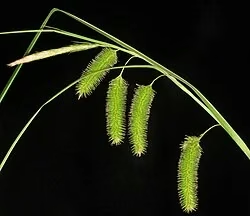
Compare the fine light-green leaves and lax flower spikes with those of Carex subviridis. NZPCN separates Carex hamlinii by its smooth rather than rough fruiting utricles; close examination of the fruits is useful.
Garden context
The species forms a fine-textured tuft for a shaded, moist position. NZPCN recommends a rich, deep and free-draining soil, and notes that divided plants can take a while to settle.
Flowering and fruiting
NZPCN records flowering in November and December and fruiting from December to March. The spike generally has about ten to twenty female flowers; mature utricles can stand erect or spread outward.
Leaf and stem growth
Each smooth flowering stem bears roughly three to six wiry leaves, usually no longer than the stem. The basal bracts are light brown. The cited NZPCN account does not prescribe a pruning routine.
How to Grow Aston's Hook Sedge (Carex hamlinii)
Fresh seed or established divisions
The species can be raised from fresh seed or by dividing established plants. NZ Plant Conservation Network adds a qualification for division: the resulting plants may take a while to settle. Its recommendation therefore supports both methods without promising immediate recovery following disturbance. Older plant labels may use Uncinia astonii, a name now included in Carex hamlinii.
A Shaded, Moist Root Zone
The recorded cultivation preference is shade and deep, rich soil that drains freely but stays permanently moist. That combination is consistent with its usual natural setting in the understorey of beech forest at about 300-1,200 m elevation. Free drainage and continued moisture are both part of the recommendation; describing it simply as a drought-tolerant grass would lose the most useful requirements given for this sedge.
Recognising developing plants
Flowering stems range from 20 to 60 cm long. The tufts are dense, and each culm carries three to six narrow leaves, generally 1-2 mm wide. The blades can be light yellow-green or occasionally red, have a wiry texture and finely roughened margins, and sometimes roll inward. These described variations help interpret the appearance of nursery-grown material without relying on a single foliage colour.
Seed-Head Development
Flowers are recorded in November and December, followed by fruit from December to March. The spikes are about 4-10 cm long and contain around ten to twenty female flowers. Flowers are farther apart in the lower portion and more crowded above. Mature utricles are approximately 5.5-7 mm long, providing another check on identity when collecting seed from an established cultivated plant.
Plant health
The leaf margins are naturally finely rough, while the grey-green utricles are smooth. These are identification features of the species; NZPCN does not provide a species-specific pest or disease treatment.
Names and classification
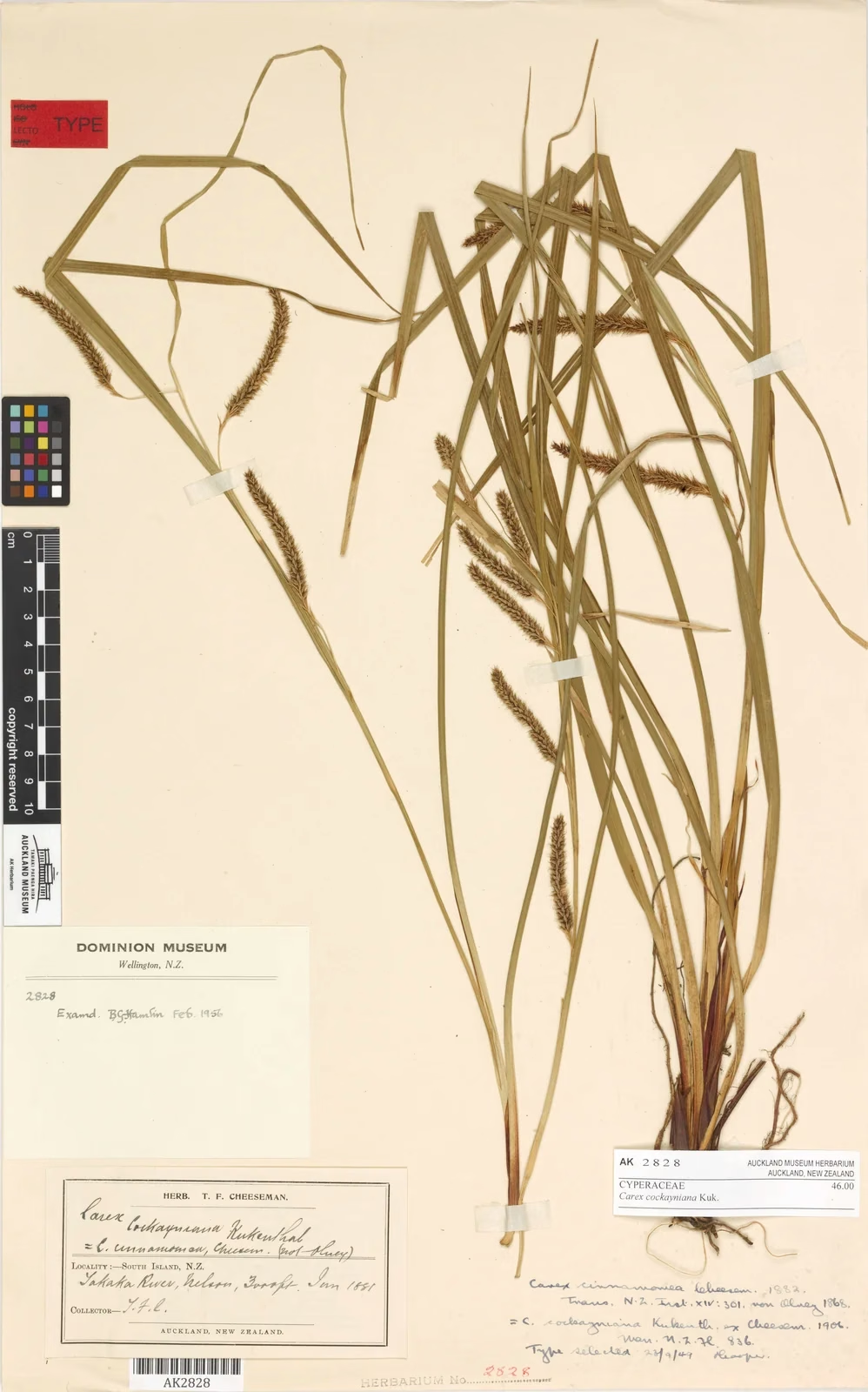
The earlier name Uncinia astonii is a synonym. The replacement name Carex hamlinii honours Bruce G. Hamlin, a New Zealand botanist; it was needed because Carex astonii was already in use for another plant.
Compare the fruiting utricles
Carex subviridis can look similar, with delicate green leaves and lax spikes. The utricles of Carex hamlinii are smooth, whereas those of C. subviridis are rough, according to the NZPCN identification notes.
Other New Zealand sedges
Explore other New Zealand Carex species, including sedges of wetlands, forest margins and open ground.
Conservation
The 2023 assessment lists this endemic sedge as nationally Not Threatened. NZPCN also records a 2025 Otago regional assessment of Data Deficient and a Wellington regional assessment of Regionally Naturally Uncommon.
Frequently asked questions
Is Uncinia astonii the same sedge?
Yes. Uncinia astonii is the earlier name for Carex hamlinii; the name Carex astonii was already occupied by another sedge.
Where does it grow?
NZPCN records it mainly in beech forest understorey at 300-1,200 metres, from southern North Island ranges to several South Island regions.
Do divisions establish immediately?
Not necessarily. Although division is a documented method for Carex hamlinii, NZ Plant Conservation Network notes that divided plants may take time to settle.
Sources
Identification, habitat, flowering, cultivation and conservation: NZPCN.
Scientific name, earlier synonym and the botanist honoured by its epithet: Biota of New Zealand.
Last updated: