Tassel Sedge
Carex fascicularis
Last updated:
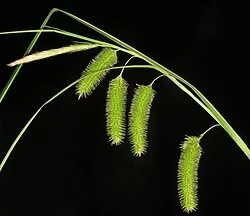
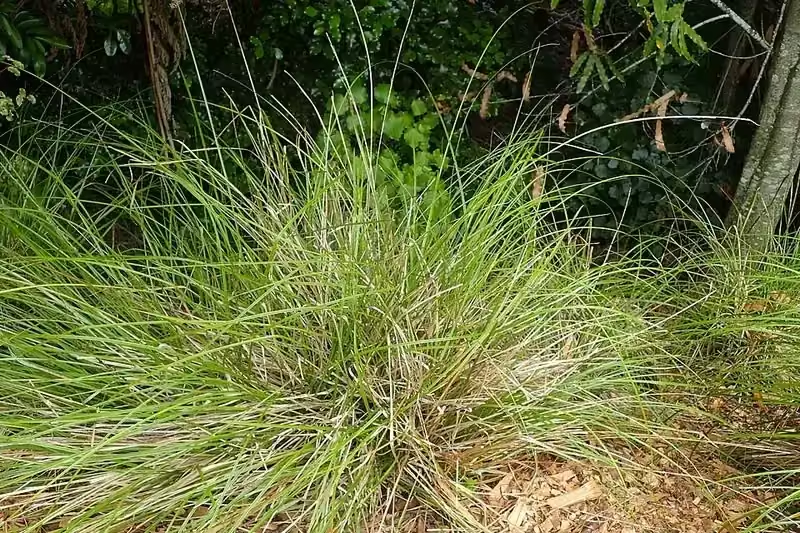
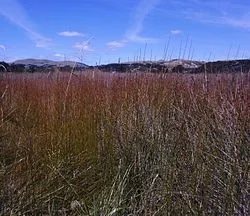
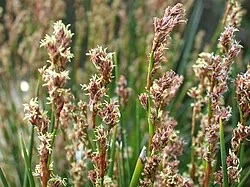
The Tassel Sedge (Carex fascicularis) is a stout, tufted perennial sedge indigenous to New Zealand's coastal and lowland freshwater wetlands. It grows 0.6 to 1.5 metres tall and 0.5 to 0.75 metres wide, with wide, pale to yellow-green, double-folded leaves 4-13 mm across marked by prominent cross-veinlets. Its three-angled culms carry 4-6 spikes, the drooping female ones giving the plant its tassel-like look. It grows along river and stream banks, lake margins, damp seepages and forest clearings, favouring fertile, moist ground in full sun. Moderately fast-growing and generally hardy, it stabilises soil and provides habitat, making it useful for freshwater wetland restoration. Explore more wetland native plants in our native plant guide.
Plant Description
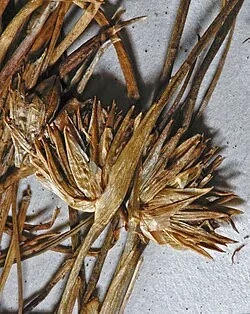
This stout, tufted, perennial sedge typically grows to a height of 0.6 to 1.5 meters and a width of 0.5 to 0.75 meters. It has pale green to yellow-green, wide leaves (4-13 mm) that are double-folded and feature prominent cross-veinlets on both the lamina and sheath. The culms (stems) are 0.6-1.1 meters tall, triquetrous (three-angled), and finely scabrid. It produces 4-6 spikes, with the uppermost one or two being male and the remaining female spikes (20-70 × 8-11 mm) usually slightly smaller, somewhat distant, pedunculate (stalked), and pendulous.
Quick Facts
| Scientific Name | Carex fascicularis |
|---|---|
| Height | 0.6-1.5 meters |
| Spread | 0.5-0.75 meters |
| Water Needs | High |
| Light | Full Sun |
| Frost Tolerance | Moderate (Specific data not available, but generally hardy for a wetland plant) |
| Salt Tolerance | Low (Specific data not available, but typically found in freshwater wetlands) |
| Growth Rate | Moderate to Fast |
| Lifespan | Perennial (Specific data not available, but sedges are long-lived herbaceous plants) |
Climate Best Suited to
Carex fascicularis is native to New Zealand, Australia, and New Guinea, indicating its preference for temperate to subtropical climates. In New Zealand, it thrives in coastal to lowland freshwater wetlands, suggesting it is well-suited to areas with consistent moisture and moderate temperatures. Its adaptability to various moisture regimes makes it a resilient plant in suitable environments.
Regional Suitability
| City | Climate Suitability |
|---|---|
| Auckland | Highly Suitable |
| Wellington | Highly Suitable |
| Christchurch | Suitable |
| Dunedin | Suitable |
| Hamilton | Highly Suitable |
| Tauranga | Highly Suitable |
| Napier | Suitable |
| Queenstown | Moderately Suitable (requires consistent moisture) |
Plant Habitat
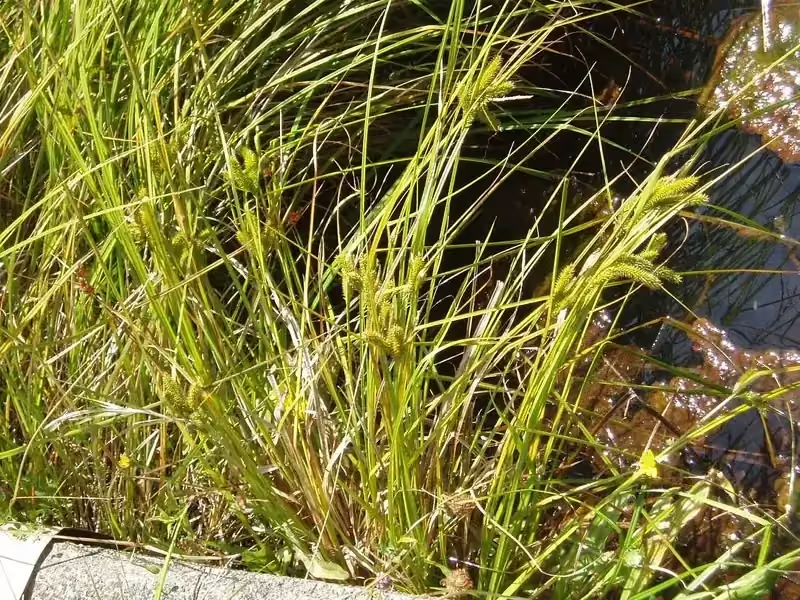
In New Zealand, Carex fascicularis is indigenous and found in coastal to lowland freshwater wetlands. Its habitats include gully systems under willows, river and stream banks, lake margins, damp seepages, and forest clearings. It prefers fertile to mid-fertile wetlands, demonstrating its need for nutrient-rich, moist environments to flourish.
Growing Requirements
Soil Requirements
Carex fascicularis is a wetland species but can grow well in most soils and moisture regimes. It prefers fertile to mid-fertile wetlands, indicating a preference for rich, moist, and well-drained soils. While adaptable, optimal growth is achieved in conditions mimicking its natural wetland habitat, which often features silty or loamy soils with good organic content.
- Moist to Wet
- Fertile to Mid-fertile
- Good organic content
- Can tolerate various soil types
Light Requirements
This sedge thrives best in full sun conditions. While it can tolerate some partial shade, especially in hotter climates, optimal growth and flowering occur when it receives ample direct sunlight throughout the day. Ensuring sufficient light exposure is key to maintaining its robust, tufted form and vibrant foliage.
- Full Sun preferred
- Tolerates Partial Shade
Water Requirements
As a wetland species, Carex fascicularis has high water requirements. It naturally occurs in freshwater wetlands, river and stream banks, lake margins, and damp seepages. It is crucial to maintain consistently moist to wet soil conditions for this plant. While it can tolerate some variation, prolonged dry periods are detrimental to its health and establishment.
- Consistently Moist to Wet
- Does not tolerate prolonged dry periods
Planting and Establishing
When planting Carex fascicularis , select a site that receives full sun and has consistently moist to wet soil, ideally mimicking its natural wetland habitat. Ensure the soil is fertile to mid-fertile, with good organic content. Dig a hole twice as wide as the root ball and just as deep. Place the plant in the hole, ensuring the top of the root ball is level with the soil surface. Backfill with soil, gently firming around the base, and water thoroughly. For best establishment, especially if the soil is not naturally wet, consider amending it with compost to improve moisture retention.
Ecological Role
Carex fascicularis plays a crucial role in wetland ecosystems. It helps to stabilize soil and prevent erosion, particularly along riverbanks and lake margins, due to its robust root system. It provides vital habitat and food for various native wildlife, including birds, insects, and amphibians, contributing significantly to the biodiversity of its environment.
Uses & Significance
Garden Uses
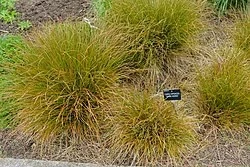
Tassel Sedge is an excellent choice for wetland gardens, pond margins, and stream banks where its robust nature helps stabilize soil. Its attractive tufted form and pale green foliage add textural interest. It can also be used in rain gardens or areas with poor drainage to absorb excess moisture.
- Wetland gardens
- Pond margins
- Stream banks
- Rain gardens
- Erosion control
Ecological Value
Beyond erosion control, Carex fascicularis offers significant ecological value as a food source and shelter. Its dense foliage provides cover for small birds and insects, while its seeds may be consumed by native wildlife. It contributes to water filtration in wetlands, improving water quality.
- Soil stabilization
- Habitat for wildlife (birds, insects, amphibians)
- Food source (seeds)
- Water filtration
Landscaping Uses
This versatile sedge is ideal for naturalistic landscaping, particularly in areas requiring erosion control or restoration of wetland habitats. It can be mass-planted for a dramatic effect or used as an accent plant in bog gardens. Its ability to thrive in moist conditions makes it suitable for difficult, damp spots.
Seasonal Care Calendar
Spring
In spring, as new growth emerges, ensure adequate moisture is available. This is a good time to observe the plant for any signs of stress or pest activity. If propagating by division, spring is an ideal time to undertake this task to allow plants to establish before summer.
- Ensure adequate moisture
- Monitor for pests
- Divide plants (if propagating)
Summer
During summer, especially in drier periods, consistent watering is crucial to maintain the moist conditions Carex fascicularis prefers. Monitor for any heat stress, though its wetland nature makes it resilient. Ensure full sun exposure is maintained for optimal growth.
- Consistent watering
- Monitor for heat stress
- Ensure full sun exposure
Autumn
Autumn is a time for consolidation. Reduce watering as temperatures drop. Spent flower spikes can be removed for aesthetic purposes, though many prefer to leave them for natural appeal and seed dispersal. The plant will begin to prepare for winter dormancy or slower growth.
- Reduce watering
- Remove spent flower spikes (optional)
- Prepare for winter dormancy
Winter
In winter, Carex fascicularis typically requires minimal intervention. Ensure the soil remains moist but not waterlogged. In areas prone to heavy frosts (though it generally tolerates moderate frost), some protection may be beneficial, though often unnecessary for established plants.
- Minimal intervention
- Maintain moist soil
- Consider protection in heavy frost areas
When to Prune and How Much
Pruning Carex fascicularis is generally minimal. The primary reason for pruning is to remove old, dead, or discoloured foliage to maintain a tidy appearance and encourage fresh growth. This can be done by cutting back the spent leaves and flower stalks close to the base of the plant. Avoid excessive pruning of healthy green foliage, as this can stress the plant.
- Minimal pruning required
- Remove old, dead, or discoloured foliage
- Cut back spent leaves and flower stalks at the base
- Avoid excessive pruning of healthy foliage
The best time for pruning is usually in late winter or early spring before new growth begins, but light tidying can be done at any time of year as needed.
How to Grow Tassel Sedge
Cultivating Tassel Sedge ( Carex fascicularis ) is a rewarding endeavor for any gardener interested in New Zealand's unique flora. This species can be propagated through several methods, each requiring specific conditions to ensure healthy growth and establishment. Successful propagation depends on mimicking the plant's natural environment and providing consistent care during the early stages of development.
From Seed
Propagation from fresh seed is often the most effective way to produce a large number of Carex fascicularis plants. Seeds should be collected when fully mature, typically in late summer or autumn. They often benefit from a period of cold stratification to break dormancy. Sow seeds on the surface of a well-draining, moist seed-raising mix, lightly covering with fine grit. Keep consistently moist and in a sheltered location until germination occurs, which can be erratic.
- Collect seeds when mature (late summer/autumn).
- Consider cold stratification to break dormancy.
- Sow on a well-draining, moist seed-raising mix.
- Lightly cover with fine grit.
- Keep consistently moist and sheltered.
For best results, use fresh seeds as viability decreases with storage. Germination can be slow and irregular, so patience is key.
From Cuttings
While possible, propagation from cuttings is less common for sedges like Carex fascicularis compared to division. If attempting, take semi-hardwood basal cuttings in spring or early summer. Cuttings should be 10-15 cm long, with the lower leaves removed. Dip the cut end in rooting hormone and plant into a free-draining, moist propagation mix. Provide warmth and humidity, but avoid waterlogging. Rooting can be slow and success rates vary.
- Take semi-hardwood basal cuttings (10-15 cm) in spring/early summer.
- Remove lower leaves.
- Dip in rooting hormone.
- Plant in free-draining, moist propagation mix.
- Provide warmth and humidity, avoid waterlogging.
Additional Methods
The easiest and most reliable method for propagating Carex fascicularis is by division. Mature clumps can be divided in spring or early autumn. Carefully dig up the entire plant, then gently separate the clump into smaller sections, ensuring each section has a healthy portion of roots and foliage. Replant the divisions immediately into prepared moist soil and water thoroughly. This method also helps to rejuvenate older, congested plants.
- Divide mature clumps in spring or early autumn.
- Gently separate into smaller sections, ensuring roots and foliage.
- Replant immediately into prepared moist soil.
- Water thoroughly.
Pests & Diseases
Carex fascicularis is generally a robust plant and not highly susceptible to pests or diseases. However, in poorly drained or overly dry conditions, it may become vulnerable to root rot or fungal issues. Occasionally, aphids or scale insects may appear, but these are rarely severe and can often be managed with horticultural soap or by simply rinsing them off.
Cultural Significance
While not extensively documented for specific Māori cultural uses compared to some other native plants, sedges like Carex fascicularis would have been an integral part of the wetland ecosystems providing resources and habitat. They contribute to the natural landscape and the rich biodiversity that is deeply valued in Māori culture.
- Integral to wetland ecosystems
- Contributes to natural landscape and biodiversity
- Valued in Māori culture as part of the environment
Bonus Tip
To mimic its natural habitat and promote vigorous growth, consider creating a small wetland area or bog garden feature in your landscape, where Carex fascicularis can truly flourish alongside other moisture-loving native plants.
Related Plants
Explore other native plants that share similar characteristics or habitats with Tassel Sedge ( Carex fascicularis ), offering further insights into New Zealand's diverse flora. These related species provide context and opportunities for complementary planting in your garden. For another native wetland plant, explore Antarctic Starwort.

Plant Conservation
The conservation status of Carex fascicularis in New Zealand is generally Indigenous, meaning it is naturally occurring within the country. However, regional assessments, such as in Auckland, have classified it as 'At Risk - Regionally Relict.' This highlights the importance of protecting its specific wetland habitats to ensure its continued presence across its native range and prevent further decline in localized populations.
Frequently Asked Questions
How tall does the Tassel Sedge grow?
Carex fascicularis grows 0.6 to 1.5 metres tall and 0.5 to 0.75 metres wide.
Where does Carex fascicularis grow naturally?
It grows in coastal to lowland freshwater wetlands, along river banks, lake margins and damp seepages.
What light does the Tassel Sedge need?
It prefers full sun and fertile, consistently moist to wet ground.
Is the Tassel Sedge good for wetland restoration?
Yes, it stabilises soil and provides habitat for birds, insects and other wetland wildlife.
Sources and Further Reading
The botanical, growing, and conservation details for Tassel Sedge (Carex fascicularis) on this page draw on authoritative New Zealand plant references and citizen-science observation records. Consult the sources below for full technical records and the latest distribution data.