Druce's Hook Sedge
Carex drucei
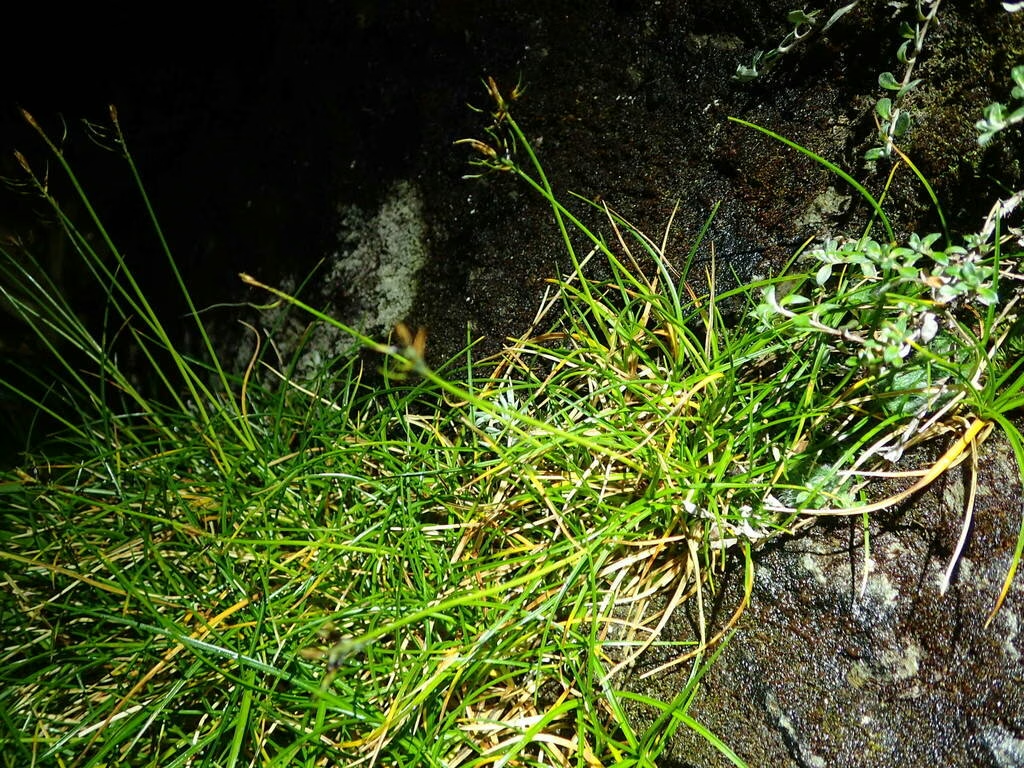
Druce’s hook sedge, Carex drucei, is a spreading alpine sedge endemic to New Zealand. Its narrow leaves and dark, glossy fruiting spikes help distinguish it from the related hook sedge Carex edura.
Identification
This sedge spreads widely by slender stolons. Its pale to reddish-green shoots bear soft, bright green leaves 1-1.5 mm wide, usually five to six per stem. Leaf margins are rough and taper to narrow triangular tips.
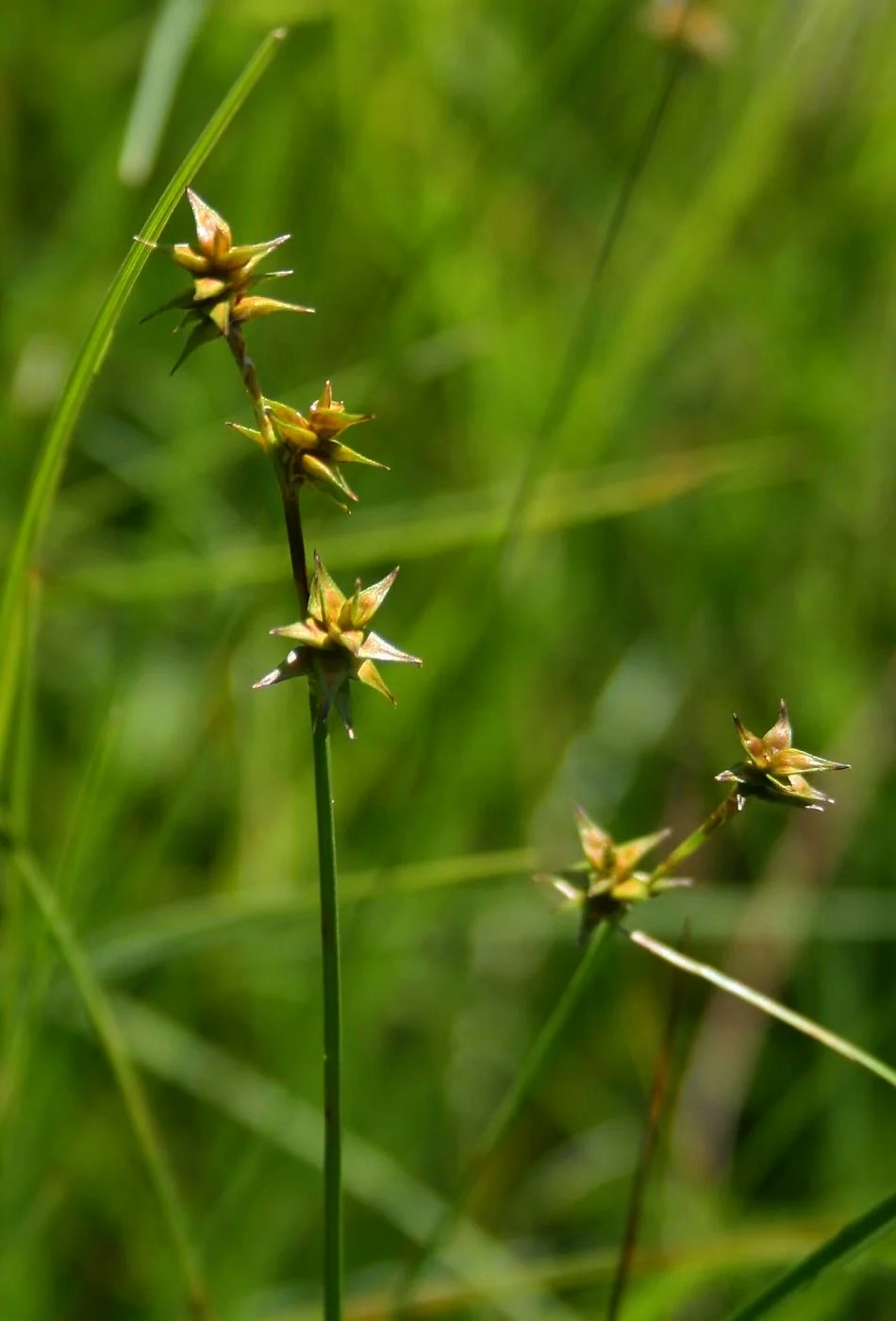
The oblong spikes carry closely crowded female flowers. Ripe fruiting structures are shiny dark brown, 4-5 mm long and spread widely from the spike.
Quick facts
| Scientific Name | Carex drucei |
|---|---|
| Former name | Uncinia drucei |
| Family | Cyperaceae |
| Stem height | 50-200 mm |
| Flowering | October to January |
| Fruiting | December to April |
| Status | Not Threatened (2023) |
| Height | Flowering stems 5-20 cm long |
| Water Needs | Wild sites include bogs and seepages; garden watering needs are untested |
| Light | A cultivation light requirement has not been established |
| Spread | Spreads widely by stolons; total width is not specified |
| Frost Tolerance | Minimum tolerated temperature is not documented |
| Salt Tolerance | Salt tolerance is not documented |
| Growth Rate | Annual extension is not quantified in the cited accounts |
| Lifespan | Longevity in years is not documented |
Alpine range
Druce’s hook sedge is recorded from Mt Hikurangi and Mt Taranaki south through the South Island to Stewart Island/Rakiura. Its described habitats are alpine; the conservation network does not give a tested garden temperature range.
| City | Climate Suitability |
|---|---|
| Auckland | Not assessed |
| Wellington | Not assessed |
| Christchurch | Not assessed |
Habitat and distribution
The species is endemic to New Zealand and occurs in the North Island, South Island and Stewart Island/Rakiura. Known alpine habitats include cushion bog, fellfield, snow banks, seepages and herbfield.
Its spreading stolons distinguish its growth form from many tufted sedges found in mountain vegetation.
Natural growing conditions
The conservation network records this hook sedge in a range of alpine settings, including snow banks and seepages as well as fellfield. Those observations describe where it occurs rather than a tested soil or watering regime.
Planting considerations
NZPCN does not specify a propagation technique, while suggesting that an alpine house or rock garden may be worth investigating. This is a tentative suggestion, not a documented planting trial for Carex drucei.
Growth and ecology
Slender stolons about half a millimetre across allow this alpine sedge to spread. The flowering stems are 50-200 mm tall; their basal bracts are light brown or straw-coloured, and the leaves are shorter than the stems.
Observing the plant
Look for the combination of spreading shoots, soft narrow leaves and short oblong spikes. The conservation network notes that mature, dark-brown fruiting structures spread out from the spike and have a prominent lateral nerve.
Garden context
The conservation network tentatively suggests an alpine house or rock garden but explicitly does not describe a propagation method. Its alpine distribution and spreading habit are useful context when considering the plant, not proof of garden performance.
Flowering and fruiting
NZPCN records flowering from October to January and fruiting from December to April. The oblong spikes are initially 5-20 mm long and can reach about 10 mm across when the fruiting structures mature and spread.
Growth form
Rather than forming a woody framework, this sedge has narrow leaves and stems connected by spreading stolons. Its profile does not specify a pruning method; the fruiting spikes are valuable features for identification when mature.
How to Grow Druce's Hook Sedge (Carex drucei)
Seed and Division: a Tentative Recommendation
The propagation entry for Carex drucei is explicitly uncertain. NZ Plant Conservation Network suggests that fresh seed and division of established plants would probably work, and proposes an alpine house or rock garden. It does not report those suggestions as the results of cultivation trials. This distinction should be retained when selecting propagation material or interpreting advice for the species.
Its alpine setting
Natural sites include cushion bogs, fellfield, snow banks, seepages and herbfields. These records cover wet hollows as well as exposed mountain ground. Calling it an alpine plant therefore does not justify assuming that every population occupies dry scree. The habitat information is useful context for an experimental collection, while a fixed irrigation schedule remains unestablished.
Allowing for stolons
This sedge spreads through slender stolons about half a millimetre thick. Its flowering stems stand 5-20 cm long, with shorter, soft leaves 1-1.5 mm wide. Plants range from pale green to reddish green. Three to five pale, raised veins can be seen on the lower leaf surface, providing a useful check on material that has not flowered.
Recognising reproductive growth
Flowering is recorded from October to January, with fruit from December to April. Each compact spike carries roughly seven to eighteen female flowers. Although a developing spike is only a few millimetres wide, it can widen to about 1 cm at maturity. Mature fruiting heads and the spreading stolons together give more identification information than leaf colour alone.
Plant health
The cited conservation profile does not specify pests, diseases or treatments for Carex drucei. Dark, glossy fruiting structures that spread widely at maturity are described as normal features of the species.
Name and botanical history
The epithet honours New Zealand field botanist Anthony Peter Druce. The species was formerly called Uncinia drucei; the accepted name Carex drucei reflects the broader classification of hook sedges within Carex.
Separating similar sedges
Unlike the more tufted or shortly rhizomatous Carex edura, C. drucei spreads widely on stolons and has softer, narrower leaves. Its shorter, oblong spikes and smaller dark-brown fruiting structures also help distinguish it.
Other New Zealand sedges
Explore other New Zealand Carex species, including sedges of wetlands, forest margins and open ground.
Conservation
This endemic sedge was assessed as Not Threatened nationally in 2023. The conservation network lists it as Regionally Data Deficient in Otago in 2025, so a national assessment should not be assumed to describe knowledge of every region.
Frequently asked questions
Is Uncinia drucei the same plant?
Yes. NZPCN lists Uncinia drucei as a synonym of Carex drucei .
Where does it grow?
It occurs in alpine cushion bog, snow banks, seepages, fellfield and herbfield from the North Island south to Rakiura.
Does it remain in a single tight tuft?
No. Carex drucei is stoloniferous: slender horizontal stems allow it to spread beyond the original group of shoots.
Sources
Identification, habitat, names, phenology and conservation: NZPCN: Carex drucei. Classification of Uncinia within Carex: Flora of New Zealand: Carex.
The sources document its stoloniferous growth and the shiny dark-brown fruiting structures used in identification.
Last updated: