Bidibid
Acaena glabra
Last updated:
Acaena glabra is a small, clump-forming bidibid (piripiri) endemic to the mountains of the eastern South Island, from Marlborough to North Otago. It grows on the margins of shingle and scree between about 600 and 1750 m, forming tight clumps up to 50 cm across with bright green, shiny leaves. Its globular white flower heads appear in midsummer. Unusually for a bidibid, its fruits carry only two spines, and these lack the barbs that make most Acaena burrs cling so stubbornly to socks. The name glabra means hairless, referring to its smooth leaves. Explore more native ground covers in our native plant guide.
Plant Description
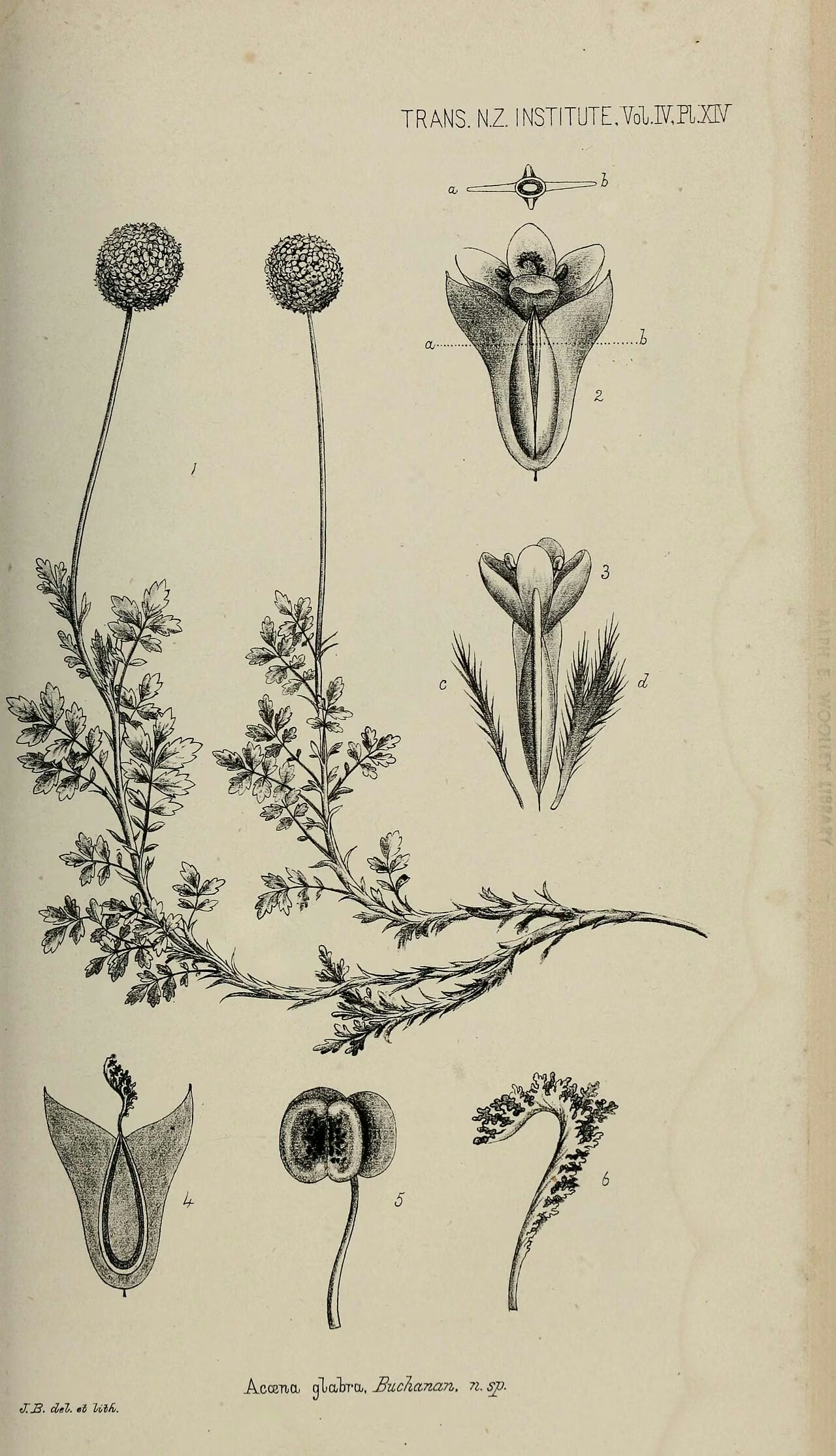
Acaena glabra is an evergreen herb in the rose family that forms tight clumps up to about 50 cm across. Its stems are hairy, 5 to 15 cm tall and root at the nodes, but the plant spreads from a rootstock rather than by long running stolons, which keeps it compact.
The leaves are odd-pinnate, 20 to 70 mm long, with 9 to 13 ovate leaflets about 4 to 6 by 6 to 9 mm. Each leaflet is deeply serrated with 7 to 9 blunt teeth that lack hair tips. The upper surface is bright green and shiny, while the underside is a dull, lighter green. Flowers are white, occasionally with red anthers, and are packed into globular heads of more than 100 florets. The fruits are roughly wedge-shaped, about 5 by 4 mm, formed by two enlarged opposite wings, and carry two spines without barbs that are enclosed within the wings.
NZPCN distinguishes it from Acaena anserinifolia, which spreads by stolons and has hair-tipped teeth and silvery leaflet undersides, and from A. novae-zelandiae, which has up to 15 teeth per leaflet against up to 9 in A. glabra. The barbless, two-spined fruit is the most reliable field character.
Quick Facts
| Scientific Name | Acaena glabra |
|---|---|
| Height | 5-15 cm |
| Spread | Clumps up to 50 cm across |
| Water Needs | Low to moderate; needs sharp drainage |
| Light | Full sun |
| Frost Tolerance | High; montane to alpine species |
| Salt Tolerance | Low; a mountain species, salt tolerance not recorded |
| Growth Rate | Slow to moderate |
| Lifespan | Perennial |
Climate Best Suited to
Suited to cold, frosty montane and alpine climates on the drier eastern side of the South Island, with snow in winter and sunny summers.
Regional Suitability
| City | Climate Suitability |
|---|---|
| Auckland | Low |
| Wellington | Low |
| Christchurch | Medium |
| Dunedin | Medium |
Plant Habitat
Acaena glabra is endemic to the eastern South Island, from Marlborough south to North Otago. It is a montane to alpine plant, recorded from about 600 to 1750 m above sea level.
Its typical habitat is the margins of shingle and scree slopes, where it roots among loose stones at the edge of more stable ground. These are open, sunny, well-drained sites with little competition from taller plants.
Growing Requirements
Soil Requirements
In the wild it roots into loose, stony scree and shingle with very little organic matter, so drainage is essential.
- Use a very gritty, free-draining mix
- Add plenty of crushed rock or pumice
- Avoid heavy or rich soils
Light Requirements
An open scree plant, it needs full sun and good air movement.
- Full sun
- Avoid shady, humid corners
Water Requirements
Water drains quickly through scree, but the roots reach down to cooler, moister layers below the stones.
- Water deeply but infrequently in dry spells
- Never let it sit wet in winter
- A stone mulch keeps the roots cool
Planting and Establishing
Plant in spring into a raised scree bed, rock garden or trough filled with a gritty mix. Set the crown slightly above the surrounding level and mulch with stone chips to keep the neck dry.
It is best suited to colder gardens. In warm, humid lowland areas, grow it in a pot or trough where drainage and exposure can be controlled.
Ecological Role
Unlike most bidibids, whose barbed burrs hitch rides on animals, NZPCN notes that the spiny fruits of Acaena glabra are dispersed by wind. The many-flowered white heads are likely visited by small insects, although specific pollinators are not recorded in the sources consulted.
On scree margins it is one of the plants that colonise and help stabilise loose stony ground.
Uses & Significance
Garden Uses
A neat, compact bidibid for alpine and rock garden enthusiasts, without the clinging burrs that make many Acaena unwelcome near paths.
- Scree beds and rock gardens
- Alpine troughs and pots
- Stony banks in cool eastern gardens
Ecological Value
As a scree-margin colonist it contributes to the specialised plant communities of eastern South Island mountains.
- Helps stabilise loose stony ground
- Part of the endemic alpine flora
- Flowers offer food for small insects
Landscaping Uses
Its glossy bright green leaves stand out against grey stone, making it a good contrast plant in a scree garden alongside grey-leaved alpines.
Because it forms a tidy clump rather than a wandering mat, it can be placed precisely between rocks without overrunning neighbouring plants.
Seasonal Care Calendar
Spring
New growth begins as snow melts in its alpine home.
- Plant or repot now
- Refresh stone mulch around the crown
Summer
Flowering runs from December to January, with globular white heads above the foliage.
- Enjoy the flower heads
- Water in long droughts
Autumn
Fruiting continues from January to March.
- Collect seed heads once dry
- Clear fallen leaves from the clump
Winter
The clump rests under snow or frost in the mountains.
- Protect pots from prolonged wet
- No feeding needed
When to Prune and How Much
No pruning is needed. Remove any dead or browned leaves from the clump to keep air moving through it.
Spent flower stems can be cut off once the seed has been collected or dispersed.
How to Grow Bidibid
No propagation protocol specific to Acaena glabra was found in the sources consulted, so the guidance below follows the general practice for small Acaena species. Because it grows from a rootstock with stems that root at the nodes, careful division of established clumps is the most reliable method in cultivation. Seed is an alternative and is the better choice for any restoration use. As a mountain plant of the eastern South Island, it is unlikely to thrive in warm lowland nurseries, so raise plants in a cool, open position with excellent drainage.
By Division
Divide established clumps in early spring as new growth begins, taking pieces that already have their own roots.
- Lift the clump or work at its edge with a sharp knife
- Separate rooted pieces, each with several leafy shoots
- Pot into a gritty alpine mix
- Keep cool and lightly shaded until re-established, then move to full sun
From Seed
Fruits ripen from January to March. Collect them when dry and sow fresh, giving the seed a cold winter outdoors as alpine species often germinate better after chilling. Because the winged fruits are shed on the wind, check plants regularly in late summer so the crop is not lost before you collect it.
- Collect dry fruiting heads in late summer
- Sow on a gritty seed mix and cover with fine grit
- Leave the pot outdoors over winter to chill
- Prick out seedlings in spring and grow on slowly
Pests & Diseases
No specific pests or diseases are recorded for this species. In cultivation, crown rot in wet, poorly drained conditions is the most likely cause of loss.
Slugs and snails may graze young growth in lowland gardens.
Cultural Significance
Piripiri is the general Māori name for bidibids, and is the origin of the English word bidibid. No traditional Māori use specific to Acaena glabra is recorded in the sources consulted.
The species name glabra is Latin for hairless, describing its smooth, shiny leaflets, which contrast with the hairy foliage of many other bidibids.
Bonus Tip
If you have avoided bidibids because of their clinging burrs, Acaena glabra is worth a look: its two fruit spines lack barbs, so it can be grown beside a path in an alpine garden without leaving seed heads stuck to your socks.
Related Plants
Explore other native plants that share similar characteristics or habitats with Bidibid (Acaena glabra), offering further insights into New Zealand's diverse flora. These related species provide context and opportunities for complementary planting in your garden.
Fennel-Leaved Pondweed
Stuckenia pectinata
Suaeda novae-zelandiae
Suaeda novae zelandiae
Acaena buchananii
Acaena buchananii
Acaena profundeincisa
Acaena profundeincisa
Devil's Horsewhip
Achyranthes velutina
Heart-Leaved Orchid
Acianthus sinclairii
Caesiiglauca Plant
Caesiiglauca Plant
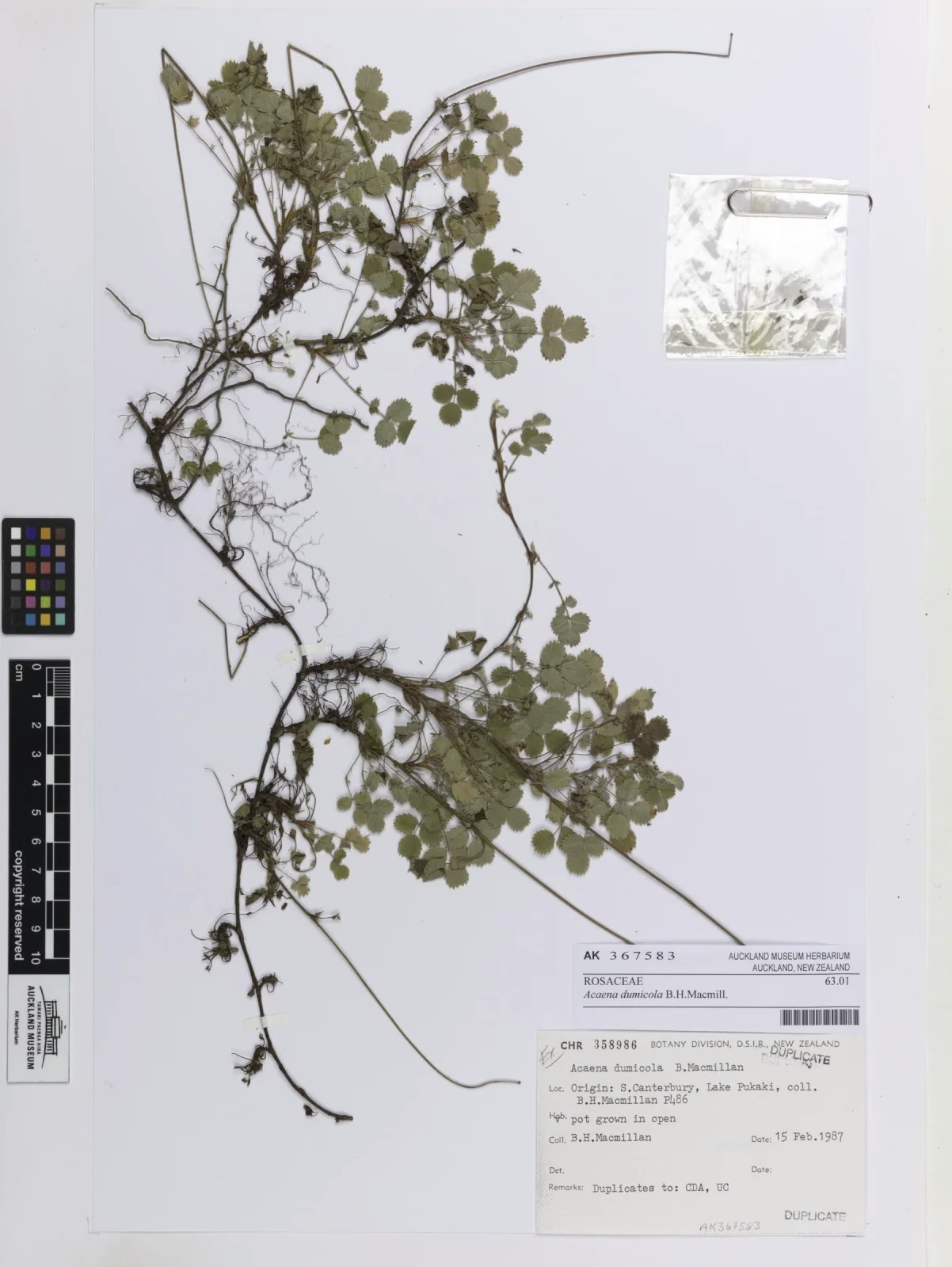
Dumicola Plant
Dumicola Plant
Plant Conservation
Acaena glabra is ranked Not Threatened (2023). In Otago, at the southern end of its range, it is listed as Regionally Naturally Uncommon.
Its scree and shingle habitat is largely on high country conservation land and pastoral leases. Keeping vehicles and stock off fragile scree margins and controlling invasive weeds help protect it.
Frequently Asked Questions
Does Acaena glabra have sticky burrs like other bidibids?
Its fruits have two spines without barbs, so they do not cling like typical bidibid burrs, and NZPCN notes they are dispersed by wind.
Where does Acaena glabra grow in New Zealand?
It is endemic to the eastern South Island from Marlborough to North Otago, on shingle and scree margins between about 600 and 1750 m.
How can you tell Acaena glabra from other Acaena species?
It grows from a rootstock rather than stolons, has shiny bright green hairless leaflets with up to 9 blunt teeth, and has two barbless fruit spines.
Sources and Further Reading
The botanical, growing, and conservation details for Bidibid (Acaena glabra) on this page draw on the New Zealand plant references below. Consult them for full technical records and the latest distribution data.