Woodrush
Luzula subclavata
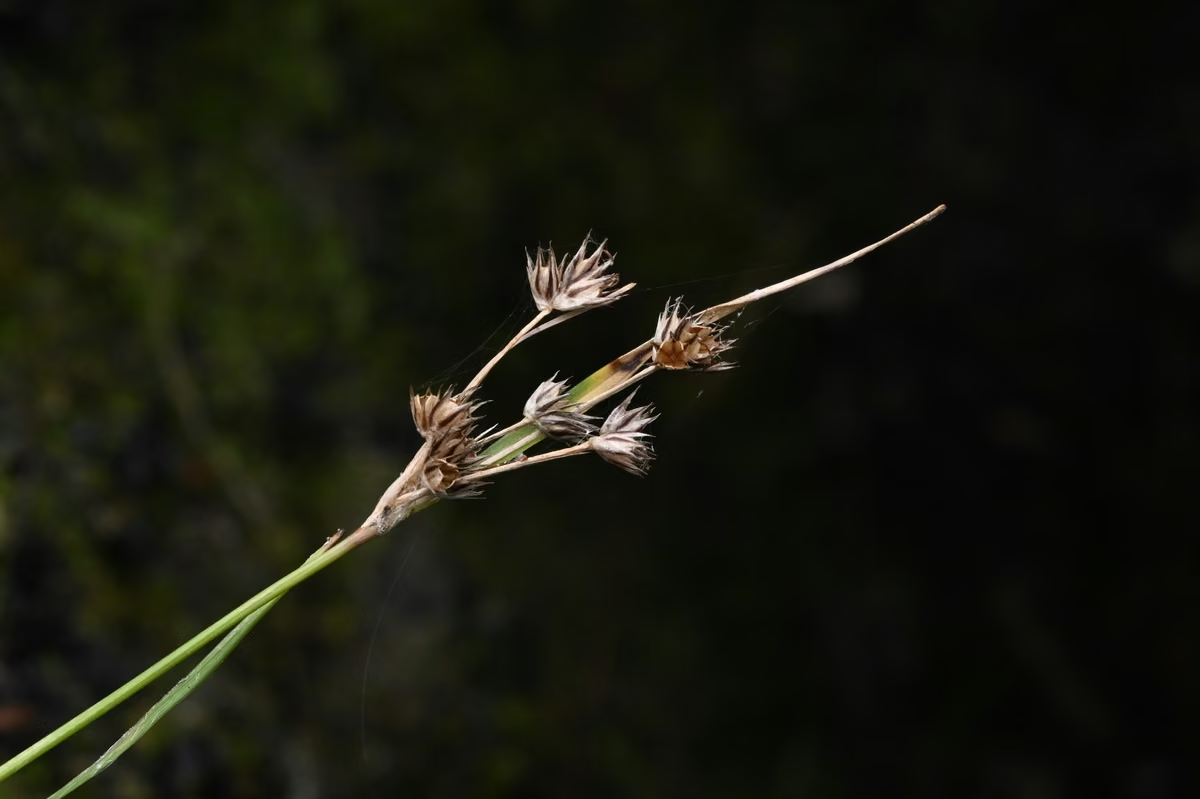
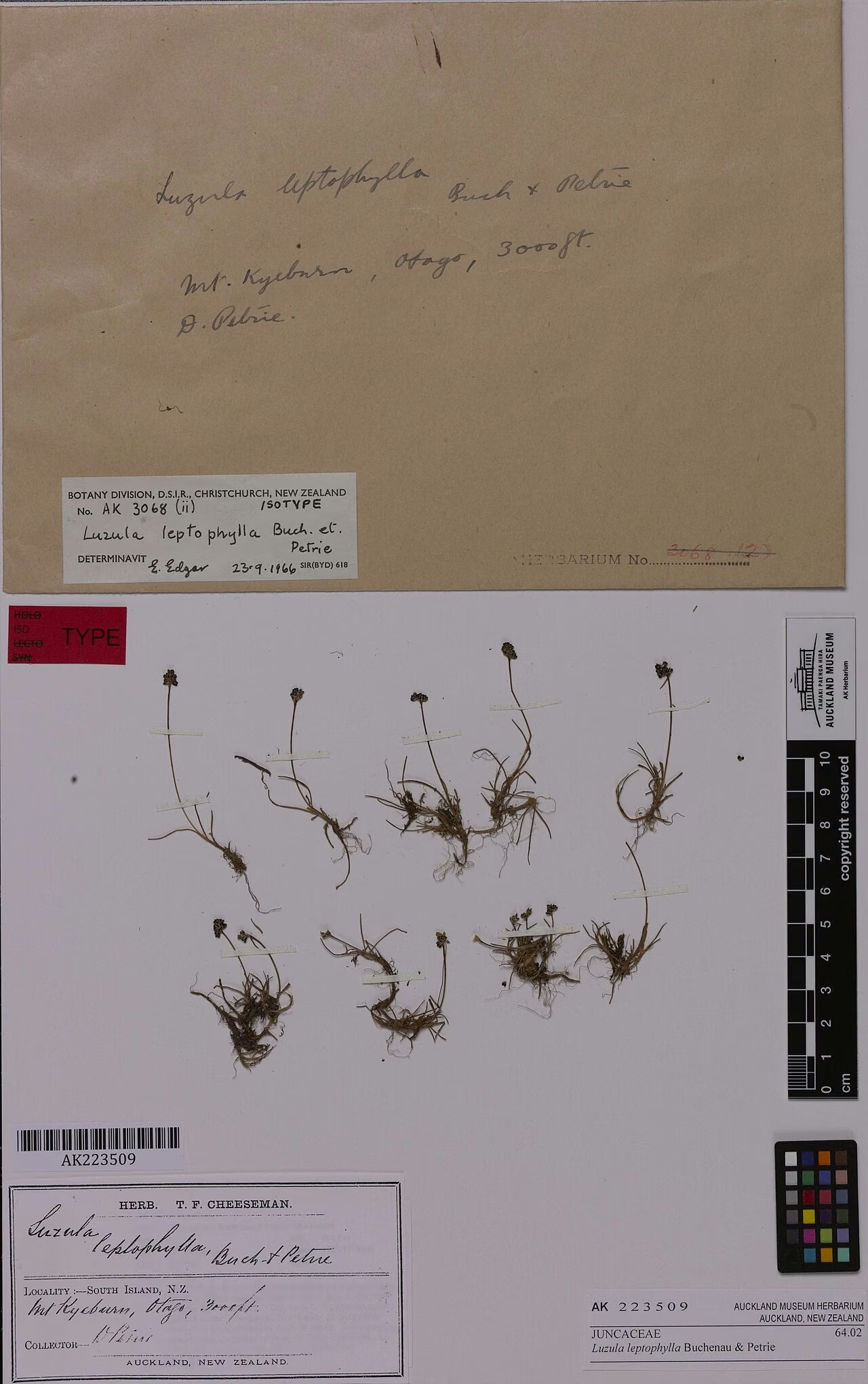
Luzula subclavata is a perennial woodrush found only in New Zealand, with narrow leaves and pale flowers arranged around a larger central cluster. Kew and Manaaki Whenua also treat this plant as Luzula picta var. pallida. Unlike the compact cushion of the related dwarf alpine woodrush (Luzula colensoi), it produces flowering stems above its tuft.
Identification
The published variety description records numerous leaves, often around 5 mm wide, and flowering stems usually 15-30 cm long, occasionally shorter or taller. Its larger central flower cluster is about 10 mm across and can appear almost triangular or ellipsoidal.
The pointed tepals are cream and membranous with a light-brown central stripe. Greenish-brown capsules are slightly shorter than the tepals or sometimes equal them. One or two leaf-like bracts may extend beyond the central cluster.
Quick facts
| Scientific Name | Luzula subclavata Colenso |
|---|---|
| Alternative treatment | Luzula picta var. pallida (Hook.f.) Edgar |
| Family | Juncaceae |
| Origin | Endemic to New Zealand |
| Height | Flowering stems usually 15-30 cm; recorded extremes 4-45 cm |
| Spread | Tufted growth; mature clump width is not quantified |
| Water Needs | Field records include damp sites; no cultivation watering schedule is given |
| Light | Regional records include shaded foothill sites; no cultivation rating is given |
| Frost Tolerance | A minimum tolerated temperature is not documented |
| Salt Tolerance | Salt tolerance is not documented |
| Growth Rate | Annual extension is not quantified in the cited accounts |
| Lifespan | Perennial in Kew's variety treatment |
| Chromosome number | 2n = 12 |
| National status | Not Threatened (2023) |
Natural range and climate evidence
Kew records the variety in both the North and South Islands. Documented sites range from foothill habitats in northern Horowhenua to a Tongariro National Park collection at about 1,128 m. Those records describe occurrence, rather than tested garden performance in a particular city.
| City | Climate Suitability |
|---|---|
| Auckland | Not assessed |
| Wellington | Not assessed |
| Christchurch | Not assessed |
Habitat and recorded sites
The northern Horowhenua flora survey records Luzula picta var. pallida in damp or shaded places, mainly in the foothills, with occurrences in Kimberley Scenic Reserve and the dune belt.
Allan Herbarium specimen CHR 210310 was collected by A. P. Druce in the Hauhungatahi basin, Tongariro National Park, in February 1971. Its recorded habitat is a stream bank in scrub at about 1,128 m.
Natural growing conditions
Damp foothill sites and a stream bank in upland scrub provide direct evidence of places occupied by this woodrush. The regional records include shade. They do not define a potting mixture, irrigation interval or temperature threshold for cultivated plants.
Checking planting material
A label may use Luzula subclavata or Luzula picta var. pallida, depending on the classification followed. Confirm the full name when obtaining identified material: the other varieties of Luzula picta have different flower-cluster characters.
Occurrence among other woodrushes
Druce's Tongariro specimen label notes that the plant grew beside an unnamed Luzula, represented by the adjacent collection CHR 210309. That field observation shows why neighbouring grass-like tufts require individual identification; shared habitat does not establish that they belong to one taxon.
Field identification value
The pale, pointed tepals and greenish-brown capsules are useful characters on a reproductive plant. The central cluster is normally larger than the lateral clusters. These features help identify material recorded under either the species name or the variety name.
Form in a planting
The numerous narrow leaves and slender flowering stems give this woodrush a grass-like outline. Published stem lengths are usually 15-30 cm, while the central cluster is only about 1 cm across. Mature clump width and garden growth rate have not been quantified in the cited descriptions.
Seasonal evidence
The Flora of New Zealand genus account gives October-December flowering and November-January mature fruit as general patterns for New Zealand Luzula. These are genus-level observations. The sources used here do not establish a separate, experimentally observed cultivation calendar for Luzula subclavata.
Structure of the flowering head
An inflorescence usually carries one to three clusters, occasionally as many as eight. The larger central head is sessile, while smaller clusters stand on flexible stalks commonly 1-6 cm long, occasionally reaching 8 cm. This structure is useful when distinguishing flowering stems from the surrounding leaves.
How to Grow Woodrush (Luzula subclavata)
Seed evidence and named material
The cited NZPCN and Flora accounts identify the plant and describe its reproductive structures, but do not supply a tested seed-germination method or division procedure for this taxon. Material may be labelled Luzula subclavata or Luzula picta var. pallida. Keeping that full identification is useful because the broader Luzula picta treatment contains several varieties.
Interpreting natural sites
A northern Horowhenua field survey places the variety in damp or shaded habitats, especially in the foothills, with additional records from a reserve and the dune belt. An Allan Herbarium specimen documents a stream bank in upland scrub at Hauhungatahi. These are observations of wild plants, not measurements of a preferred potting mix, garden watering interval or minimum temperature.
Recognising an established plant
The variety account records numerous leaves, often around 5 mm wide. Flowering stems are usually 15-30 cm long, with shorter and taller extremes recorded. A larger central head, approximately 10 mm across, is accompanied by smaller clusters on flexible stalks. Leaf-like bracts can extend beyond the central head.
Checking reproductive material
The tepals are cream and membranous with a light-brown central stripe. The greenish-brown capsule is slightly shorter than, or sometimes equal to, those tepals. These characters help distinguish an identified parent plant before considering propagation. The published genus-wide flowering and fruiting months should remain labelled as general Luzula information rather than a verified sowing calendar for this woodrush.
Interpreting the colours of the heads
A light-brown stripe on a cream tepal and a greenish-brown capsule are normal features in the published description. Their presence should be considered alongside the overall condition of the plant, rather than treating every brown part of a flower cluster as a disease symptom.
Names and taxonomic history
William Colenso published the name Luzula subclavata in 1886, originally spelling the epithet sub-clavata. NZPCN explains the epithet as nearly club-shaped, from the Latin sub- and clavatus.
NZOR and the 2023 national conservation assessment retain the species name. Kew and Manaaki Whenua's Kirschner-based treatment place it under Luzula picta var. pallida, a combination published by Elizabeth Edgar in 1966. These classifications are represented here by one plant profile.
A shared chromosome record
NZPCN's record for Luzula subclavata and the Flora description under Luzula picta var. pallida both report the chromosome number 2n = 12. The same cytological figure therefore appears under the two taxonomic treatments.
Related New Zealand rushes
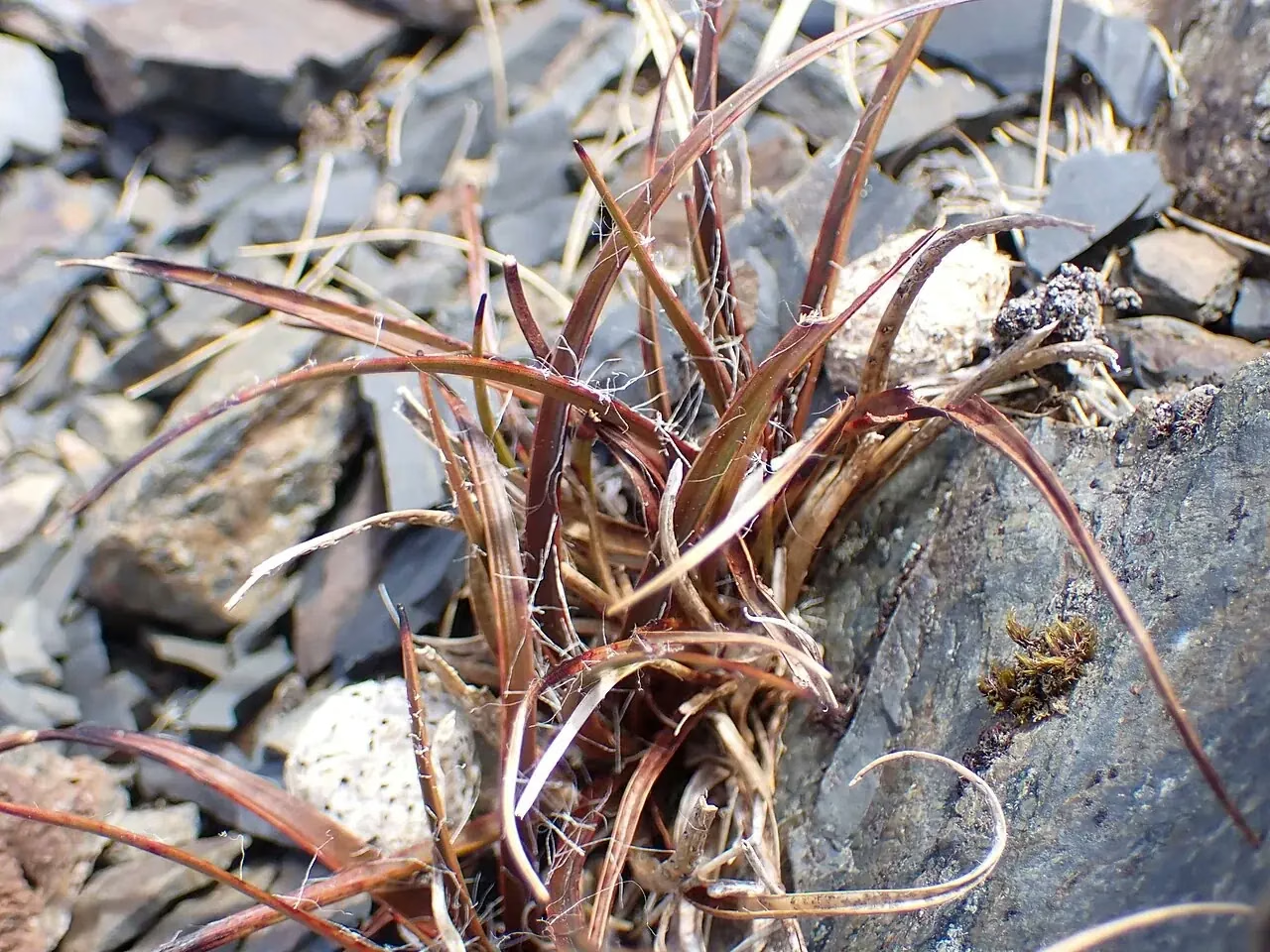
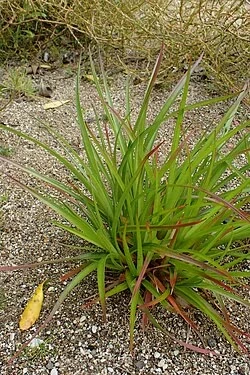
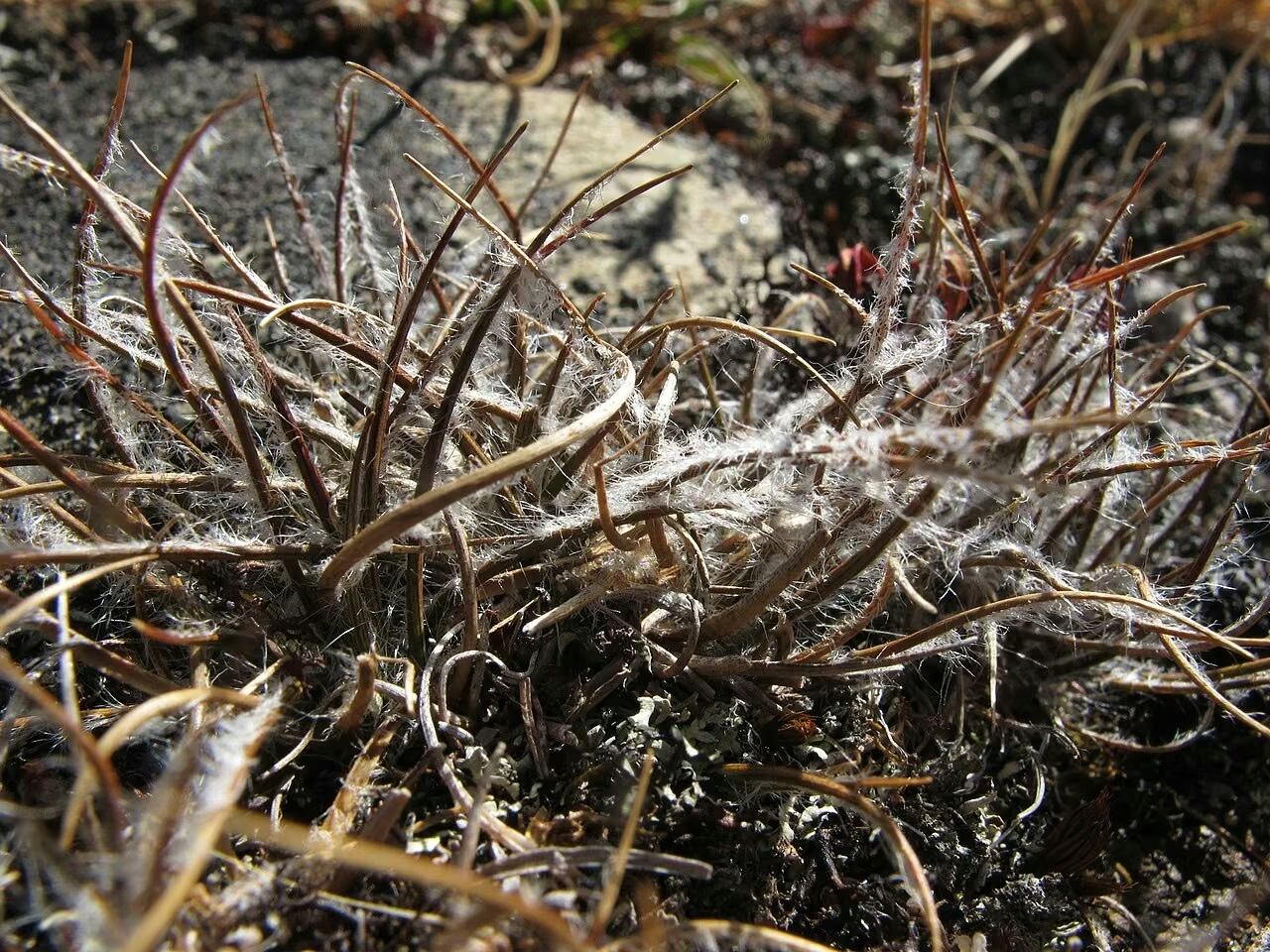
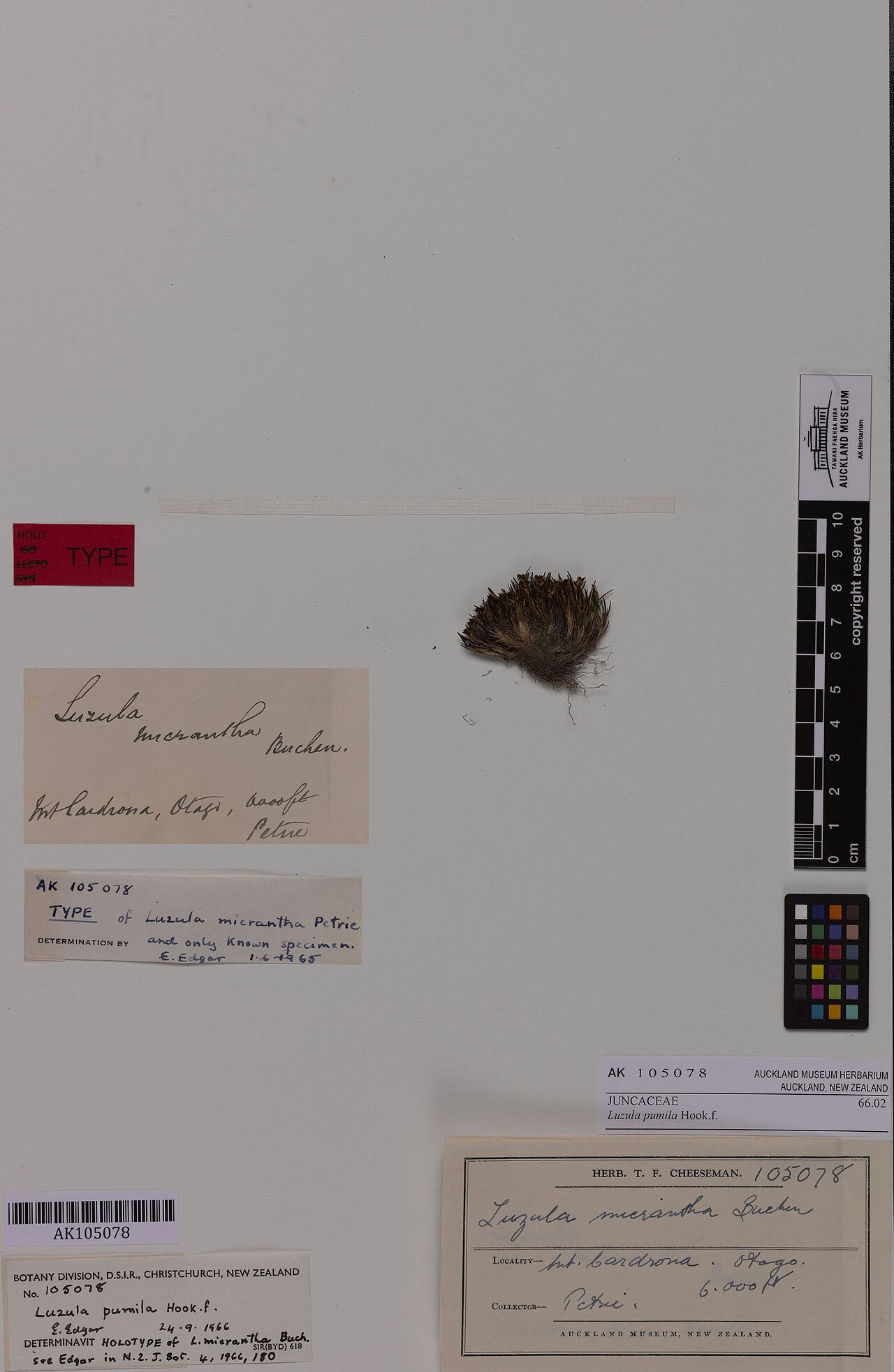
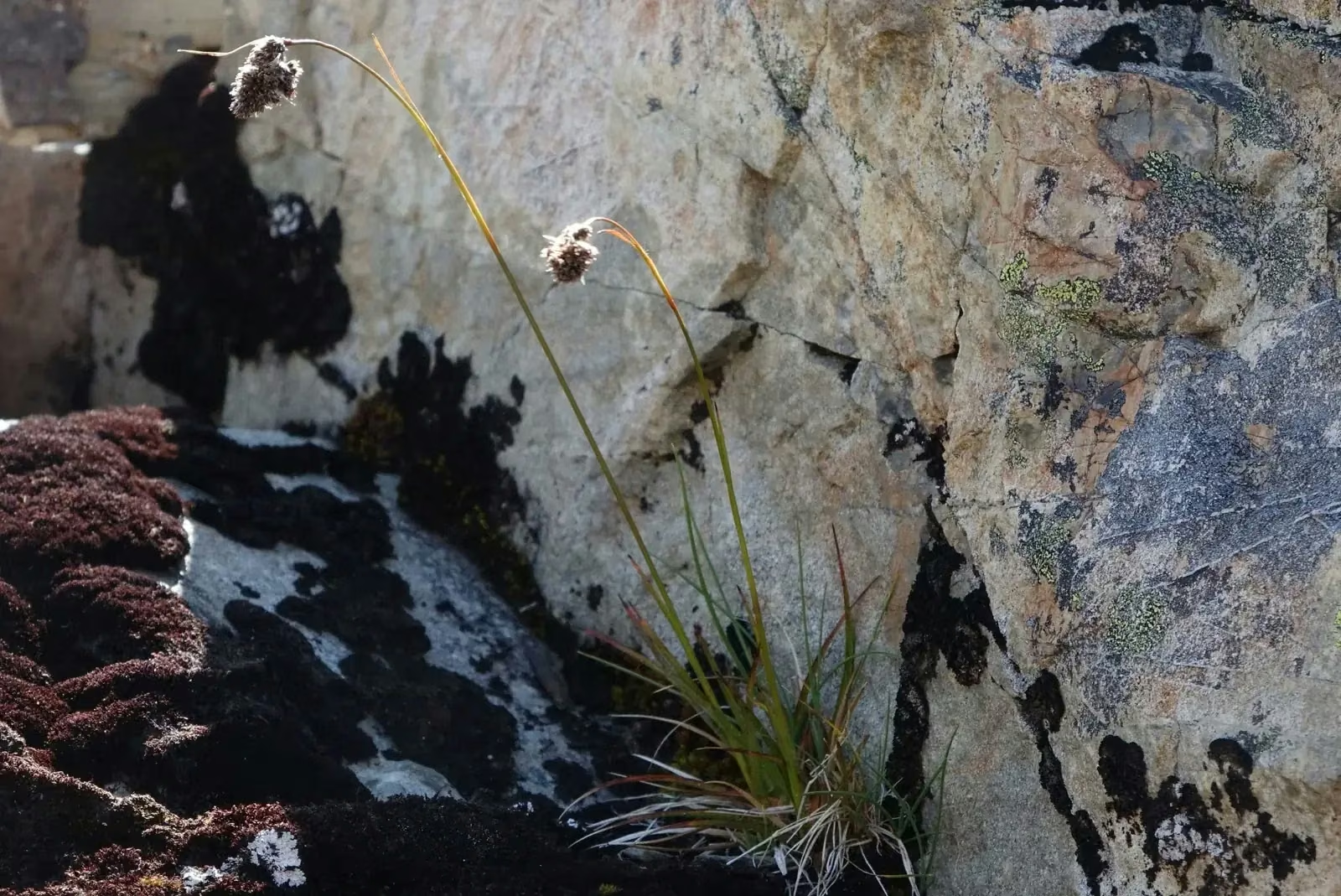
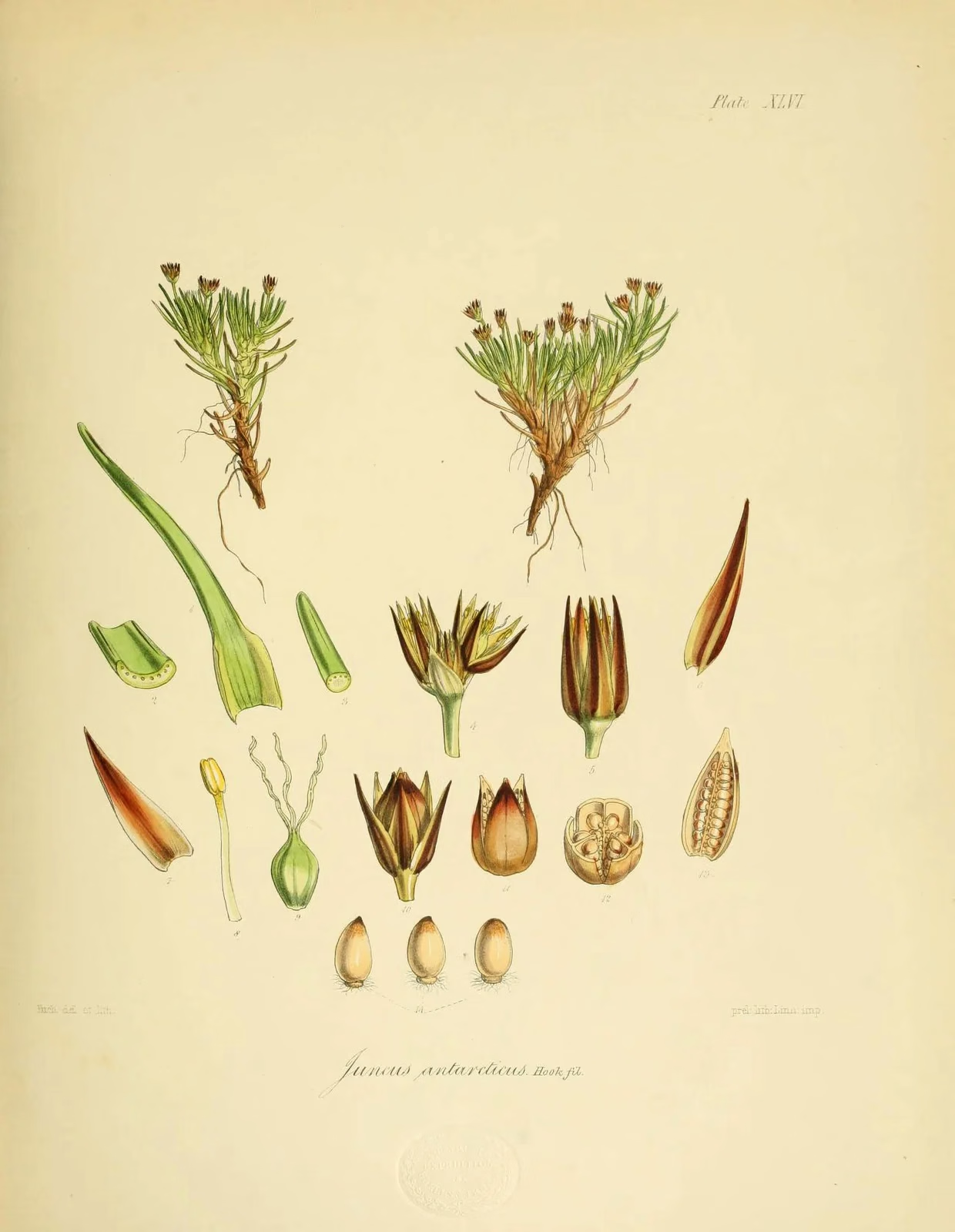
The seven other Luzula profiles show the range of leaf and flower-cluster forms in this native genus. Juncus antarcticus belongs to a different rush genus, but shares the cold, high-elevation environments where Luzula subclavata grows.

Conservation
Luzula subclavata is listed nationally as Not Threatened in the 2023 vascular-plant assessment. NZPCN records it as endemic. Its 2025 regional assessments for Otago and Wellington classify it as Regionally At Risk - Regionally Naturally Uncommon; regional rarity and national status describe different geographic scales.
Frequently asked questions
Is Luzula picta var. pallida the same plant?
It is the name used for this plant in Kew and Manaaki Whenua's Kirschner-based classification. NZPCN and the national conservation assessment retain Luzula subclavata.
How long are its flowering stems?
The Flora variety description gives a usual range of 15-30 cm, with recorded extremes of about 4-45 cm.
Which flower cluster is the largest?
The central, stalkless cluster is normally larger, about 10 mm across. The smaller lateral clusters are carried on flexible stalks.
Sources
Native status, chromosome number and conservation: NZ Plant Conservation Network. Publication and current national name: NZOR. Description and synonymy: Manaaki Whenua, including Edgar (1966) and Moore and Edgar (1970). Distribution and accepted variety: Kew Plants of the World Online. Field habitat: northern Horowhenua flora survey and Allan Herbarium specimen CHR 210310. General seasonal pattern: Flora of New Zealand genus account.
Last updated: