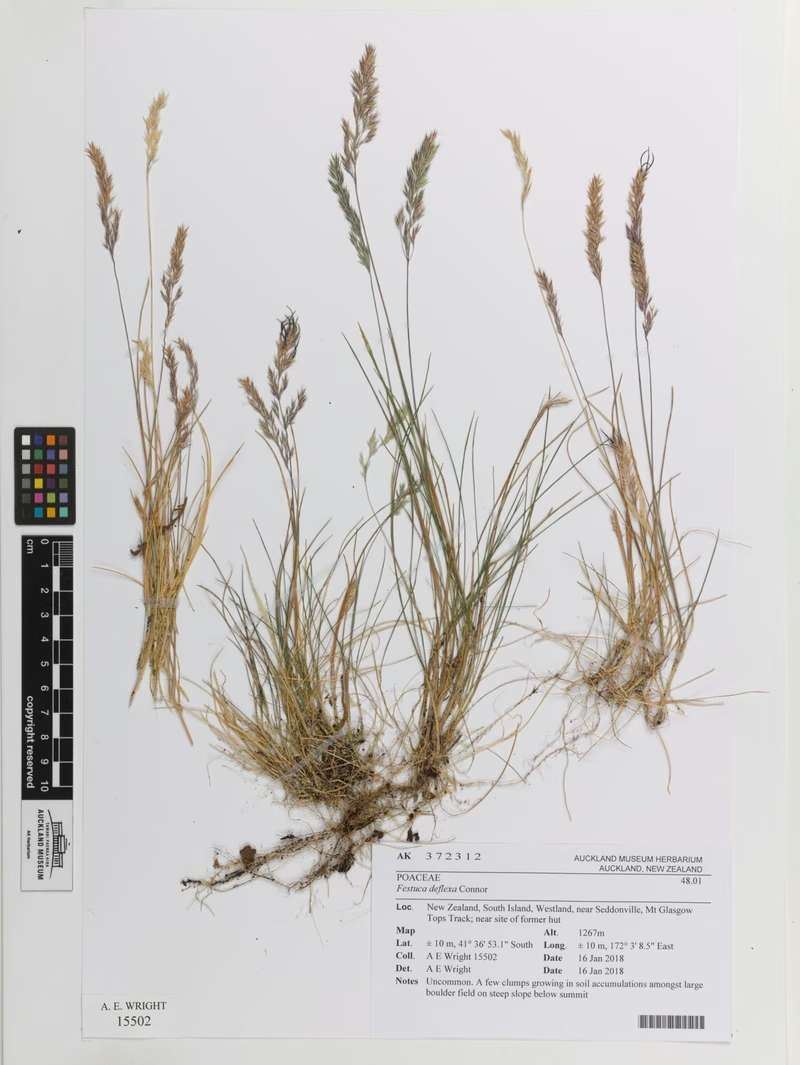
Nelson Fescue
Festuca deflexa is an endemic fescue confined to north-west Nelson. Its fine glaucous leaves form a tuft, while the flowering stems rise well above them and carry a loose panicle with long, spaced branches that spread outward or bend down. It grows mainly in tussock grassland, with records from bluffs and rocky ground, often over marble or other calcareous rock, at 600-1,650 m.
Identification
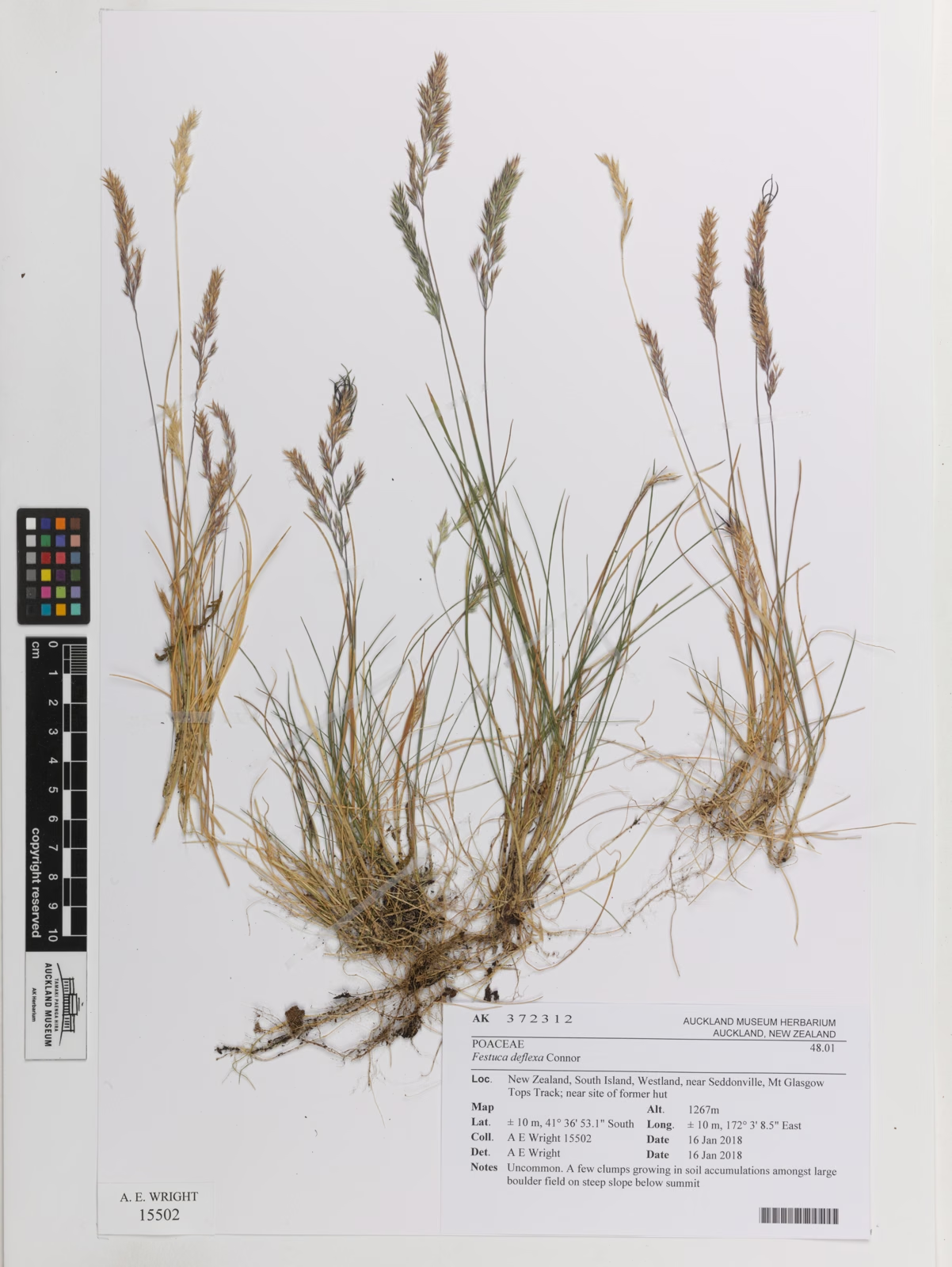
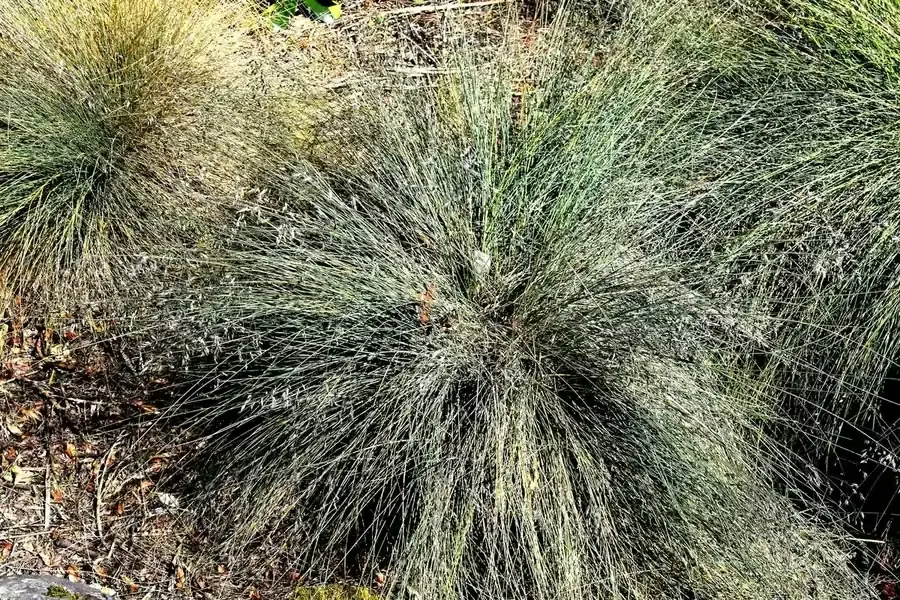
Festuca deflexa is a tufted grass, slender or somewhat stout, with shoots that branch outside the leaf sheaths and can root at their nodes. Its persistent blue-green blades are 15-25 cm long but only 0.4-0.7 mm wide. Short hairs are concentrated along the lower blade surface and margins near the base; leaf sheaths can be red, purple or straw-coloured.
Quick facts
| Scientific Name | Festuca deflexa Connor |
|---|---|
| Height | Flowering culms 15-65 cm |
| Spread | Tufted shoots can root at nodes; maximum patch width unquantified |
| Water Needs | A cultivation watering requirement is not given in the Flora account |
| Light | Open tussock grassland and exposed rocky sites |
| Frost Tolerance | Not specified in the cited flora account |
| Salt Tolerance | Not specified in the cited flora account |
| Growth Rate | Not specified in the cited flora account |
| Lifespan | Perennial grass |
Elevation and climate
The documented elevational range is 600-1,650 m in north-west Nelson. This upland distribution places the species in cool mountain environments, not lowland lawns or coastal turf. The flora records it from January and February collections, which indicate the season when flowering material has been gathered.
| City | Climate Suitability |
|---|---|
| Auckland | Not assessed |
| Wellington | Not assessed |
| Christchurch | Not assessed |
Habitat
Tussock grassland is the principal habitat, though the grass also grows on bluffs and rocky ground. Records often mention marble or other calcareous substrates. Locality and geology are helpful field notes because the taxon is geographically restricted and its fine leaves can resemble those of other fescues.
Growth form
Flowering culms rise well above the fine leaf blades and reach about 30-65 cm, with occasional plants shorter. New shoots emerge outside the enclosing sheaths, and the flora description notes rooting at nodes. The open habit and conspicuous elevated panicles give mature plants a graceful, airy outline.
Plant size and setting
This fescue has very narrow foliage below much taller flowering stems. Its natural records concern tussock grassland, bluffs and rocky ground, often with calcareous geology; the Flora account does not prescribe a garden planting distance.
Panicle and seed
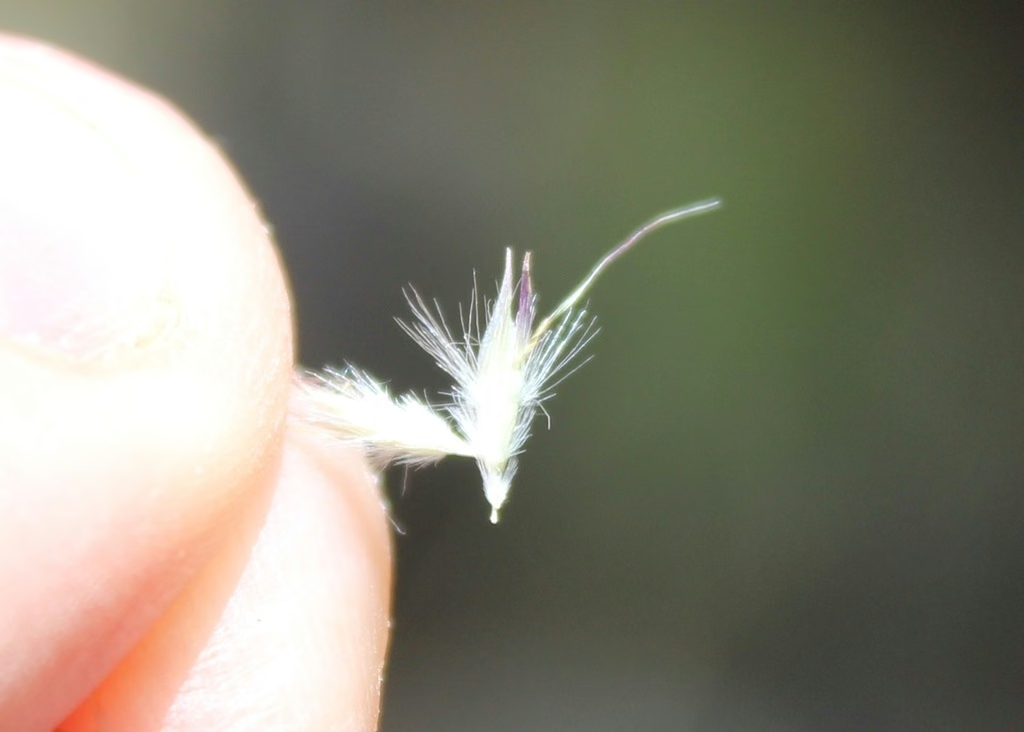
The open panicle measures 7-16 cm, with four to ten nodes and around seven to 25 spikelets. Branches are separated along the axis, spreading outward and frequently deflexed; the long basal branch is characteristically bare near its base. Spikelets contain five to seven florets and turn golden-brown as they ripen.
Ecological value
The documented value of Festuca deflexa is as a component of native mountain grassland and rocky upland vegetation. Its endemic status and regional distribution make accurate records useful for describing the composition of Nelson’s tussock communities. No traditional or commercial use is specified in the cited flora account.
Landscape character
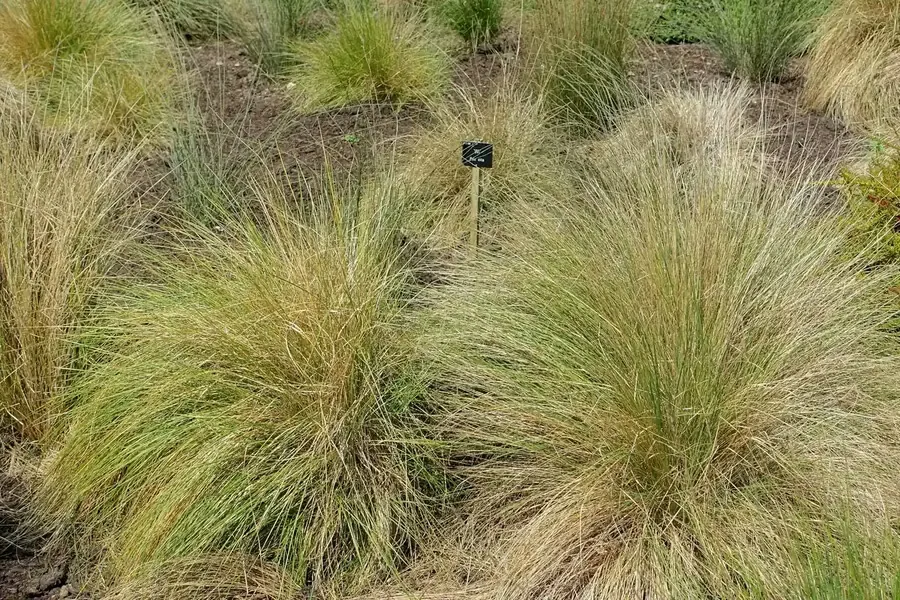
In its natural setting this grass contributes a fine-textured, glaucous element to tussock communities and rocky slopes. The tall flowering culms and drooping, widely spaced panicle branches are more visually distinctive than the dense compact heads often associated with cultivated ornamental fescues.
Flowering season
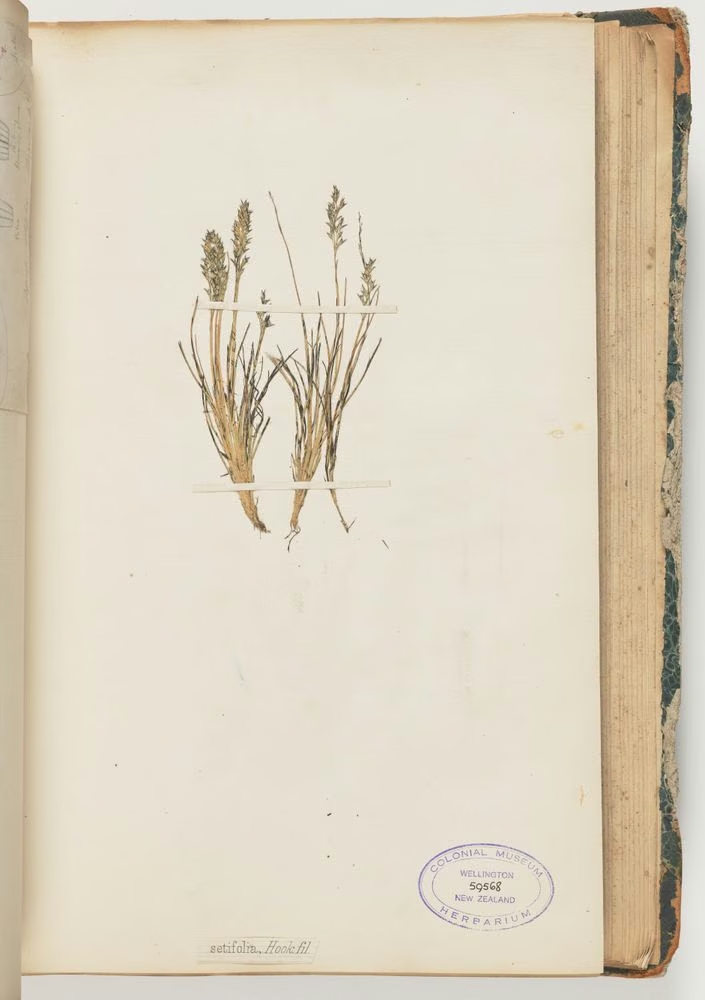
Herbarium collections cited in the Flora of New Zealand include flowering material from January and February. As the panicle matures, its florets become golden-brown. These collection dates are evidence of observed flowering material, not a guarantee that every population flowers on the same calendar schedule.
Management
No species-specific pruning or mowing regime is given in the authoritative flora description. In conservation settings, retain the tussock and rocky habitat structure and document any management rather than assuming a lawn-grass response. Photograph the flowering panicle before seed dispersal where monitoring identification is needed.
How to Grow Nelson Fescue (Festuca deflexa)
Seed and nodal rooting evidence
Flora of New Zealand describes Festuca deflexa as a tufted grass whose shoots branch outside the leaf sheaths and can root at their nodes. It also describes the mature grain. These observations document reproduction and vegetative growth, but the account does not supply a tested seed pretreatment or division protocol for cultivation.
Allowing for the elevated panicle
Flowering stems usually reach about 30-65 cm, well above the fine foliage. Leaf blades are approximately 15-25 cm long and only 0.4-0.7 mm in diameter. Their blue-green colour, narrow form and persistence give an established tuft a different appearance from the broad-bladed grasses commonly planted for large architectural clumps.
Recognising mature inflorescences
The flowering panicle is about 7-16 cm long, with widely separated branches that spread or turn downward. Its lower branches are bare near their bases and carry several spikelets farther out. Spikelets become golden brown as they mature and contain roughly five to seven florets. These distinctive drooping branches are useful when confirming the identity of seed-bearing material.
Using the natural site records
The species is recorded in tussock grassland and on bluffs or rocky ground, often on marble and other calcareous substrates. Connor's type collection came from Mt Baldy in the Mt Arthur Range. Preserve locality and geological information with any identified material. The cited botanical descriptions do not quantify watering frequency, fertiliser need or the time to a first fertile panicle.
Plant health
The cited Flora of New Zealand account does not identify a particular pest or disease affecting this species. Its narrow blades and glaucous colour are normal diagnostic traits, not symptoms. For field records, include a close view of leaf bases and panicle branches so identification does not depend on colour alone.
Name and classification
Festuca deflexa was described by H.E. Connor in 1998. The epithet deflexa reflects the downward-bending panicle branches that help characterise the species. It belongs to Poaceae and is treated as an endemic species in the Flora of New Zealand account.
A useful field clue
Look for a fine-leaved tuft with flowering stems clearly taller than the foliage, then inspect the loose panicle for its widely spaced branches and bare lower portions. The characteristic branches often bend down, while the small spikelets ripen to golden-brown.
Related grasses
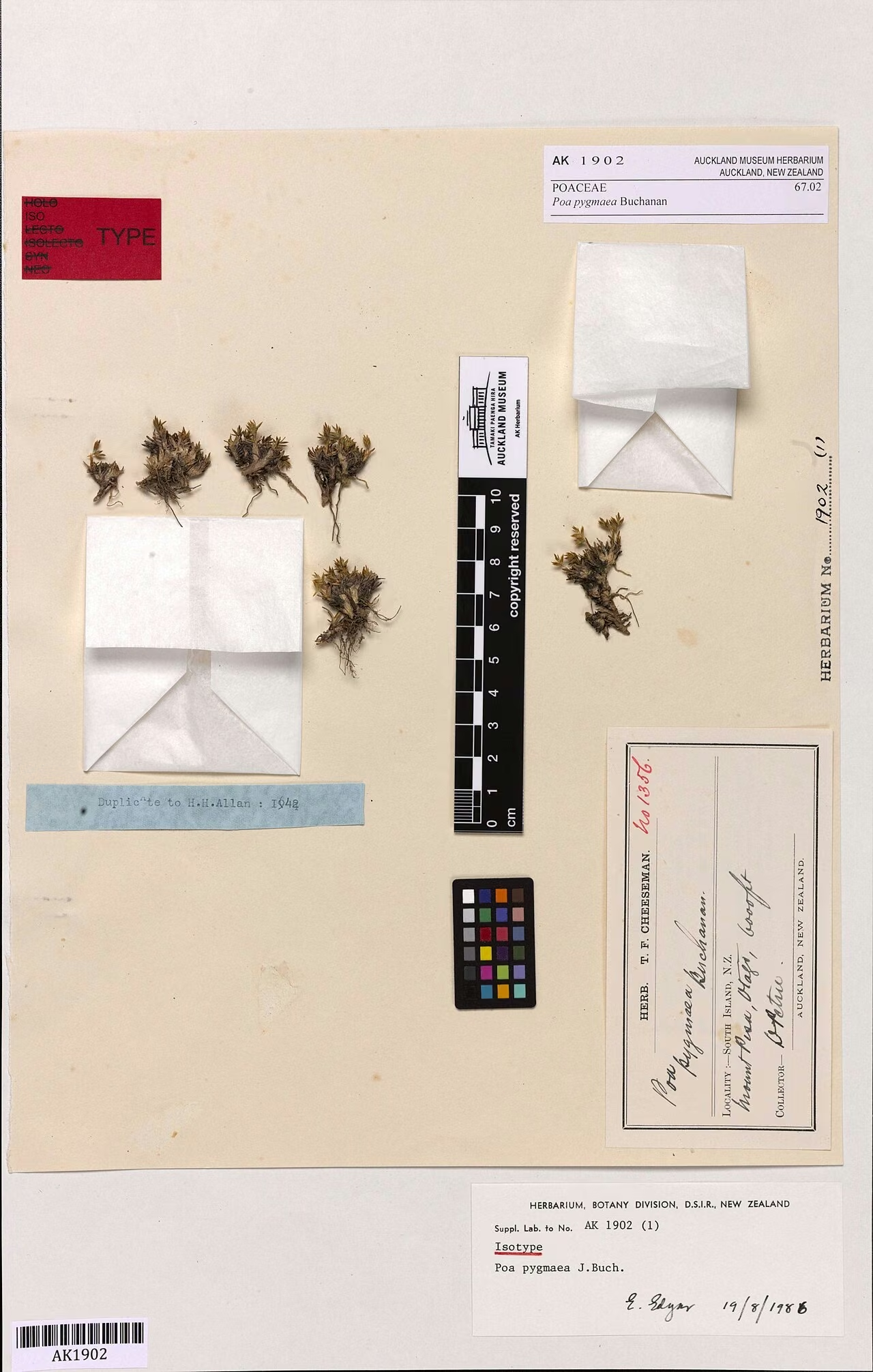
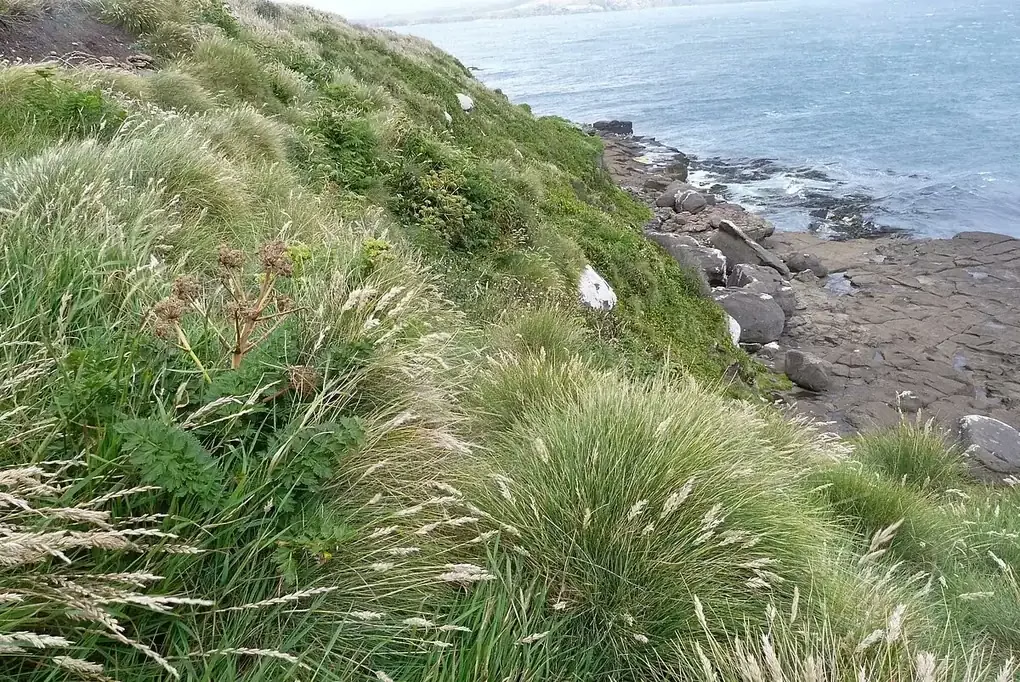
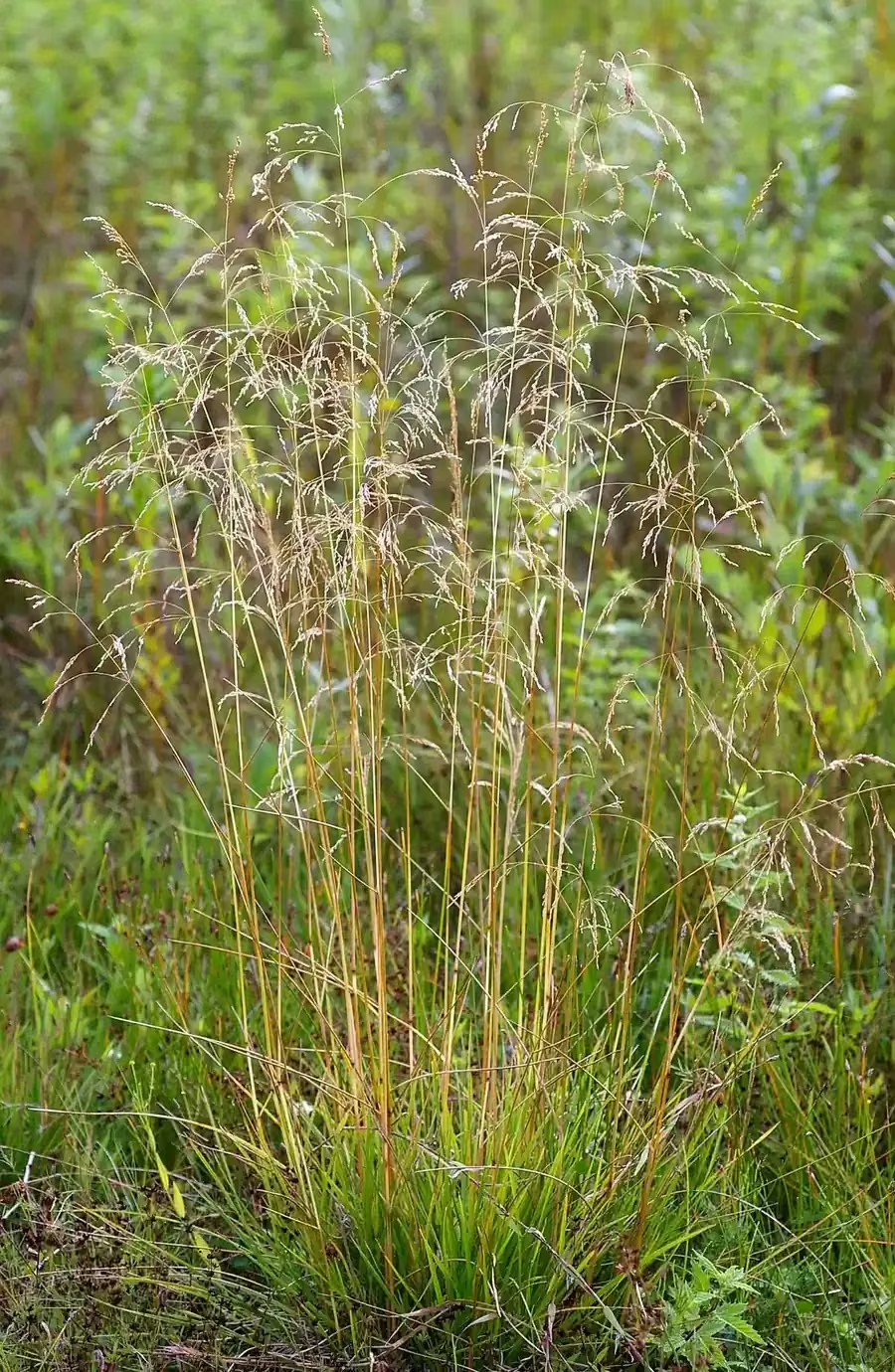
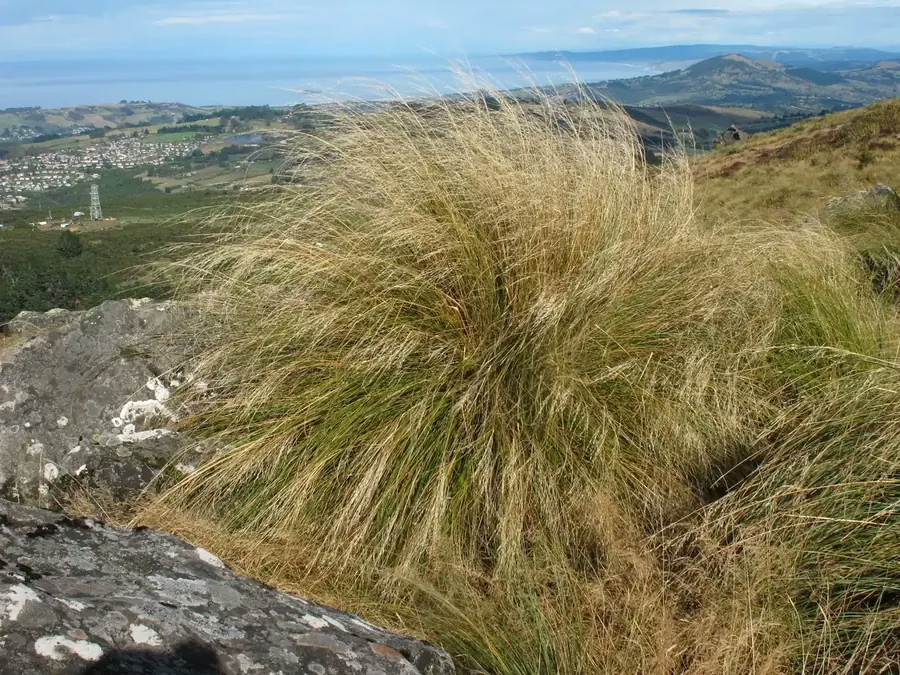
Compare this north-west Nelson endemic with other native grasses by growth form and habitat. The four Poa species span compact alpine tussocks and the coastal-cliff specialist P. astonii; Deschampsia cespitosa is associated with wetter ground, while Chionochloa rigida forms much larger snow tussocks. Rytidosperma nigricans and Pentapogon aucklandicus provide further contrasts in native grass inflorescences. These are comparisons, not substitutes for the fine leaves and characteristic loose, deflexed panicle branches used to identify Festuca deflexa.
Conservation
Festuca deflexa is endemic to north-west Nelson and was assessed as Not Threatened in the 2017 national assessment. Its limited regional range and upland habitat still make well-documented records valuable. The species account cites multiple mountain localities, including Mt Arthur, Mt Luna, Gouland Downs, Lake Sylvester and Owen Range.
Frequently asked questions
Why do the flower branches point down?
Spreading to downward-bent panicle branches are characteristic of the species and are reflected in the epithet deflexa.
How fine are its leaves?
The blades are about 0.4-0.7 mm in diameter, despite reaching roughly 15-25 cm long.
Where was the type specimen collected?
Connor's description identifies Mt Baldy in the Mt Arthur Range, north-west Nelson, as the type locality.
Sources
Identification, distribution, habitat and ecology: authoritative botanical account. Image reuse terms and source record are stated in the figure caption. Flora of New Zealand: detailed species description. Connor's 1998 description of Festuca deflexa.
Additional botanical reference: Flora of New Zealand, Manaaki Whenua.
Last updated: