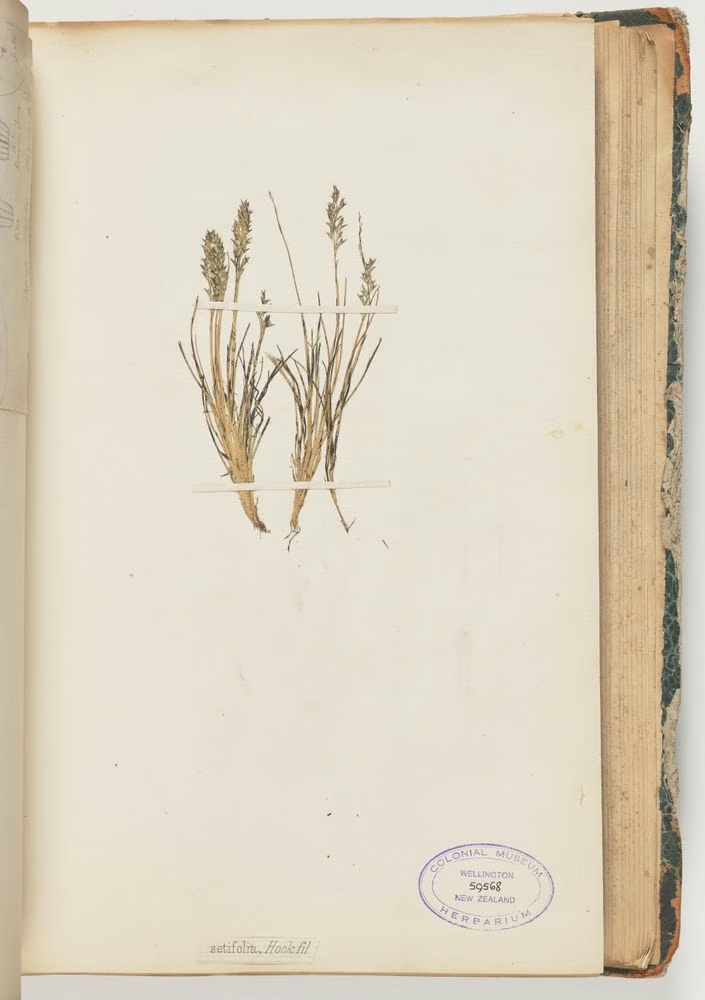
Auckland Grass
Pentapogon aucklandicus
Pentapogon aucklandicus is an endemic New Zealand grass with narrow, inrolled leaves and compact flowering heads. It forms open or dense tufts, sometimes growing as a small tussock. The stiff tufts or small tussocks range from about 6 to 35 cm, occasionally reaching 55 cm.
Identification
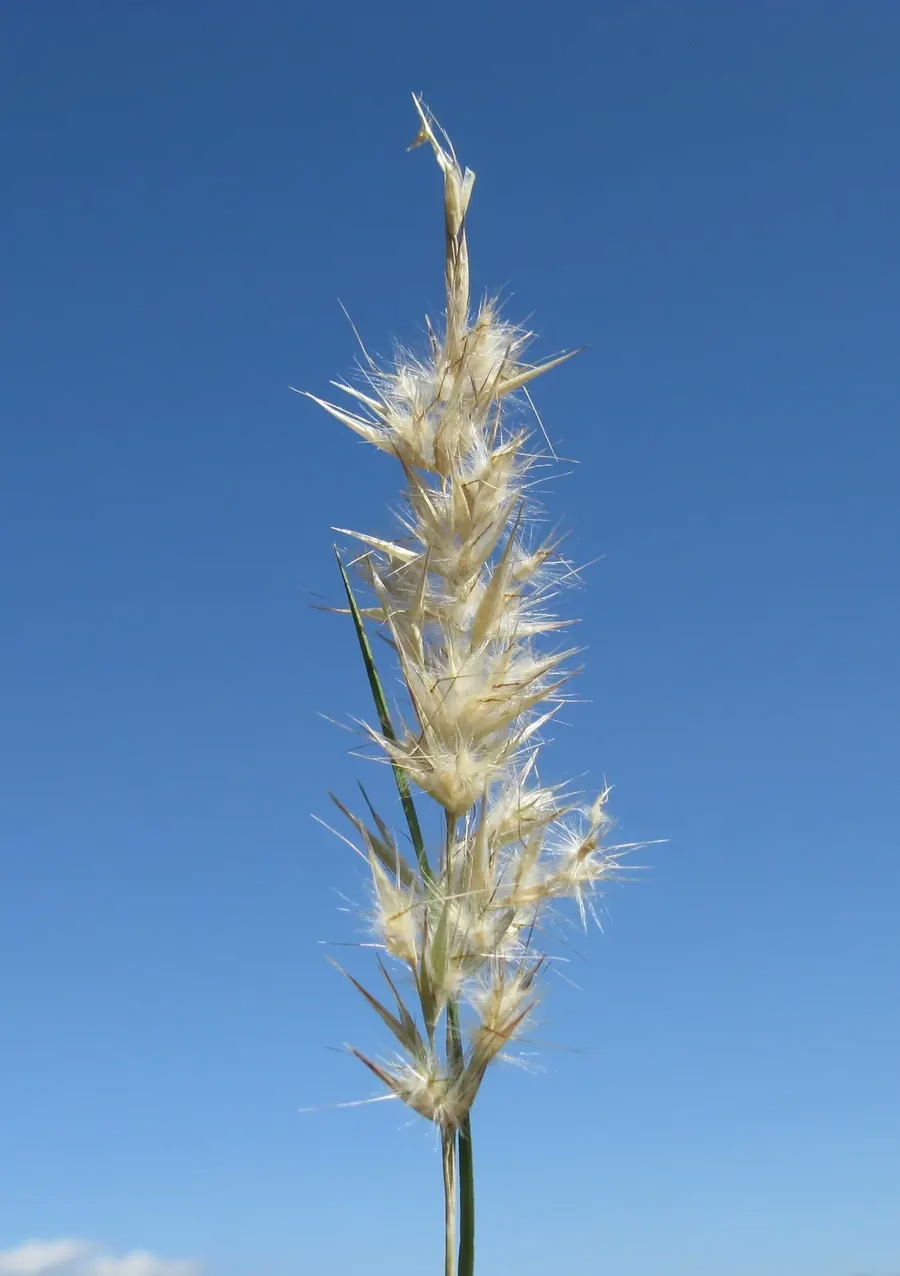
The stiff tufts or small tussocks range from about 6 to 35 cm, occasionally reaching 55 cm. The wiry leaf blades are 2.5-15 cm long and only 0.3-1.5 mm wide, with margins rolled inward. Narrow flowering heads spread somewhat at flowering and contract afterwards; their spikelets are greenish or purplish before turning pale brown.
Quick facts
| Scientific Name | Pentapogon aucklandicus (Hook.f.) de Lange & L.M.H.Schmid |
|---|---|
| Earlier names | Deyeuxia aucklandica; Deyeuxia setifolia |
| Family | Poaceae |
| Origin | Endemic to New Zealand |
| Habit | Stiff tuft or small tussock |
| Leaf width | 0.3-1.5 mm |
| Flowering head | Narrow panicle, 2-5.5 cm, occasionally longer |
| National status | Not Threatened (2023) |
| Height | Usually 6-35 cm; occasionally up to 55 cm |
| Water Needs | Tolerates waterlogged soil |
| Light | A cool or shaded position is recommended |
| Spread | Tufts or small tussocks; mature width is not quantified |
| Frost Tolerance | Minimum tolerated temperature is not documented |
| Salt Tolerance | Salt tolerance is not documented |
| Growth Rate | Annual extension is not quantified in the cited accounts |
| Lifespan | Longevity in years is not documented |
Natural range
NZPCN records this endemic grass in the North, South and Stewart Islands, from Mount Pureora southward. The name aucklandicus originates in an earlier botanical name and should not be taken alone as a guide to its present range.
| City | Climate Suitability |
|---|---|
| Auckland | Not assessed |
| Wellington | Not assessed |
| Christchurch | Not assessed |
Habitat
A botanical revision places this species among grasses of grassland, open scrub or open forest. It has also been recorded in a wetland survey in the Remarkables, illustrating that some populations occur in wet mountain vegetation.
Growing conditions
NZPCN reports that this grass does best in a cool or shaded site and tolerates waterlogged soil. Its small stiff tufts are also recorded in open grassland, scrub and forest in the botanical literature.
Planting considerations
The plant forms small stiff tufts, occasionally reaching 55 cm. NZPCN suggests a cool or shaded position and notes tolerance of waterlogged soils; its account does not specify a planting distance.
Growth in open vegetation
The plant branches from outside the leaf sheath and can form either open tufts or dense small tussocks. Published habitat summaries include grassland, open scrub and open forest, and wet mountain sites have also been documented.
Field identification
Examine the narrow folded leaf blades and the compact panicle with a hand lens. Its spikelets are only 3-5.5 mm long, with a usually stout, bent awn projecting between the surrounding glumes.
Garden context
Its wiry, very narrow foliage produces a fine-textured tuft. NZPCN recommends a cool or shaded position and reports tolerance of waterlogged soil, though its profile does not provide a detailed garden maintenance schedule.
Flowering structures
The narrow panicle is widest when the grass flowers and becomes contracted afterwards. Spikelets begin greenish or purplish and mature pale brown. The consulted accounts do not provide a species-specific flowering calendar.
Stem and leaf growth
Culms are erect or curved and can bend near the base. The leaf sheaths are distinctly ribbed and range from light green to light brown; the cited botanical profiles do not prescribe pruning.
How to Grow Auckland Grass (Pentapogon aucklandicus)
Fresh seed and rooted pieces
NZ Plant Conservation Network records fresh seed and rooted pieces as straightforward propagation routes for Pentapogon aucklandicus. Older references and plant labels may use Deyeuxia aucklandica, the name used by the Flora of New Zealand grass description. The two accounts therefore need to be read together when checking the identity of a cultivated parent plant.
A cool position with moisture
The cultivation preference is a cool or shaded spot, and the species is reported to tolerate waterlogged soil. That is a useful species-specific distinction when choosing among native grasses with different moisture requirements. The source does not prescribe an irrigation interval, germination temperature or fixed rooting period for the recommended propagation material.
Allowing for the tuft
Plants form open to dense, stiff tufts or small tussocks, usually 6-35 cm high and occasionally reaching 55 cm. Leaves are approximately 2.5-15 cm long and only 0.3-1.5 mm wide, with folded blades and inward-rolled margins. They range from bristle-like to thread-like or wiry, so the natural appearance is finer than that of a broad-leaved ornamental tussock.
Recognising reproductive growth
The flowering head is usually 2-5.5 cm long, occasionally longer, and widens at flowering before contracting again. Spikelets are greenish or purplish and become pale brown. The small grain is approximately 1.6-2.2 mm long. These developmental features are useful for checking an established collection without assigning a flowering month that the cited grass description does not provide.
Plant health
Greenish or purplish spikelets that later turn pale brown are normal stages described in the Flora account. The cited sources do not provide a species-specific list of pests, diseases or treatments.
Names and classification
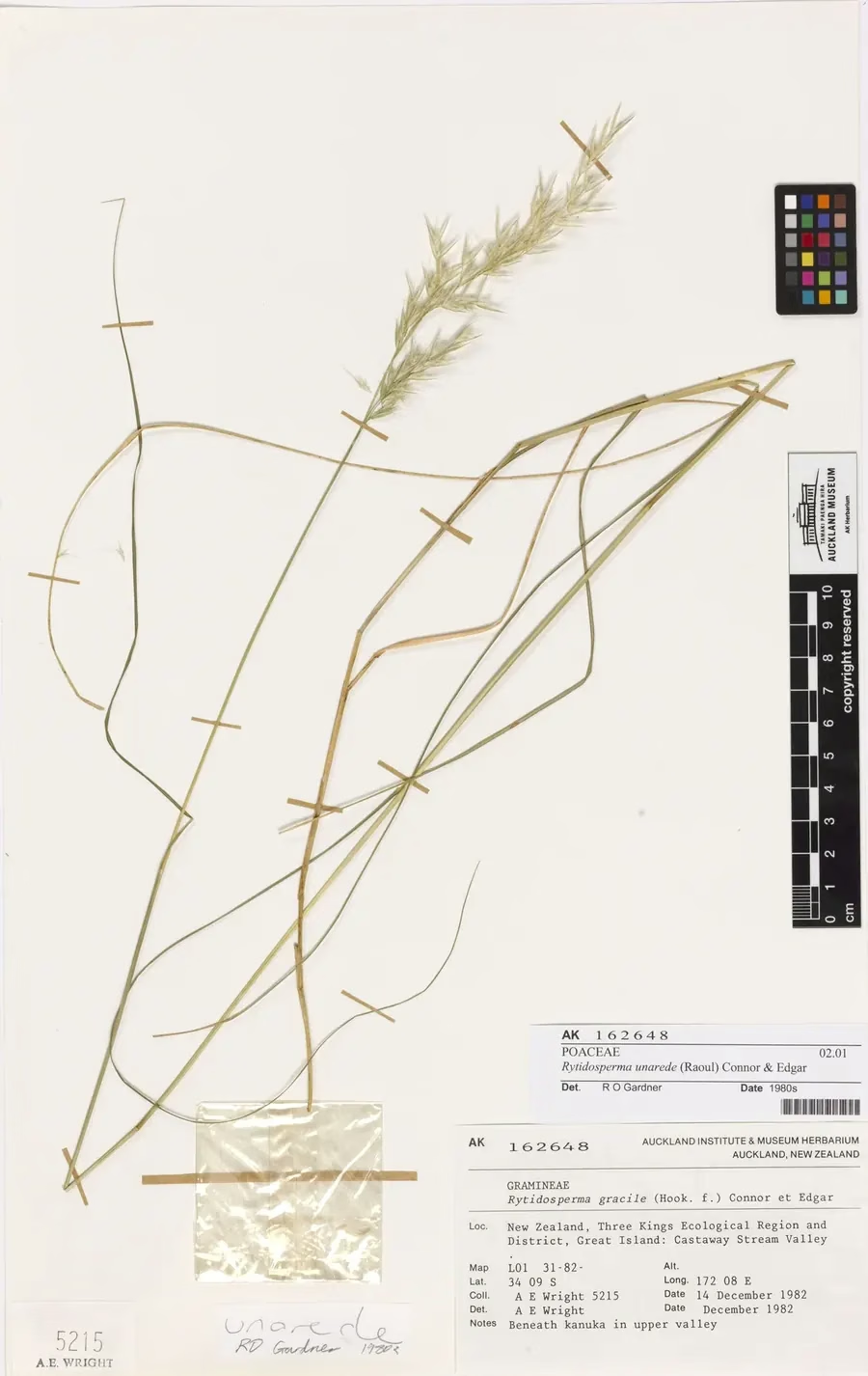
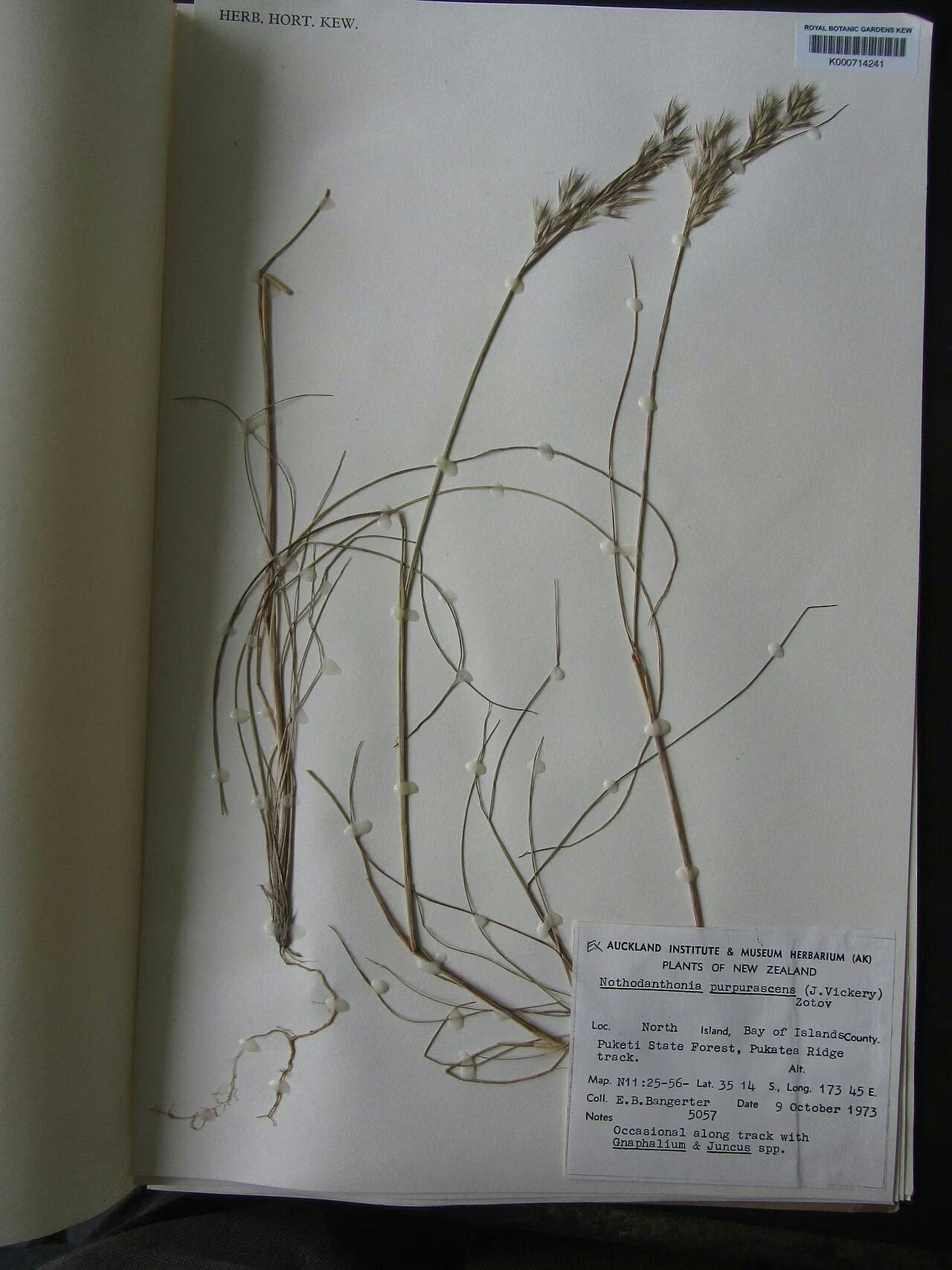
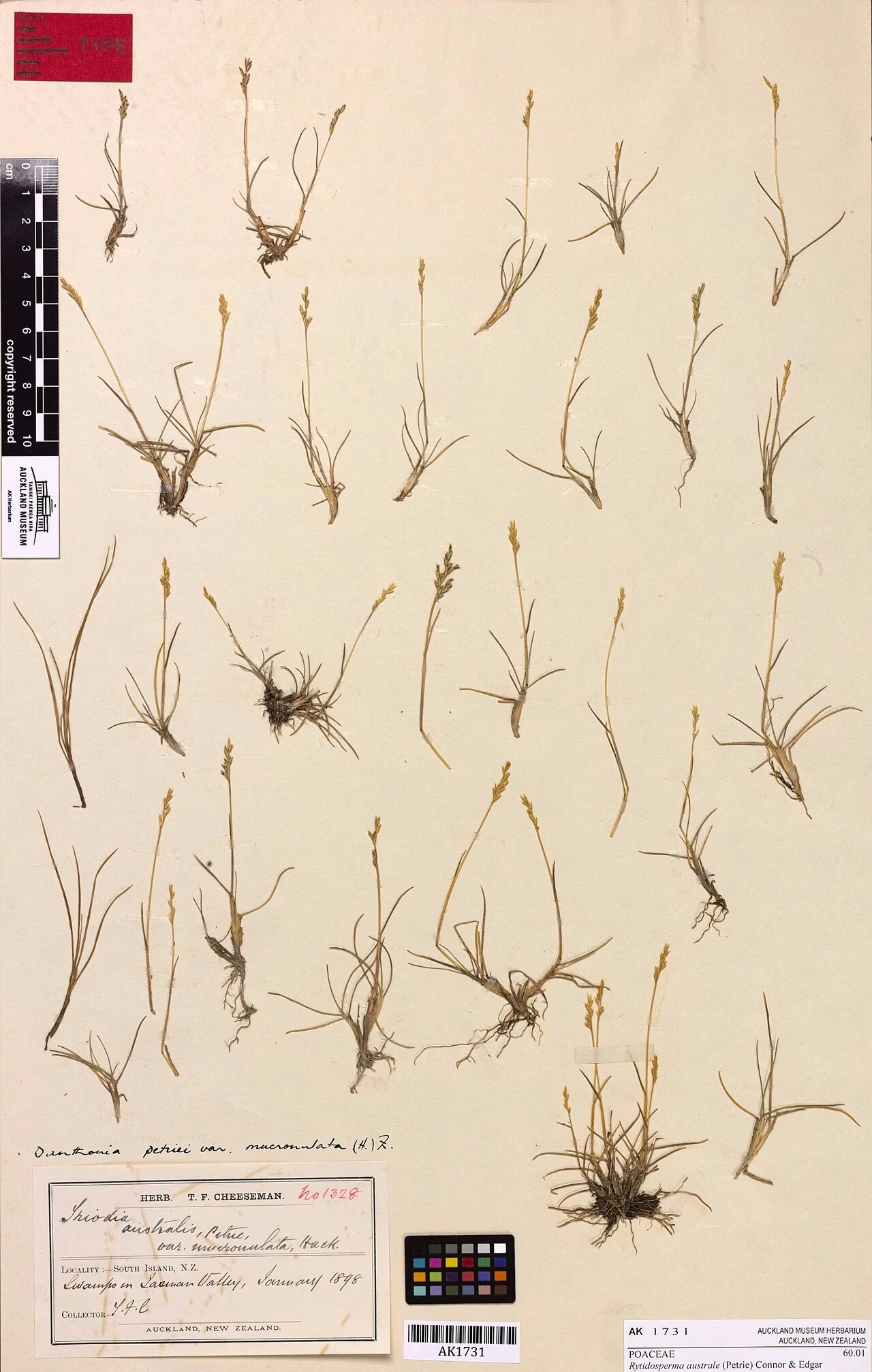
The species was formerly called Deyeuxia aucklandica and Deyeuxia setifolia, among other names. In 2022 it was transferred to Pentapogon. The photographed museum specimen carries the earlier name Deyeuxia setifolia.
A small grass under magnification
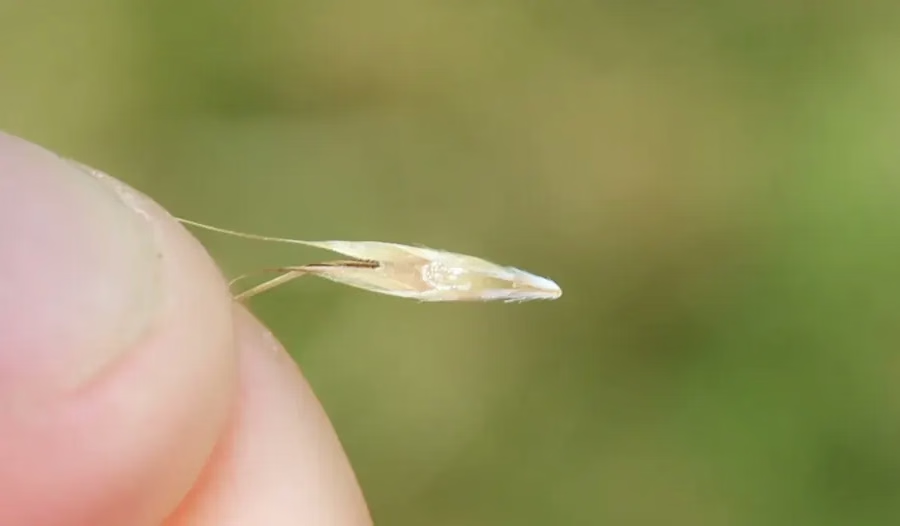
The spikelet contains a usually bent awn projecting from the glumes. At its base are hairs about 1.5-2.5 mm long; the prolonged axis bears another tuft of hairs reaching approximately to the floret tip.
Other native grasses
Explore other New Zealand grasses from open habitats, wetlands and mountain country.
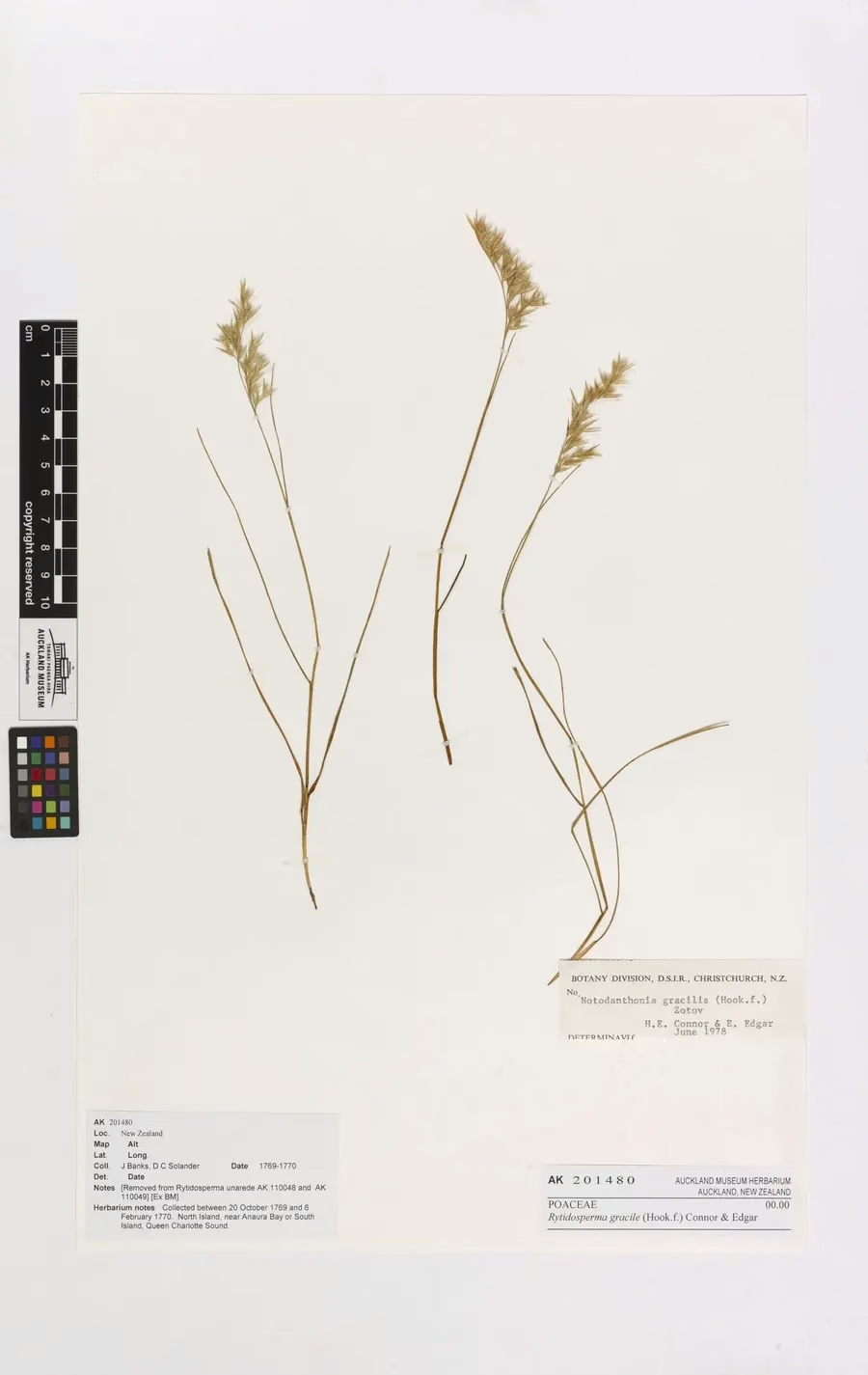
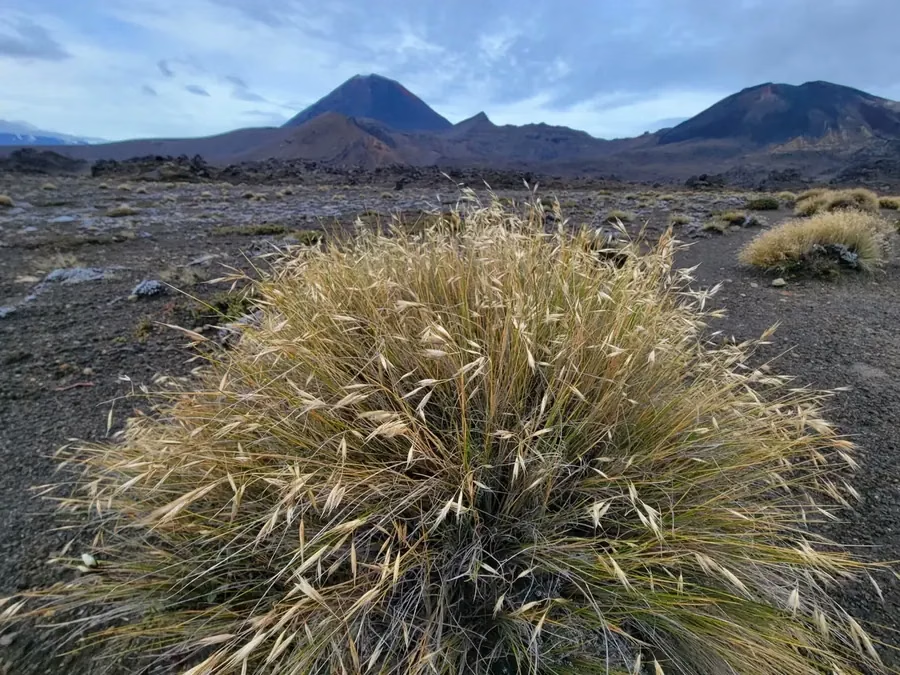
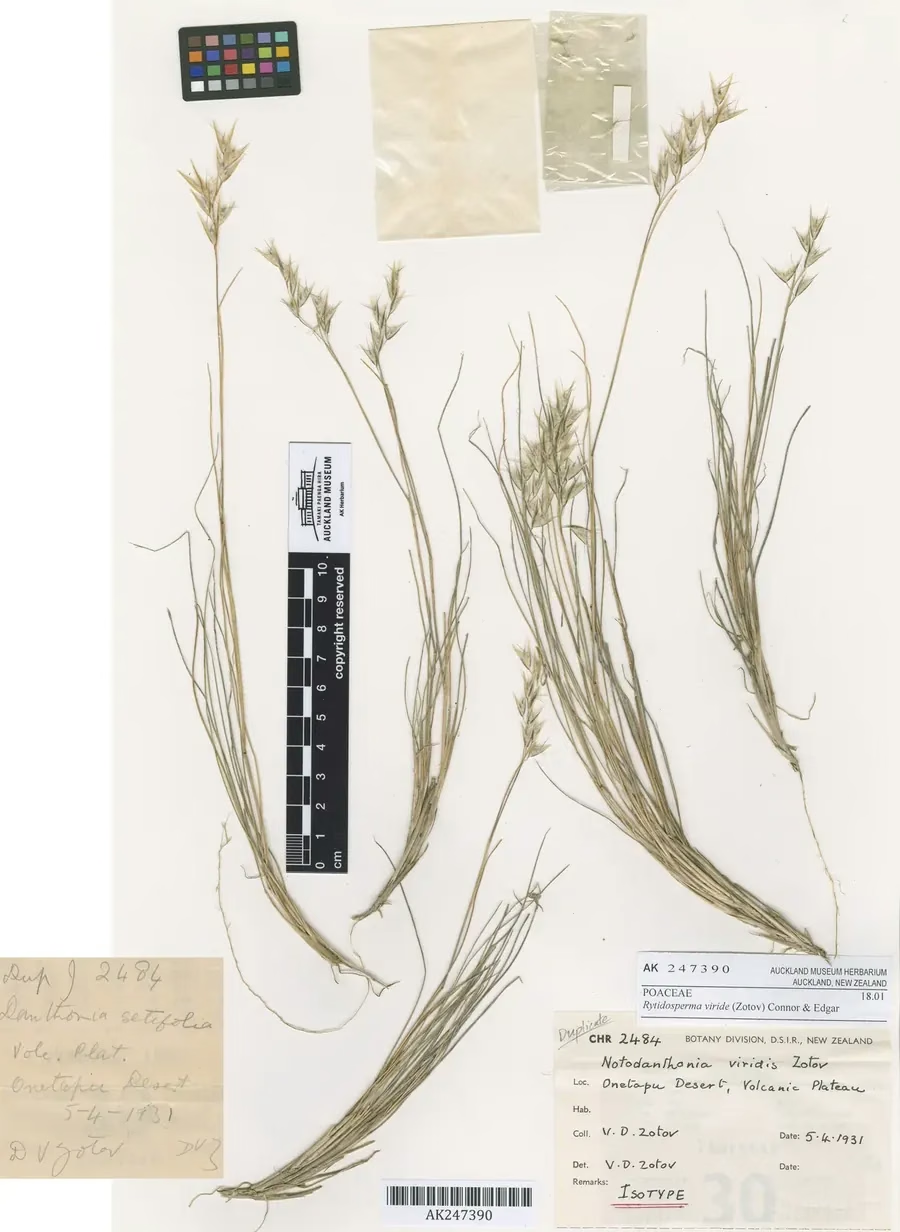
Conservation
This grass is endemic to New Zealand and was assessed nationally as Not Threatened in 2023. NZPCN records it across the North, South and Stewart Islands, beginning in the north at Mount Pureora.
Frequently asked questions
Is Deyeuxia aucklandica the same grass?
Yes. NZPCN lists Deyeuxia aucklandica and Deyeuxia setifolia as synonyms of Pentapogon aucklandicus, following the 2022 transfer.
How can it be recognised?
Look for a stiff tuft with fine, inrolled leaves and a narrow flowering head. A lens helps reveal the spikelet hairs and usually bent projecting awn.
Can it tolerate waterlogged soil?
Yes. Waterlogging tolerance is specifically reported for Pentapogon aucklandicus, alongside a preference for a cool or shaded growing position.
Sources
Detailed morphology: Flora of New Zealand: Deyeuxia aucklandica. Distribution, propagation and conservation: NZPCN.
Names and 2022 classification: Biota of New Zealand. Habitat: Edgar, 1995, New Zealand Journal of Botany.
Last updated: