Donn's Grimmia
Grimmia donniana
Last updated:
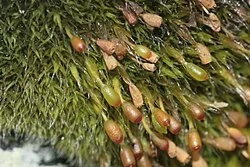
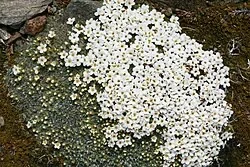
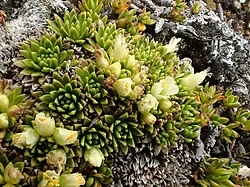
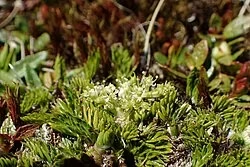
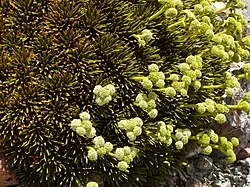
Grimmia donniana, or Donn's Grimmia, is a small cushion-forming moss of New Zealand's alpine rocks. It builds dense, rounded cushions only about 8 to 12 mm high that are dark green to almost blackish, often looking hoary or grey because of the long, glassy hair-points on the leaf tips. Strictly rock-dwelling, it favours acidic substrates such as granite, schist and sandstone in exposed, high-altitude sites where competition is minimal. Very frost-hardy and slow-growing, it is a pioneer that helps begin soil formation by trapping windblown dust on bare boulders and scree. Explore more native mosses and lichens in our native plant guide.
Plant Description
Identification and Physical Characteristics
Donn's Grimmia forms small, dense, rounded cushions that are typically dark green to almost blackish in colour, often appearing hoary or greyish due to the presence of long, hyaline hair-points on the leaf tips. The stems are short, usually ranging from 8 to 12 mm in length. The leaves are oblong-lanceolate and keeled, closely appressed to the stem when dry but spreading slightly when moist. A distinctive feature is the leaf tip, which tapers into a smooth or slightly toothed hair-point (awn). The capsules are pale yellow-brown, oblong to ovoid, and are exserted on a straight seta (stalk), making them visible above the vegetative cushion. It is an autoicous species, meaning male and female reproductive organs are found on the same plant, facilitating frequent spore production.
Quick Facts
| Scientific Name | Grimmia donniana |
|---|---|
| Height | 0.8-1.2 cm |
| Spread | 2-5 cm |
| Water Needs | Moderate (Natural Rainfall) |
| Light | Full Sun to Semi-Shade |
| Frost Tolerance | High |
| Salt Tolerance | Low |
| Growth Rate | Slow |
| Lifespan | Perennial |
Climate Best Suited to
Grimmia donniana is an alpine and subalpine specialist, thriving in cool to cold climates. It is well-adapted to high-altitude environments where temperatures can be extreme and fluctuate rapidly. In New Zealand, it is typically found in mountainous regions, enduring freezing winters and cool summers. It relies on the ambient humidity and precipitation typical of these elevated zones.
Regional Suitability
| City | Climate Suitability |
|---|---|
| Auckland | Not Suitable |
| Wellington | Not Suitable |
| Christchurch | Not Suitable |
| Dunedin | Not Suitable |
| Queenstown | Suitable (Alpine zones) |
| Invercargill | Not Suitable |
Plant Habitat
Natural Occurrence and Ecology
This moss is strictly saxicolous, meaning it grows on rocks. It has a strong preference for acidic substrates such as granite, schist, and sandstone. Donn's Grimmia is characteristically found in exposed, alpine situations, often on isolated boulders, scree slopes, or rock outcrops where competition from vascular plants is minimal. It generally avoids calcareous (limestone) rocks. Its habitat ranges from the subalpine zone up to the high alpine zone, where it plays a role in the primary colonization of bare rock surfaces.
Growing Requirements
Soil Requirements
Does not grow in soil. Requires a rock substrate, specifically acidic rocks like granite or schist.
- Acidic rock surface
- No soil needed
- Good drainage (runoff)
Light Requirements
Thrives in exposed, open situations often receiving full sun, but can tolerate some shading from rock crevices.
- Full sun
- Partial shade
- High UV tolerance
Water Requirements
Poikilohydric; tolerates desiccation but requires periodic moisture (rain, mist, snowmelt) to metabolize.
- Rainfall dependent
- Tolerates drying out
- High humidity benefits
Planting and Establishing
Establishment Guidance
As a moss, * Grimmia donniana * is not "planted" in the traditional sense. Establishment involves the settlement of spores on a suitable rock surface. For those attempting to cultivate it in a terrarium or rockery, the most success comes from translocation of small established colonies attached to their rock substrate, rather than attempting to detach the moss. It requires a stable rock surface and should not be buried in soil. Mist regularly until established if moved to a controlled environment.
Ecological Role
Biodiversity and Ecosystem Impact
Grimmia donniana is a pioneer species in alpine environments. By colonizing bare rock, it contributes to the slow process of soil formation through the trapping of windblown dust and the decomposition of its own organic matter over time. It provides a micro-habitat for microscopic invertebrates (like tardigrades and rotifers) and can facilitate the eventual germination of higher vascular plants by creating small pockets of moisture and substrate.
Uses & Significance
Garden Uses
Generally not used in standard gardening due to its specific alpine rock requirements. However, it is valued by bryologists and enthusiasts of alpine rock gardens or terrariums who wish to replicate a high-altitude micro-environment.
- Alpine rockeries
- Terrariums
- Native bonsai accents
Ecological Value
Significant for biodiversity in extreme alpine zones where few other plants survive. It aids in rock weathering and nutrient cycling in oligotrophic (low nutrient) environments.
- Soil formation
- Invertebrate habitat
- Rock colonization
Landscaping Uses
Its use is limited to specialized alpine rock gardens where it can be allowed to naturally colonize weathered stones. It adds a sense of age and established maturity to rock features.
Seasonal Care Calendar
Spring
Active growth period as temperatures rise and snow melts. Capsules often mature during this time.
- Monitor moisture
- Observation
Summer
May enter dormancy if conditions become too hot and dry. Will revive with rain.
- Do not overwater if dormant
- Protect from disturbance
Autumn
Another period of potential growth with increased rainfall and cooler temperatures.
- Check for capsules
- Ensure stability
Winter
Often covered by snow in its natural habitat, which insulates it from extreme freeze-drying winds.
- Snow cover is beneficial
- Dormant period
When to Prune and How Much
Pruning is not applicable to mosses like Grimmia donniana . They do not require trimming or cutting back. The plant naturally regulates its size based on available resources and environmental constraints.
- No pruning required
- Self-maintaining
Removal of dead patches is rarely necessary as new growth often overtakes old material, building up the cushion over time.
How to Grow Donn's Grimmia
Cultivating Donn's Grimmia ( Grimmia donniana ) is a specialized pursuit, distinct from growing vascular plants. Success depends entirely on replicating the harsh, specific conditions of its natural alpine rock habitat. Unlike flowering plants that root in soil, this moss attaches directly to rock surfaces using rhizoids. Propagation is most commonly achieved through the natural dispersal of spores or by careful fragmentation and translocation of established colonies. It is not a plant for the casual gardener but offers a unique challenge for bryology enthusiasts.
From Spores
In nature, Grimmia donniana reproduces readily via spores released from its abundant capsules. Collecting these capsules when they are mature (turning brown and opening) allows for spore propagation.
To attempt this, you must prepare a suitable substrate, ideally a piece of acidic rock like granite or schist.
- Collect mature capsules and crush them gently to release the fine spores.
- Prepare a rock surface by moistening it. Some growers use a thin smear of plain yogurt or buttermilk on the rock to provide a sticky, nutrient-rich base that encourages initial protonema growth.
- Dust the spores onto the prepared surface.
- Place the rock in a humidity-controlled environment, such as a sealed clear container or terrarium, out of direct sunlight.
- Mist daily with distilled water or rainwater. Tap water often contains chemicals that can harm moss.
- Be patient; moss growth from spores is slow and can take months to become visible to the naked eye.
This method requires patience and a sterile environment to prevent mould/algae from outcompeting the moss.
From Fragments
Vegetative propagation is generally faster. This involves taking small pieces (fragments) of an existing cushion and encouraging them to attach to a new surface.
This method leverages the totipotent nature of moss cells, where fragments can regenerate into whole plants.
- Carefully remove a small portion of a healthy cushion. Please do this ethically and only where permitted, taking only a tiny fraction to ensure the parent colony survives.
- Crumble the moss fragment into smaller pieces or create a slurry by blending it with a small amount of water (and optionally a binder like buttermilk).
- Spread the fragments or paint the slurry onto the target rock surface.
- Keep the rock in a cool, shaded, and humid environment.
- Mist regularly to prevent the fragments from drying out before they have anchored.
Additional Methods
Translocation of an entire cushion on its original rock substrate is the most reliable method but is only applicable if you have legal access to move loose rocks (e.g., from a private property scree).
Moving the entire micro-ecosystem minimizes shock.
- Move the rock with the moss attached to a similar location (aspect, light, humidity).
- Ensure the rock is stable and won't roll.
- Water initially to help it acclimate to the new microclimate.
Pests & Diseases
Generally free from pests and diseases. However, in cultivation (terrariums), it can be susceptible to fungal moulds if air circulation is poor and conditions are too constantly wet without a drying cycle. Birds may sometimes disturb cushions while searching for insects.
Cultural Significance
While specific Māori cultural references to Grimmia donniana are not widely documented individually, mosses (waewae kōhatu or rimurimu) generally hold a place in the ecosystem acknowledged by Māori. They represent the clothing of Papatūānuku (Earth Mother), softening the hard rock.
- Part of alpine biodiversity
- Symbol of resilience
Bonus Tip
If you find this moss in the wild, look closely with a hand lens. The delicate, frosted appearance created by the hair-points is a beautiful adaptation that helps reflect intense alpine UV radiation and trap moisture directly from clouds.
Related Plants
Explore other native plants that share similar characteristics or habitats with Donn's Grimmia ( Grimmia donniana ), offering further insights into New Zealand's diverse flora. These related species provide context and opportunities for complementary planting in your garden. For another native moss, explore Billard's Bryum Moss.

Plant Conservation
Conservation Status and Threats
Grimmia donniana is currently considered Not Threatened in New Zealand. It is widespread in its appropriate high-altitude habitats. However, like all alpine species, it faces potential future risks from climate change, which could reduce the extent of its alpine zone habitat. Conservation efforts largely focus on preserving the integrity of these wild, natural landscapes.
Frequently Asked Questions
How big is Donn's Grimmia?
It forms small cushions roughly 0.8 to 1.2 cm high and 2 to 5 cm across.
What does Donn's Grimmia grow on?
It grows strictly on acidic rocks such as granite, schist and sandstone.
Is Donn's Grimmia frost-hardy?
Yes, it has high frost tolerance and thrives in cold alpine environments.
Where does Donn's Grimmia grow?
It grows in exposed alpine sites on boulders, scree slopes and rock outcrops.
Sources and Further Reading
The botanical, growing, and conservation details for Donn's Grimmia (Grimmia donniana) on this page draw on authoritative New Zealand plant references and citizen-science observation records. Consult the sources below for full technical records and the latest distribution data.